

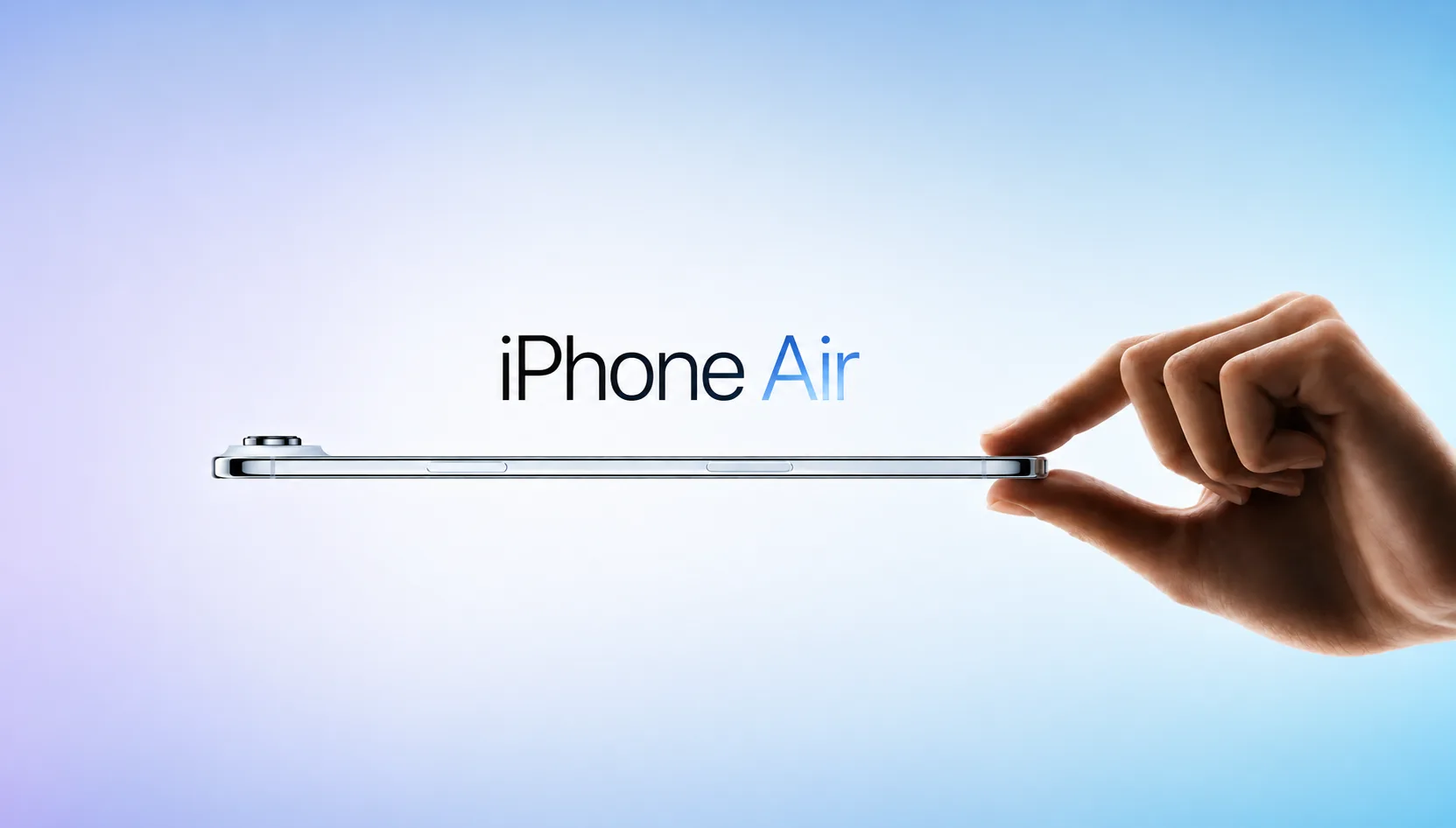
Picking up an iPhone Air after months of using a normal iPhone, and you don’t know if the first thing you notice is how light it is; what you notice is how little you feel it in your hand. At 5.6 mm thick and 165 grams, the iPhone Air is the lightest, thinnest phone Apple has ever shipped and still the only mainstream iPhone that is built around that one idea: less phone, more comfort, and nearly a year after launch it is still the only one. That focus comes with real trade-offs: one camera, a smaller battery, and a $999 starting price, and that’s why so many people still aren’t sure about it in 2026.
What matters the most after living with the iPhone Air in the long run, in this guide: the design, the battery life (not spec sheet fear), the single-camera performance, and why you should buy one instead of the iPhone 17 or Pro model?
It’s important to say right now that the iPhone Air isn’t chasing the same buyer as the iPhone 17 Pro Max. It’s about someone who’s quietly tired of carrying a phone that feels like a paperweight in their pocket and is a smaller audience than Apple’s usual “best iPhone for everyone” pitch, and that’s why the conversation around this phone has been so split.
iPhone Air Specs and Price in 2026
The iPhone Air launched in September 2025 at $999 for 256GB, with 512GB and 1TB options above that. Nearly a year later, that starting price hasn’t moved much, though retailers and carriers now regularly knock it down with trade-in credit, and the used and refurbished market has matured enough that an excellent unit can be found well under retail if you aren’t planning to buy new.

| Spec | iPhone Air |
| Display | 6.5-inch Super Retina XDR OLED, 120Hz ProMotion |
| Chip | A19 Pro (6-core CPU, 5-core GPU, 16-core Neural Engine) |
| Thickness | 5.64mm |
| Weight | 165g |
| Camera | Single 48MP rear lens, 18MP Center Stage front camera |
| Battery | 3,149mAh |
| Build | Titanium frame, Ceramic Shield 2 glass, IP68 |
| Connectivity | Apple-designed C1X modem, N1 chip (Wi-Fi 7, Bluetooth 6) |
| Storage | 256GB / 512GB / 1TB |
The one thing people miss is the modem. Apple built its own C1X cellular chip and N1 wireless chip for the Air instead of Qualcomm, and it is a strong reason the phone is this thin and has Wi-Fi 7 and Bluetooth 6.
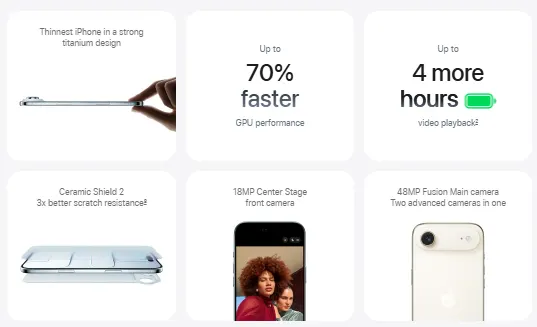
iPhone Air Design: Why “Thin” Actually Matters
It is easy to dismiss “thin and light” as a gimmick until you’ve carried the phone for a few weeks. Long-term reviewers frequently repeat the same thing: When you pick up a regular iPhone after that, you’re like picking up a brick by comparison. It’s not just the thinness, it’s how the reduced weight affects the experience of holding the phone for long stretches, scrolling in bed, or even holding it one-handed.
The trade-off is width. At 6.5 inches, the Air’s screen is noticeably wider than the iPhone 17’s 6.3-inch screen, which can cause more accidental palm taps for those who tend to have smaller hands. It’s a real complaint of some long-time owners, though most say they’ll get used to it in a few weeks and wouldn’t call it a dealbreaker.
Colors: Space Black, Cloud White, Light Gold, Sky Blue.
The camera plateau, explained
Instead of the pill-shaped dual-lens block on the base iPhone 17 or the triangular arrangement on the Pro models, the Air has a thin horizontal “plateau” across the top edge of the back panel. With only one lens to house, Apple didn’t need to have a deep camera bump, so the phone sits almost flat on a table instead of rocking on a raised module.
How it compares in the hand
The numbers on a spec sheet don’t really reflect what a 40-gram difference feels like over a day. The Air’s 165g is closer to an iPhone 12 mini than to any current flagship, despite having a much larger screen; that’s why long-term owners tend to compare it with older, smaller iPhones they loved rather than the current Pro models.
iPhone Air Battery Life: The Real-World Verdict
This is the number one search question about the iPhone Air, and it deserves a straight answer: The 3,149mAh battery is smaller than every other iPhone 17 model and is the phone’s most-cited compromise. But “smaller” and “bad” aren’t the same thing.
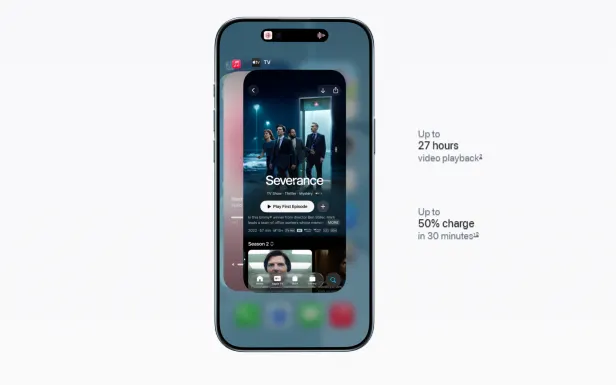
Here’s what most guides don’t know: People keep comparing the Air’s battery to the iPhone 17 Pro Max, which is like comparing a compact c fuel tank to a pickup truck’s. The more useful comparison is against the iPhones people are actually upgrading from. Long-term owners of an iPhone 14 Pro or 15 Pro consistently report equal or better real-world battery life on the Air, thanks to a more efficient chip and modem even if they have a physically smaller cell.
In daily use, most reviewers report finishing a full day with 20-40% remaining under normal use and drop to 10-20% only on heavy-use days. Extreme users (e.g., gaming and navigation-heavy travel days) might want Apple’s optional MagSafe battery pack, but it’s not required for everyday use.
Charging speed hasn’t changed much from the rest of the lineup, and the Air supports the same MagSafe and Qi2 wireless charging as its siblings. If you top up in the day rather than waiting for a nearly-empty battery, a 15-20 minute charge at your desk closes most of the gap with the bigger-battery models anyway. If you want to keep the phone for three-plus years, it’s also a good idea to set a charge limit from day one, since a smaller cell tends to feel battery-health dips a bit sooner than larger ones.
iPhone Air Camera: Can One Lens Really Compete?
The iPhone Air has a single 48MP rear camera instead of two or three lens setup on the rest of the line, and it’s the second-most debated spec after battery. DXOMARK’s lab test scored the camera at 141 points, putting its image quality close to the iPhone 17 Pro’s primary sensor and roughly on par with cameras from a couple of generations of Pro-level iPhones.
What that means in practice:
- Everyday photos and portraits: It is almost indistinguishable from the iPhone 17 and 17 Pro at 1x, because it’s the same sensor technology. Apple re-engineered its portrait pipeline so Air can get great depth-of-field shots without a second lens.
- Zoom: That single-lens design is where everything goes wrong with the Air. The Air is at about 2X optical quality zoom, compared to up to 8x on the 17 Pro, so anything that requires real reach will come off as out of reach.
- Low light: Reviewers found it competently compared to, and in some cases better than, competitors such as the Google Pixel 10 Pro and Samsung Galaxy S25 Edge.
- Ultra-wide shots: It is simply not available. If you are a landscape photographer and a tight interior photographer, this is the thing you’ll miss most.
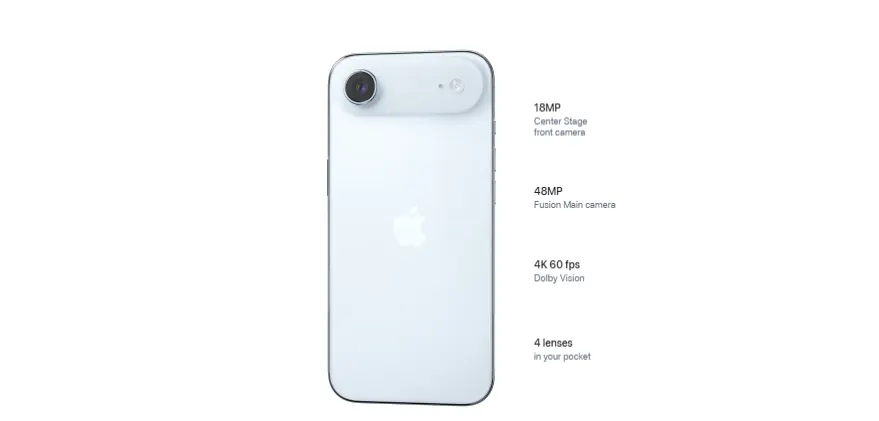
If your photography is mostly everyday snapshots, social posts, and portraits, the single camera won’t feel like a downgrade. If you lean on zoom or ultra-wide regularly, it will.
Video: The Air records the same resolution and frame rates as its siblings, including 4K at up to 60fps. Lab testing did detect occasional exposure shifts and white-balance adjustments during video capture that were slightly less consistent than on the Pro models, worth knowing if you shoot a lot of moving footage in mixed lighting.
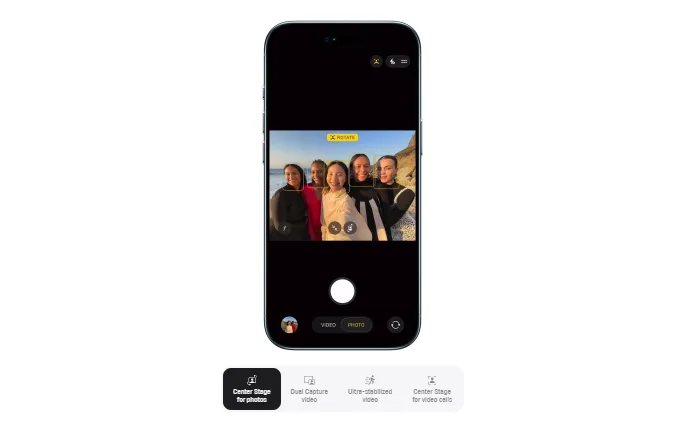
Front camera: The 18MP Center Stage front camera is shared across the entire iPhone 17 family and offers a wider field of view, meaning fewer “can everyone fit in the shot” moments on video calls.
What Else Is Missing Compared to the Rest of the Lineup
Besides the camera and battery, two smaller omissions are worth knowing before you buy: a single mono speaker instead of stereo (which is the most common complaint from owners who listen to music or podcasts without earbuds) and a slightly higher delta-E (color inaccuracy) reading in lab display tests compared to the base iPhone 17, small enough that most people won’t notice that they’re in the same phone, but well-grounded on paper.
iPhone Air Performance and Apple Intelligence
The Air also has the same A19 Pro chip that Apple uses for its Pro-tier phones, so day-to-day performance, gaming and multitasking all feel top-tier, reviewers say it’s easy to forget that you’re not using anything other than a flagship because performance isn’t a talking point.
On the software side, the Air can fully support Apple Intelligence on iOS 26, including Visual Intelligence, Live Translation in Messages and calls, Genmoji, Image Playground, and the AI-powered writing tools built into system apps. It’s one of the older iPhone models still eligible for the full Apple Intelligence feature set going forward, alongside the iPhone 15 Pro and newer.
iPhone Air Durability: Should You Worry About Bending It?
Given how thin the Air is, bend-test anxiety is a fair question, and one long-term owner says it comes up constantly when they hand the phone to someone new. Despite the ultra-slim profile, the Air retains a titanium frame (not the aluminum employed elsewhere in the 2025-2026 lineup) and Ceramic Shield 2 glass and IP68 water/dust resistance.
The owners report the phone surviving normal drops without issues, and there’s no evidence of a real bending problem in real-world use. You should not treat the Air any more delicately than you would a standard iPhone.
iPhone Air vs iPhone 17 vs iPhone 17 Pro
| Specification | iPhone 17 | iPhone Air | iPhone 17 Pro |
| Starting price | $799 | $999 | $1,099 |
| Display | 6.3″ | 6.5″ | 6.3″ |
| Thickness | 7.95 mm | 5.64 mm | 8.75 mm |
| Weight | 177 g | 165 g | 206 g |
| Chip | A19 | A19 Pro | A19 Pro |
| Rear cameras | 2 (48MP main + 48MP ultra-wide) | 1 (48MP main) | 3 (48MP main, ultra-wide, telephoto) |
| Optical-quality zoom | Up to 4x | Up to 2x | Up to 8x |
The honest takeaway: the base iPhone 17 now has a 120 Hz ProMotion display and A19 generation chip as the Pro line, which is closing much of the old gap between “cheap iPhone” and “flagship iPhone.” And that is part of why the Air’s value proposition is questioned because you’re paying $200 more than the iPhone 17 for a thinner design while losing a camera lens and battery capacity. And if camera flexibility and all-day battery matter more to you than the industrial design, the base iPhone 17 is the better buy, full stop. If the design itself is the feature you want, the Air earns its premium.
iPhone Air vs Samsung’s Slim and Budget Rivals
The Air’s closest real competitor is not a budget smartphone, but Samsung Galaxy S25 Edge, the brand’s own ultra-thin flagship. In DXOMARK’s camera testing, the Air’s bokeh and portrait segmentation actually outperformed the Edge, but the Edge does find some flexibility with its ultra-wide lens which the Air does not have.
For buyers who are comparing Samsung’s cheaper Galaxy A series, the comparison is different entirely: the Galaxy A line trades the Air’s premium titanium build, A19 Pro performance and quality of camera for a significantly lower price. You’re only comparing it if your budget (not your design preference) is the deciding factor; feature-for-feature, the Air’s in a different class.
iPhone Air Accessories Worth Considering
Because the Air’s main attraction is its slim profile, the accessories you choose matter more here than on a bigger iPhone, a thick case can erase the whole point of the phone. Apple’s own MagSafe cases are built around the Air’s thinner chassis, and the MagSafe Battery Pack is what most long-term owners are looking for on travel days or heavy-gaming sessions rather than carrying that extra weight full-time. A screen protector is also helpful because of the wider, more exposed display, and good earbuds matter more here than any other iPhone as the single speaker is the Air’s weakest link for media playback.
Is the iPhone Air a Preview of Apple’s Foldable Plans?
Worth knowing if you’re weighing the Air against Apple’s roadmap, not just this year’s lineup: the Air’s ultra-thin engineering, its custom modem, redesigned internals, titanium frame, is seen as a precursor to an iPhone Fold that would look like two Air-like halves with a hinge. That isn’t to say the Air is a foldable alternative in any functional sense, it’s a single rigid slab, but if you’re waiting for a folding iPhone, patience is a better strategy.
Who Should Actually Buy the iPhone Air
- Buy it if you want the lightest, most comfortable iPhone you can hold every day, you’re not a heavy zoom or ultra-wide photographer, and you mostly use wired or wireless earbuds instead of the phone’s built-in speaker.
- Skip it if: you use the phone’s speaker for music or podcasts (the Air has only one speaker), you do a lot of zoom or landscape photography, or you want the best battery life iPhone money can buy.
- Consider the iPhone 17 instead if: you want the best value for money in the lineup and do not care about the thin and light design.
- Consider the 17 Pro or Pro Max instead if: camera versatility and battery life are more important than weight and thinness.
Conclusion
The iPhone Air isn’t for everyone, and Apple never lied about it. It’s a phone for people who feel the difference every time they pick it up- and for them, trade-offs in camera flexibility and battery capacity matter less in daily life than the spec sheet indicates. And even though you’ve been fearing battery or camera concerns, most long-term owners say those fears get overblown in the end when you’re actually using the device.
If an ultra-thin, ultra-light iPhone appeals to you more than squeezing out every last camera lens or battery percentage, the iPhone Air remains, nearly a year in, the most distinctive iPhone Apple sells, and still the best slim iPhone you can buy in 2026.
Frequently Asked Questions (FAQs)
Q. Is iPhone Air worth it in 2026?
A.It depends on what you value the most. If the thin, light phone with flagship-level performance and high quality really does matter to you, then most long-term users say yes. If you’re looking at camera flexibility or battery life, the base iPhone 17 or a Pro model is the better value.
Q. Does the iPhone Air have bad battery life?
A. No, it has the smallest battery in the current iPhone lineup, but real-world reports show most users comfortably finish a full day, especially compared to older iPhone models like the 14 Pro or 15 Pro.
Q. Why does the iPhone Air only have one camera?
A. Apple focused on thinness and weight over a multi-lens camera system. The single 48MP sensor still provides image quality close to the main camera on the iPhone 17 Pro, but loses ultra-wide shots and most optical zoom.
Q. Is the iPhone Air durable, or does it bend easily?
A. The Air has a titanium frame and Ceramic Shield 2 glass with IP68 water resistance, and owner reports show no meaningful durability issues from normal daily use, including drops.
Q. What makes the iPhone Air better than the iPhone 17?
A. It’s thinner and lighter and has a slightly larger and brighter display, but the base iPhone 17 costs $200 less and has a second camera lens and a larger battery. And neither is objectively “better”, it’s about design versus practicality for you.