

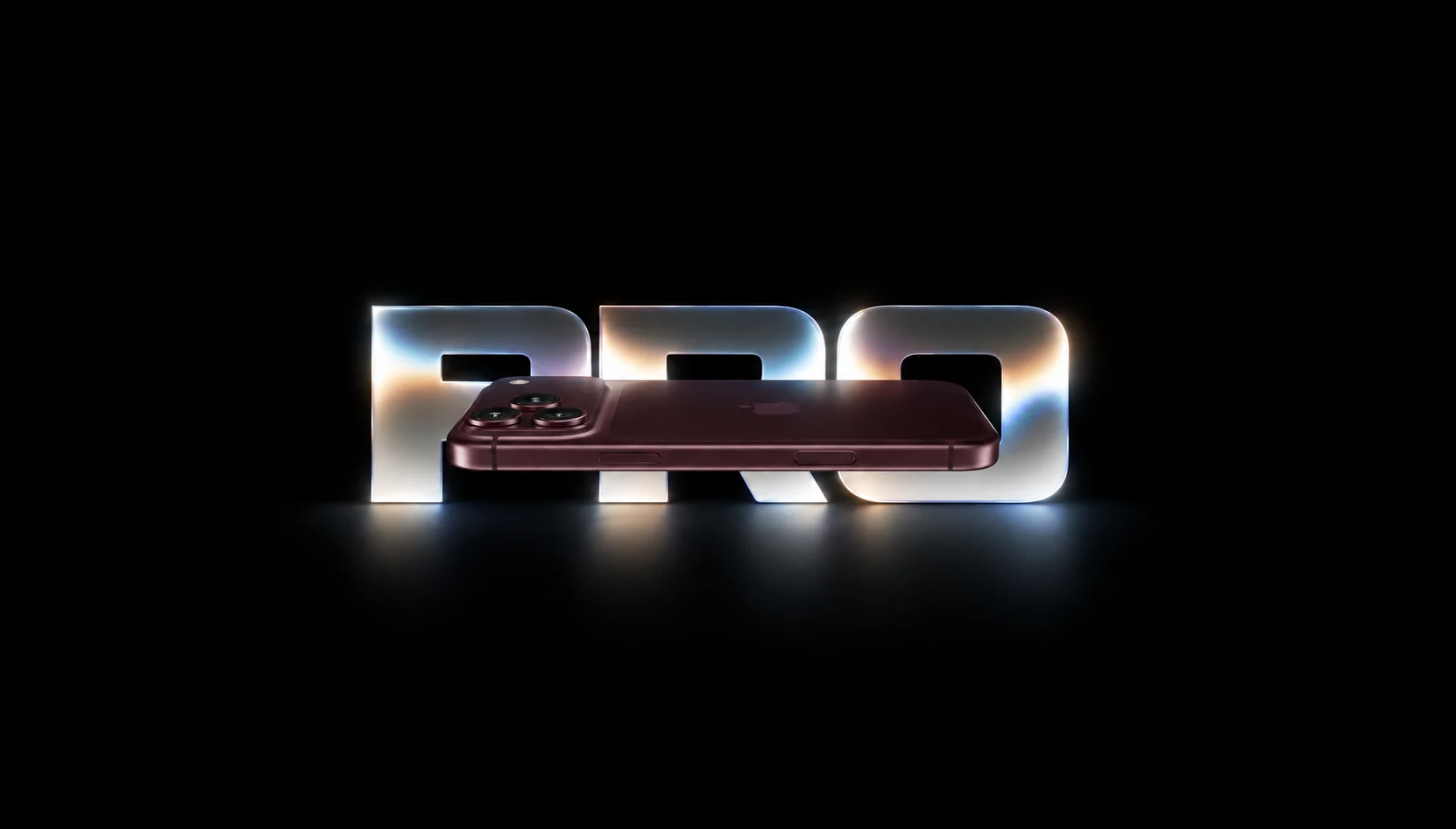
Note: prices, storage tiers, battery figures, and modem details below are current as of September 2026 and should be re-verified against Apple’s store page before publishing.
Quick answer
The iPhone 18 Pro is the fastest, best-shooting iPhone Apple has made, and it’s also the heaviest and most expensive. If you’re coming from an iPhone 15 Pro or older, it’s an easy recommendation at $1,199. If you already own the iPhone 17 Pro, the year-over-year gains won’t justify the outlay. The A20 Pro chip and the new variable aperture camera are the real story here, not the design.
Key info at a glance
| Detail | Info |
| Starting price | $1,199 (iPhone 18 Pro, 256GB), $1,299 (iPhone 18 Pro Max, 256GB) |
| Release date | On sale September 18, 2026 (pre-orders opened September 12) |
| Chip | A20 Pro, the first 2 nm processor in a smartphone |
| Display | 6.3″ (Pro) or 6.9″ (Pro Max) Super Retina XDR OLED, 120Hz ProMotion |
| Main camera | 48MP Fusion with variable aperture (f/1.48 to f/4.0) |
| Standout feature | Variable aperture camera plus a 3x-larger vapor chamber |
| Main drawback | Heaviest iPhone yet, and storage upgrades cost far more than last year |
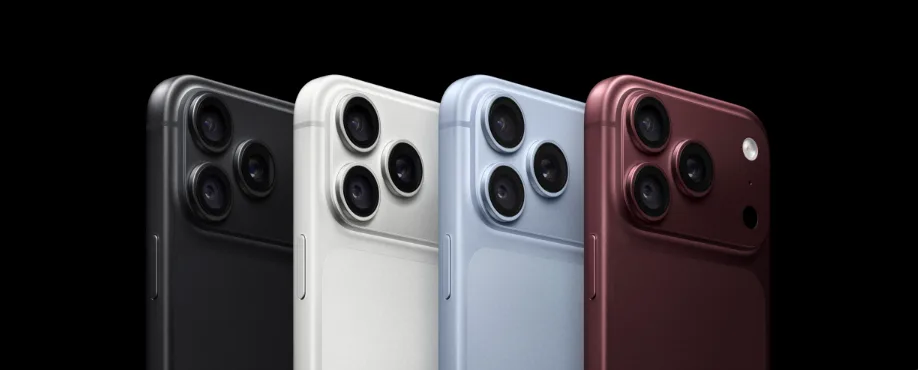
| Colors | Burgundy, Glacier, Silver, Black |
What is new in the iPhone 18 Pro
The short version: a new 2nm chip, a camera that can change its aperture, a smaller Dynamic Island, a color-matched back, and a bit more weight to carry it all. The iPhone 18 Pro features worth your attention this year all sit under the surface.
Apple gave the Pro line its big redesign last year with the iPhone 17 Pro and its full-width camera plateau. So the iPhone 18 Pro keeps that silhouette and spends its energy on the parts you don’t see in a store display. That’s a deliberate choice, and it shapes how you should think about this phone. You’re paying for the internals, not a new shape.

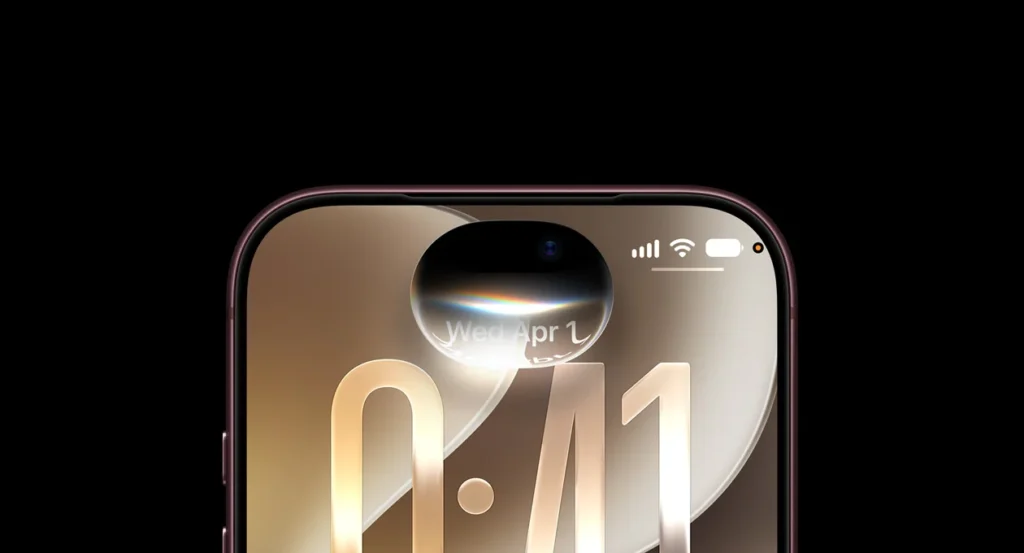
The most visible change sits at the top of the screen. Apple shrank the Dynamic Island by moving the Face ID infrared camera under the display into the top-left corner, behind a patch of pixels with a special pattern that lets infrared light through. A REWA Technology teardown confirmed the repositioned sensor. The result is a notch cutout that’s roughly a third smaller than the one on the iPhone 17 Pro, and it now holds three Live Activities at once, or two with more detail. If you run a timer, a Now Playing card, and a food-delivery tracker at the same time, you’ll feel the difference.
The other change you’ll notice is the back. iPhone 17 Pro owners spent a year complaining about the two-tone look, where the aluminum frame met a mismatched glass window. Enough of them slapped a case on a phone they’d hoped to run naked. This year Apple color-matched the aluminum to the glass, so the burgundy, glacier, silver, and black finishes read as one continuous surface. The silver in particular went from the worst-looking option to one of the best.
Round that out with the new features that matter day to day: the A20 Pro’s dual 16-core Neural Engine, iOS 27 with the rebuilt Siri, and a battery bump. We’ll get into each below.
What stands out
The A20 Pro chip is a real leap, and the cooling is why
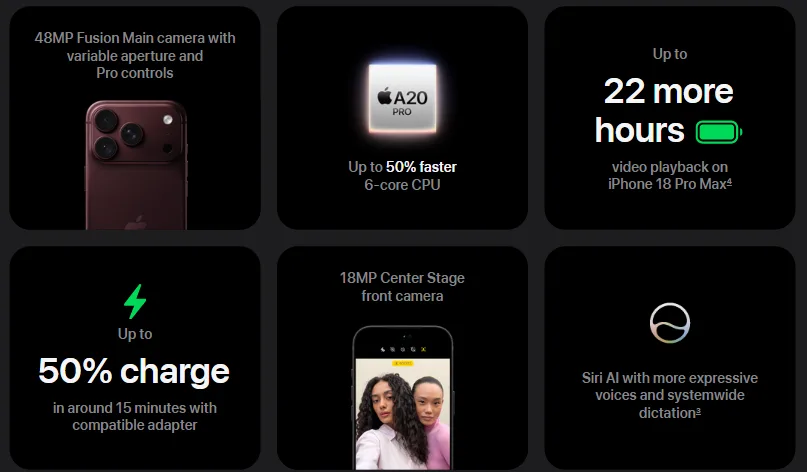
The A20 Pro is the first smartphone chip built on TSMC’s 2nm process, and it’s not marketing fluff. Apple quoted up to 20% faster CPU and up to 40% faster graphics against the A19 Pro. Independent numbers back that up. Gizmodo’s Raymond Wong ran Geekbench 7 on both phones with the shipping build of iOS 27: the iPhone 18 Pro scored 4,027 single-core and 11,540 multi-core, versus 3,258 and 9,167 for the iPhone 17 Pro. That works out to a 24% single-core and 26% multi-core gain in one generation, which is a large jump by 2026 standards.
Raw scores only tell half the story, though. The upgrade you’ll feel is thermal. Apple tripled the surface area of the vapor chamber, so the A20 Pro holds its peak clocks longer before it throttles. If you scroll Instagram and check email, you were never going to tax the old chip anyway, and you won’t notice the new one. Load up a demanding game or export a 4K project and the difference shows: the phone stays cooler and keeps its speed instead of sagging after ten minutes. Android Authority framed the A20 Pro as the fastest phone silicon on the market, at least until the next Snapdragon and MediaTek flagships arrive late in the year.

Pair that with 12GB of RAM and a wider memory interface, and the iPhone 18 Pro has more headroom than almost anyone will use in the next four years. That’s the practical read: the chip is excellent, and most buyers won’t push it.
The variable aperture camera is the headline feature.
The iPhone 18 Pro camera is where Apple spent its ingenuity this year. The 48MP Fusion main camera now has a mechanical variable aperture with four stops: f/1.48, f/1.8, f/2.8, and f/4.0. The blades physically move inside the lens, the same way a real camera works. Open it up to f/1.48 in a dim restaurant, and the sensor drinks in light. Close it to f/4.0 on a bright beach and you get sharper landscapes with more of the frame in focus.
Most of the time the phone picks the aperture for you, and you’ll never think about it. When you want control, the new Pro Controls let you set aperture, shutter speed, white balance, and ISO by hand. Engadget’s Cherlynn Low watched the blades move in the viewfinder at Apple Park and confirmed it behaves as advertised, though she found the on-screen controls a touch fiddly one-handed.
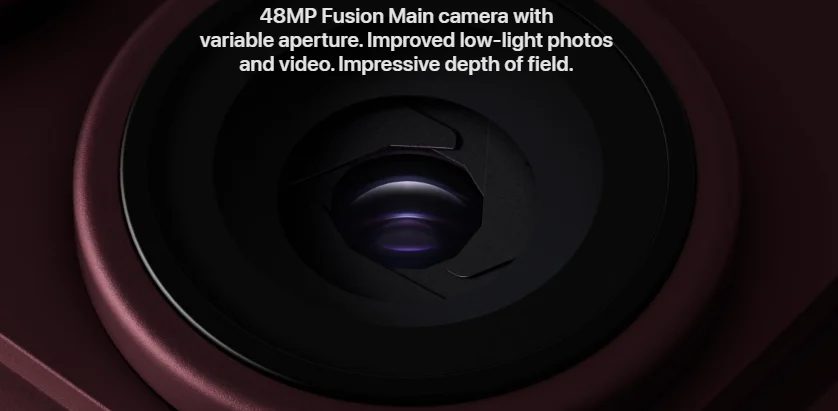
Is it a gimmick? PetaPixel went in skeptical. Their reviewer sat through the keynote underwhelmed, then shot around 1,000 photos and changed his mind. The gains sound small on a spec sheet and read larger in practice, mostly in low light and in portrait shots where the wider aperture produces optical background blur instead of the software fake. The telephoto and ultrawide lenses carry over from the 17 Pro largely unchanged, so this is a main-camera story, not a whole-system overhaul. For anyone who shoots a lot of photos, it’s the most compelling reason to buy.
Battery life and the smaller Dynamic Island
The iPhone 18 Pro carries a 4,056mAh battery in the physical-SIM version and 4,288mAh in the eSIM-only model sold in the US, up from 3,998mAh and 4,252mAh on the iPhone 17 Pro. On paper that’s a modest gain. In practice, the 2nm chip sips less power than the 3nm A19 Pro, with early reports pointing to as much as 30% better efficiency, so the endurance improvement is bigger than the battery number suggests. Tom’s Guide called the battery life across both models stellar. The Pro Max, with its larger cell, remains the pick for anyone who wants two days between charges.
The smaller Dynamic Island splits opinion. Some owners love reclaiming screen space and running an extra Live Activity. Others shrug and point out that a smaller cutout doesn’t change what the phone does. Both camps are right. It’s a refinement that points toward the full under-display front camera Apple is working on for a future model.
Apple’s AI push: the new Siri, finally
Apple built the iPhone 18 Pro launch around software as much as hardware, and the centerpiece is the new Siri AI in iOS 27. This is the assistant overhaul Apple announced at WWDC 2024, delayed in early 2025, and shipped in September 2026. Apple rebuilt it for the LLM era with a new System Orchestrator that ties Apple Intelligence together, and reports point to an Apple foundation model developed with help from Google’s Gemini.
What can it do? Siri now answers general-knowledge questions, understands personal context across Messages, Mail, Calendar, Notes, and Reminders, reads what’s on your screen, and takes actions inside apps such as sending a message or creating an event. There’s a dedicated Siri app, a Siri mode in the Camera for visual search, and Write with Siri for drafting text anywhere you type.
One honest caveat that most launch coverage buries: you don’t need an iPhone 18 Pro for most of this. The new Siri AI runs on the iPhone 15 Pro and later. What the 18 Pro adds is the top tier of on-device processing and the expressive voice feature, which need 12GB of memory and the newest silicon. If Apple Intelligence is your reason to upgrade, know that a 17 Pro gets you almost all of the same experience.
Where it falls short
No phone at this price gets a free pass, and the iPhone 18 Pro has real trade-offs worth weighing before you buy.
It’s the heaviest iPhone Apple has ever sold. MacRumors measured the iPhone 18 Pro Max at 249 grams in its unboxing, up from 233 grams on the 17 Pro Max, and it’s a phone you feel in a shirt pocket. The smaller Pro gained weight too. If you loved the lightness of the titanium iPhone 15 Pro, this generation moves in the opposite direction. Apple seems to have concluded, after the slim iPhone Air didn’t sell, that buyers want specs over grams.
Then there’s the price, and this is the part the glossy coverage skips. Yes, the base iPhone 18 Pro is $100 more than the 17 Pro at $1,199. But the storage ladder climbed much higher. A 1TB iPhone 18 Pro runs $1,799, which is $300 more than last year’s 1TB model. The new 2TB tier hits $2,399 on the Pro and $2,499 on the Pro Max, and that top Pro Max is a full $500 above the equivalent 17 Pro Max. A global memory shortage drove those surcharges, and it means the real cost of the phone you probably want, one with room for years of 4K video, jumped a lot more than the headline $100.
The upgrade math is the other soft spot. Reviewers reached a rare consensus: MacRumors put it plainly, saying there’s no strong reason to move up from an iPhone 17 Pro or even a 16 Pro, while a jump from a 14 Pro or older makes sense. The variable aperture is genuine, but the phone looks like last year’s and shares its telephoto and ultrawide. Two of the marquee changes, the smaller Dynamic Island and iOS 27, reach older phones too.
A couple of smaller notes. The flagship burgundy color looks stunning in Apple’s renders and reads as a muddy brown-purple in dim rooms, an effect Digital Trends flagged as metamerism, and its matte finish grabs fingerprints. Several reviewers preferred the understated glacier blue in person. And variable aperture, while new to iPhones, isn’t new to phones. Samsung and Huawei shipped it years ago, so Apple’s version is best judged on execution rather than novelty.
iPhone 18 Pro vs iPhone 17 Pro
If you’re cross-shopping the two, start with the table, then read the reasoning under it.
| Spec | iPhone 18 Pro | iPhone 17 Pro |
| Chip | A20 Pro (2 nm) | A19 Pro (3 nm) |
| Geekbench 7 (single / multi) | 4,027 / 11,540 | 3,258 / 9,167 |
| Main camera | 48MP, variable aperture f/1.48–f/4.0 | 48MP, fixed f/1.78 |
| Cooling | Vapor chamber, 3x larger | Vapor chamber |
| RAM | 12GB | 12GB |
| Battery (Pro / Pro Max) | 4,056 / 4,288 mAh | 3,998 / 4,252 mAh |
| Weight (Pro Max) | 249g | 233g |
| Dynamic Island | ~35% smaller, under-display IR | Standard |
| Front glass | Ceramic Shield 2 | Ceramic Shield |
| Colors | Burgundy, Glacier, Silver, Black | Cosmic Orange, Deep Blue, Silver |
| Starting price | $1,199 | $1,099 |
The verdict in one line: buy the iPhone 18 Pro if you shoot a lot of photos or you’re upgrading from a phone two or more years old, and keep the iPhone 17 Pro if you already own it.
On raw speed, the A20 Pro wins by about a quarter, and that lead grows under sustained load thanks to the bigger vapor chamber. For gaming and video work, the 18 Pro is the better tool. For everyday scrolling and messaging, you won’t tell the two apart, because the A19 Pro was already faster than most people need.
The camera is the deciding factor for a lot of buyers. If you care about low-light shots and real optical depth of field, the variable aperture main camera is a tangible reason to move up. If you mostly shoot in daylight and share to social, the 17 Pro’s fixed-aperture 48MP camera still holds up well.
Everything else favors keeping your money. The 17 Pro is lighter, it now costs less than it did at launch, and it runs the same iOS 27 with the same new Siri AI. The two-tone back that annoyed people is the one design win for the newer phone, and a case hides that anyway.
iPhone 18 Pro price and release date
The iPhone 18 Pro release date was September 18, 2026, with pre-orders that opened on September 12 at 5 a.m. Pacific. It launched in more than 65 countries and regions on day one, alongside the foldable iPhone Duo and the new AirPods 5, and demand in China outpaced the 2025 Pro models at pre-order.
Here’s the full iPhone 18 Pro price ladder, unlocked from Apple:
| Storage | iPhone 18 Pro | iPhone 18 Pro Max |
| 256GB | $1,199 | $1,299 |
| 512GB | $1,399 | $1,499 |
| 1TB | $1,799 | $1,899 |
| 2TB | $2,399 | $2,499 |
Apple lists a monthly option of $49.95 for 24 months on the base Pro and $54.12 on the base Pro Max, and its trade-in program takes up to $1,200 off with an eligible iPhone 14 or newer. If those numbers sting, last year’s iPhone 17 Pro is still on sale at a lower price and remains a strong buy.
Who should buy the iPhone 18 Pro
Buy it if you’re upgrading from an iPhone 15 Pro or older, if you shoot enough photos and video to care about a variable aperture and manual Pro Controls, if you game or edit on your phone and want silicon that won’t throttle, or if you want the longest battery life and go for the Pro Max.
Skip it if you own an iPhone 17 Pro or 16 Pro, since the gains are marginal for the price. Skip it too if you want a light phone, since this is the heaviest iPhone ever made. And skip it if Apple Intelligence is your only draw, because the new Siri AI runs on phones going back to the iPhone 15 Pro. If a foldable is what tempts you, look at the new iPhone Duo instead.
For most people ready for a new phone, the iPhone 18 Pro is the best iPhone you can buy right now. Whether it’s the best value is a different question, and the answer depends entirely on what you’re holding today.
FAQs
Q. When did the iPhone 18 Pro release?
A. The iPhone 18 Pro and iPhone 18 Pro Max went on sale September 18, 2026, after pre-orders opened on September 12.
Q. How much does the iPhone 18 Pro cost?
A. It starts at $1,199 for the 256GB iPhone 18 Pro and $1,299 for the 256GB iPhone 18 Pro Max. Higher storage runs up to $2,399 (Pro) and $2,499 (Pro Max) for 2TB.
Q. What is the biggest new feature in the iPhone 18 Pro?
A. Two: the A20 Pro chip, the first 2nm processor in a phone, and the 48MP main camera with a mechanical variable aperture that ranges from f/1.48 to f/4.0.
Q. Is the iPhone 18 Pro camera worth upgrading for?
A. If you shoot a lot in low light or want real optical background blur in portraits, yes. If you mostly shoot in daylight, the 17 Pro camera still does the job.
Q. Should I upgrade from the iPhone 17 Pro to the iPhone 18 Pro?
A. For most people, no. The performance and camera gains are real but incremental, and the design, Dynamic Island size aside, is the same. Owners of a 15 Pro or older will feel a much bigger difference.
Q. Does the iPhone 18 Pro have a smaller Dynamic Island?
A.Yes. Apple moved the Face ID infrared camera under the display, shrinking the cutout by roughly a third and letting it show up to three Live Activities at once.
Q. How is the iPhone 18 Pro battery life?
A. The battery is slightly larger than the 17 Pro’s, and the 2nm A20 Pro is more power-efficient, so real-world endurance improves more than the capacity numbers imply. The Pro Max lasts longest.
Q. Does the iPhone 18 Pro run the new Siri?
A. Yes. It ships with iOS 27 and the rebuilt Siri AI, and it supports the most advanced on-device Apple Intelligence models and expressive voices, which need the newest chip and 12GB of memory.