
 Shikha Kumari
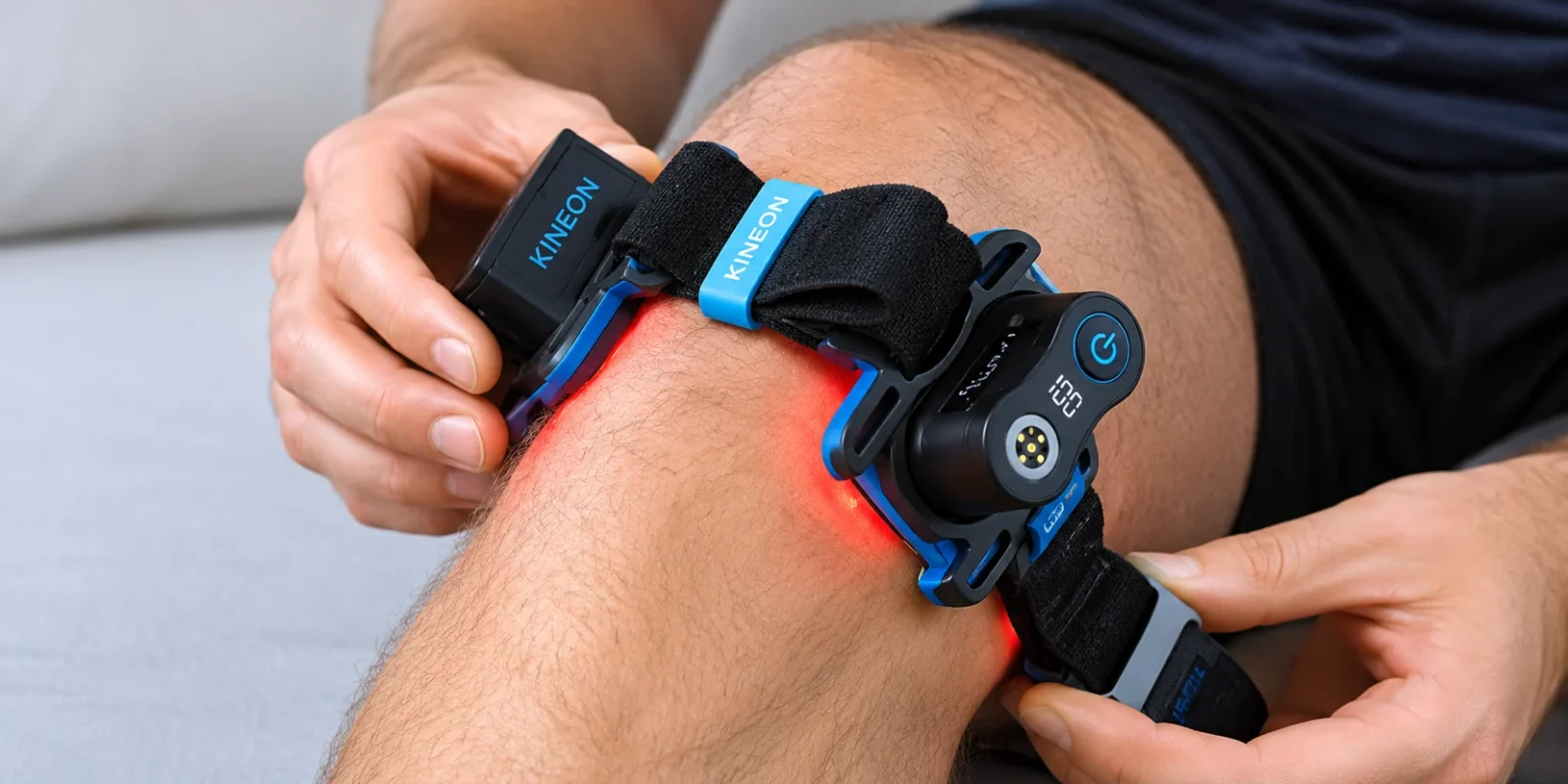
The Kineon MOVE+ is a $399 strap of three small pods that shine red LED light and near-infrared laser light into one sore joint. Its FDA listing puts it under the same product code as an infrared heat lamp, which means it went on sale without the FDA reviewing whether it works. Owners still rate it highly, and it makes the most sense for one knee, elbow or shoulder you’ll treat every day. This Kineon review checks Kineon’s specs and refund rules, the FDA record, Trustpilot and published owner reports.
Quick answer: The MOVE+ is a strap-on red LED and near-infrared laser device with a 4.7 Trustpilot score (as of November 2026). Research on laser therapy for knee pain is promising but mixed, and the MOVE+ itself hasn’t been trialled. At $399 it suits one joint, and the 30-day refund has conditions.
Key info at a glance
- Price: $399 on kineon.io, compare-at $699 (as of November 2026)
- What it is: Three strap-on pods with red LEDs and near-infrared lasers
- Wavelengths: 660 nm LED and 808 nm Class 1 laser
- Session: 10 to 15 minutes, up to twice a day
- Battery: About 4 hours per pod (Kineon’s figure)
- Warranty: 1 year
- Trial: 30 days, after daily use
- HSA/FSA: Yes, through Flex on kineon.io
- FDA status: Listed and exempt from premarket review; no clearance or approval
- Best for: One problem joint and a daily habit
- Skip if: You want to treat your whole back at once
What is Kineon? Our Kineon review starts with the MOVE+
Kineon Labs is a home light therapy brand, and its main product is the MOVE+: three wearable LED and laser pods that clip into an adjustable strap. You wrap the strap around a joint, and the pods lie flat against your skin.
The naming trips a lot of buyers up. As of November 2026, Kineon’s own product page carries three names for one listing: MOVE+, MOVE+ Pro and “MOVE+ LED & Laser”. So today they’re the same device. Some YouTube reviewers call it the “Move+ 2.0”, a label Kineon’s store doesn’t use. Older reviews also mention an original MOVE+ that came before the Pro. This review covers the model on sale now.
Strap 3.0 is a newer strap with quick-release clips, and the device itself is unchanged. Kineon says it fits every MOVE+ shipped in 2023 and 2024 and sells it on its own for $29.
Two other Kineon products come up in searches. RELIEF+ is a manual trigger-point tool that comes in a bundle. HEAL+ has been announced through an Indiegogo campaign and isn’t in Kineon’s store yet.
How does the Kineon MOVE+ work?
The MOVE+ shines red and near-infrared light into the area under the strap for 5 to 15 minutes, with the pods pressed against your skin. The idea behind it is photobiomodulation, the research term for using low-power light to affect how cells behave.
660 nm red LEDs vs 808 nm near-infrared lasers
Each pod pairs two light sources. It has eight 660 nm deep-red LEDs, which Kineon uses for the tissue near the surface. It also has ten 808 nm near-infrared laser diodes, which Kineon says reach deeper into the joint. That depth claim is Kineon’s; we found no independent measurement of how far the light gets on a real knee.
The lasers are Class 1, the lowest laser safety class: safe under normal use. The5krunner’s July 2026 review points out that 808 nm lasers are the wavelength with the stronger trial research behind them for joints. That makes the laser half the most interesting part of the device.
What a session looks like
Setup takes a minute the first time and seconds after that. You clip the pods into the strap’s holders, wrap the strap over the sore spot and press one power button. That button starts all three pods at once, and they switch off on their own when the session ends.
Kineon recommends 10 to 15 minutes a day, at most twice a day. Bennett Carby, who used his MOVE+ for 16 weeks, says setup took him under 20 seconds once the strap was sized.
The pods charge in their case in about 3.5 hours. The case has no battery of its own, so it needs a wall outlet, as the5krunner notes.
What are the Kineon MOVE+ specs?
These are Kineon’s figures from its product page, checked on 6 November 2026.
| Spec | Kineon MOVE+ |
| Modules | 3 per unit, 2 emission areas each |
| Red LEDs | 8 × 660 nm per module, 80 mW per emission area (160 mW per module) |
| Lasers | 10 × 808 nm Class 1 VCSEL diodes per module, 5 mW each (50 mW per module) |
| Battery | About 4 hours per module (about 24 ten-minute sessions) |
| Charge time | About 3.5 hours |
| Module size | 59 × 37 × 37 mm |
| Strap length | 8.5 to 39.5 inches with all three modules |
| In the box | 3 modules, Adjustable Strap 3.0, charge case, charge cable, travel case, user manual, quick start guide |
| Extender strap | Sold separately |
| Warranty | 1 year, plus “lifetime support” |
Real use runs a little shorter than the battery claim. The5krunner measured about 3 to 3.5 hours of continuous use per pod. At one 10 to 15 minute session a day, that still means charging roughly every week or two.
How much does Kineon cost, and is it HSA/FSA eligible?
The Kineon MOVE+ is $399 on kineon.io as of November 2026, down from a $699 compare-at price. It’s also HSA/FSA eligible through Kineon’s partner Flex, but only when you buy on kineon.io.
Treat $399 as a sale price. The5krunner wrote in July 2026 that the US price was “usually discounted to $499”, and Bennett Carby quoted $499 in May 2026. If the page shows more than $399 when you check, the promotion has ended.
The other things you might buy:
- Pain to Possible bundle: $599 (compare-at $924) for the MOVE+, the RELIEF+ tool and the extender strap.
- Extender strap: $55 on its own, for hips, thighs or a lower back.
- Payments: Affirm and Klarna spread the price over four payments.
The 30-day guarantee has fine print. Kineon’s FAQ asks you to use the MOVE+ every day for 5 to 15 minutes for at least 3 to 4 weeks before you ask for a refund. The refund policy also says shipping costs aren’t refunded. One banner on the same page promises a full refund “no questions asked”, so keep a simple log of your sessions in case you need it.
Does Kineon really work? What the research and our Kineon review sources say
Owner reviews are mostly positive, and studies of laser therapy for knee pain are encouraging. As of November 2026, though, ClinicalTrials.gov lists no trial of the MOVE+ itself. The evidence you’ll see quoted is for the type of treatment, and none of it tested this device.
What the studies on light therapy show
The strongest pooled evidence is Stausholm and colleagues’ 2019 review in BMJ Open. It’s a meta-analysis, which means it pooled results from many trials: 22 placebo-controlled trials with 1,063 people with knee osteoarthritis. Laser therapy cut pain by 14.23 points on a 100-point scale compared with a fake treatment, and it also improved disability scores.
There are two catches. The benefit showed up at set doses of 4 to 8 joules per treatment spot with 785 to 860 nm lasers. That range includes the MOVE+’s 808 nm, but the trials used clinic lasers on marked treatment points. The authors also note that major guidelines don’t currently recommend this therapy for knee osteoarthritis. A home device using a similar wavelength won’t automatically give the same results.
What owners and reviewers report
On Trustpilot, Kineon Labs has a TrustScore of 4.7 from 695 reviews as of November 2026. 70% of those reviews are 5-star and 11% are 1-star. Recent praise centres on quick replacements and easy setup.
The published reviews describe slow, steady relief more than instant results. Bennett Carby felt nothing for two weeks, then had steady relief in his knees, elbows and biceps from around weeks 2 to 3. It did little for a hand injury. The5krunner got relief for tennis elbow and results similar to a rival PRUNGO device, though Kineon supplied that unit for free. Wareable’s reviewer found it easy to run but said it needs frequent charging.
Reddit opinion falls into two camps. Owners in r/Pickleball and r/redlighttherapy describe relief for tennis elbow and knee pain after weeks of daily use. A January 2026 r/Osteoarthritis thread calls the device overpriced and points to Kineon’s large referral program as a reason for some of the glowing posts. Kineon’s own FAQ says most customers notice a change within 1 to 4 weeks, but that’s the brand’s figure.
Is Kineon FDA approved?
No. The MOVE+ is listed with the FDA, and it isn’t FDA approved or 510(k) cleared. Its AccessGUDID record lists KINEON model XG-01B, made by Shenzhen Kaiyan Medical Equipment. It’s listed under product code ILY, “Lamp, Infrared, Therapeutic Heating”, and is marked exempt from premarket submission.
Here’s what each FDA term means:
- Listed or registered: The company has told the FDA it makes and sells the device. Nobody checked whether it works.
- 510(k) cleared: The FDA reviewed the device and agreed it’s equivalent to one already on the market.
- Approved: The strictest route, for high-risk devices, with clinical evidence reviewed by the FDA.
You’ll see “FDA cleared” and “FDA approved” in some MOVE+ reviews. We searched the FDA’s 510(k) database and found no clearance for a Kineon, MOVE+ or XG-01 device as of November 2026.
What are the common complaints about Kineon?
Straps, battery life and slow phone support come up most. Here’s each pattern, with where it comes from:
- Straps: Trustpilot reviewers mention broken straps and cracked holders. The5krunner warns that the elastic may lose its stretch over time. Bennett Carby found it doesn’t wrap well around a shoulder or lower back.
- Battery: Runtime comes in under the 4-hour claim (see the specs above). Some r/redlighttherapy owners also report pods keeping less charge after long use.
- Small coverage: Three pods cover one joint. A whole back means moving the strap around or buying the extender, as Bennett Carby and the5krunner both note.
- No app: Kineon’s product page lists none, and everything runs from the buttons. Some owners like that, while others want session tracking.
- Phone support: Trustpilot’s review summary flags slow replies and trouble reaching anyone by phone. Kineon replies to about 15% of negative reviews.
- Module faults: Trustpilot reviewers mention faulty pods, and r/redlighttherapy owners describe pods falling out of sync.
Faults usually get fixed. Trustpilot reviewers often say Kineon sent replacement parts fast and sorted out refunds.
Is red light therapy safe? Downsides to know
Kineon says side effects are rare: mostly mild warmth or temporary redness that fades quickly. The MOVE+’s lasers are Class 1, so the main rule is to keep the pods on your skin and follow the user manual.
The bigger downside is cost and uncertainty. You could spend the money and weeks of daily sessions on something that doesn’t help your particular pain. Check with your doctor or a physio before you start, especially if the pain hasn’t been diagnosed. A home light device shouldn’t stand in for that visit.
This article is for general information and isn’t medical advice. Read our disclaimer for more.
Kineon MOVE+ vs other red light devices
Kineon’s edge is lasers plus modular pods for one joint. Panels and wraps cover more area. Here’s how the MOVE+ lines up against the rivals owners compare it with, using each brand’s official US store as of November 2026:
| Device | Type | Wavelengths | Coverage | Price (Nov 2026) | Trial |
| Kineon MOVE+ | Laser + LED | 660 nm LED, 808 nm laser | 3 strap-on pods | $399 | 30 days, after daily use |
| PRUNGO FluxGo | Laser + LED | 660 nm LED, 850 nm laser | 3 strap-on modules, use 1 to 3 | $399 | 30 days, $50 restocking fee after day 14 |
| Solio Alfa | Laser + LED, plus RF heat | 620 nm red, about 805 to 915 nm infrared | Handheld, 2 to 3 cm focus | $475 (from $595) | 60 days |
| dpl Joint Wrap | LED only | Red and infrared (not listed) | Wrap for knee, elbow, shoulder or ankle | $179 | 30 days, unused only |
| Joovv Go 2.0 | LED only | 660 nm, 850 nm | Handheld, under 6 × 4 inches | $549 | 30 days |
PRUNGO is the closest match, with the same laser-plus-LED pod idea at the same price as of November 2026. The5krunner found the MOVE+ pods ran longer per charge. Solio adds radio-frequency heat and a 60-day guarantee, but you hold it in your hand. The dpl wrap costs less than half as much and uses LEDs only. Joovv Go 2.0 is a handheld LED light for treating spots.
Kineon pros and cons
Pros
- 808 nm lasers fall inside the wavelength range studied for knee pain
- One button runs all three pods, with an automatic stop
- HSA/FSA eligible on kineon.io
- 30-day guarantee and a 1-year warranty
- Replacements are handled quickly, per Trustpilot
Cons
- Battery runs under the 4-hour claim
- Three pods won’t cover a whole back
- Refund needs 3 to 4 weeks of daily use, and shipping isn’t refunded
- FDA listed only, with no trial of the device itself
- A rival laser device costs the same
Who should buy the Kineon MOVE+, and who should skip it?
Buy the MOVE+ if one joint bothers you and you’ll actually strap it on every day. It suits a pickleball elbow, a runner’s knee or a sore shoulder that keeps coming back. It’s also a good fit if you want something small enough to wear at a desk or pack in a gym bag.
Skip it if you need to treat a large area like your back or both legs at once, since a panel covers more. Skip it if you want app tracking, or if you’ll only be happy with a guaranteed result. And if what you really want is recovery data, a tracker like the Oura Ring 5 or the Apple Watch Series 12 does that job.
For pain that keeps going or gets worse, see a doctor or physio first. The MOVE+ can work alongside their plan, but it shouldn’t replace one.
Kineon review verdict: is the MOVE+ worth it?
The MOVE+ is a well-built red LED and laser wrap that owners rate highly. It’s worth $399 if you have one stubborn joint and the patience for weeks of daily use.
At this price it beats its own $499 history and matches PRUNGO’s laser option. The cheaper dpl wrap makes sense if you’re happy with LEDs only. Think of the 30-day guarantee as a safety net with conditions: log your sessions and expect to pay the shipping.
Go in with realistic expectations. The research on laser therapy for knee pain is promising, but nobody has trialled this exact device. Check the price on the Kineon MOVE+ product page before you buy, and compare it with our other gadget reviews if you’re weighing it against a wearable.
FAQs
Q. Is Kineon legit?
Yes. Kineon is a real company that sells the MOVE+ with a 1-year warranty and a 30-day guarantee, and it has a 4.7 TrustScore from 695 Trustpilot reviews as of November 2026. The device is FDA listed, with no FDA clearance or approval.
Q. What is the difference between Kineon Move+ and Move+ Pro?
As of November 2026, there’s no difference: Kineon’s product page uses both names for the same device. An earlier original MOVE+ came before the Pro. Strap 3.0 is a newer strap that fits every MOVE+ shipped in 2023 and 2024.
Q. Can you overdo red light therapy on your knee?
More isn’t better. Kineon recommends 10 to 15 minutes a day, at most twice a day, and its guarantee terms cap use at 30 minutes per area. Stick to the user manual. The knee studies found benefits at set doses, and no study shows that longer sessions help more.
Q. Can red light therapy regrow knee cartilage?
There’s no good evidence that it does, and Kineon doesn’t claim it. The knee research measured pain and disability scores, not cartilage growth. If you’ve been told you have cartilage damage, talk to your doctor about treatment options.
Q. Does K-Laser really work, and is Kineon the same thing?
K-Laser is a brand of laser therapy machines used in clinics, so it’s a different product from Kineon. The MOVE+ is a much lower-power home device. Clinic results don’t transfer directly to it, so judge each one on its own evidence.
Q. What does Mayo Clinic say about red light therapy?
Mayo Clinic has no page on red light therapy for joint pain. In an April 2024 Mayo Clinic News Network piece, dermatologist Dr. Dawn Davis says over-the-counter red light skin devices may not be effective or safe. She suggests talking to a dermatologist before you buy one.
Q. Is it cheaper to buy Kineon on Amazon?
Not usually. Kineon.io sells the MOVE+ for $399 as of November 2026, and Amazon prices change by seller. Buying direct also gets you Kineon’s 30-day guarantee and HSA/FSA payment through Flex, which only works on kineon.io.
Q. Can I use a Kineon on my back?
Yes. Kineon says the strap fits most joints and the lower back. Three pods cover a small area, though, so a whole back means moving the strap or buying the $55 extender strap. A red light panel may suit large areas better.