

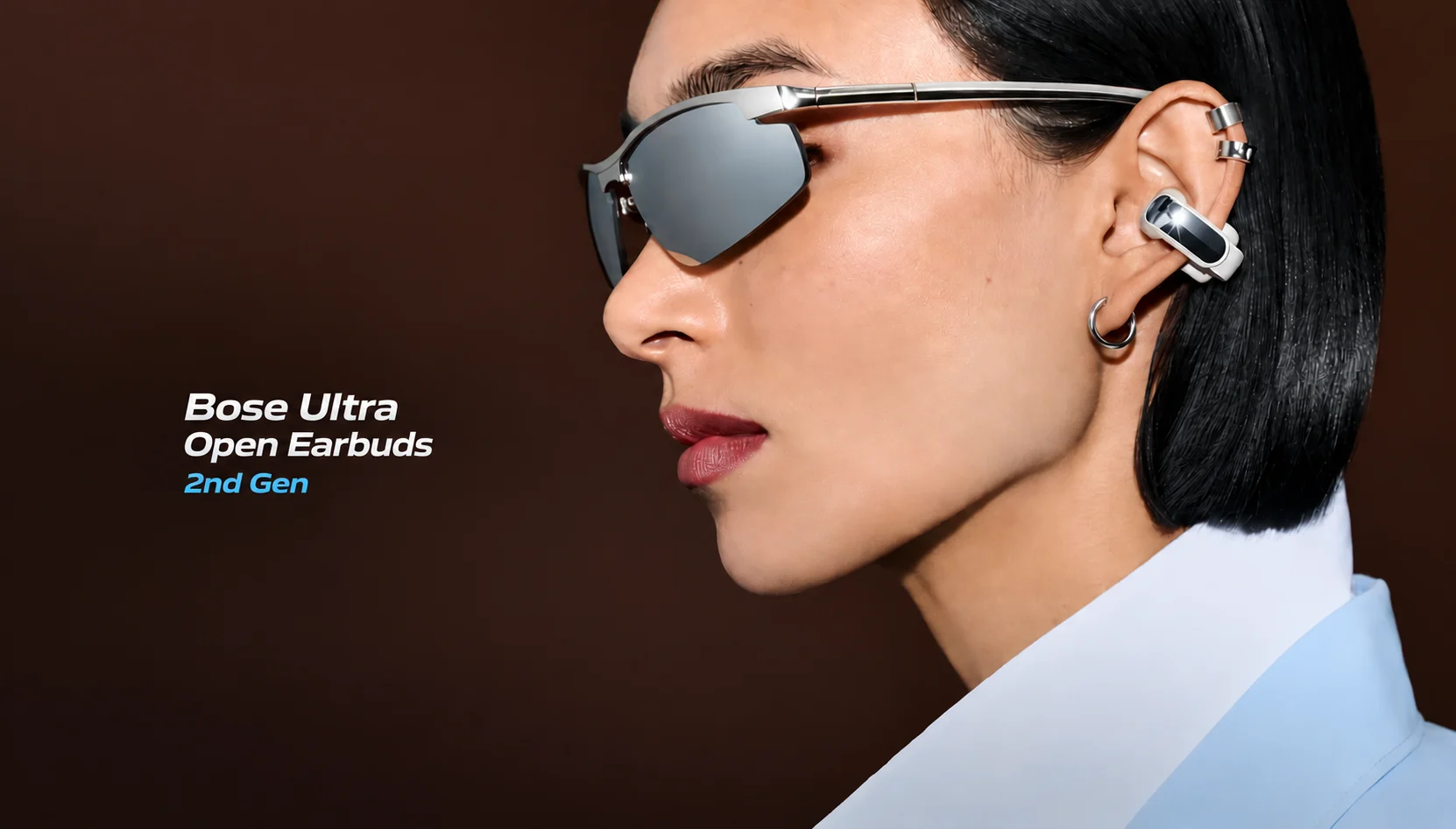
Quick answer: The Bose Ultra Open Earbuds 2nd Gen fixes the biggest practical complaints owners had about the 2024 model: no wireless charging, short battery life, and a thin bass response. At $299, they make sense if you wear open earbuds for most of the day and care about sound quality over sport-grade durability. They make less sense if you mostly use Immersive Audio, because that mode cuts battery life to about 5 hours, or if you can find the first-gen pair at $199, which Bose itself now charges. Runners and gym users should look at the $199 Bose Sport Open Earbuds instead.
How we put this review together: The 2nd Gen earbuds go on sale October 1, 2026, and we have not worn a retail pair yet. This review draws on Bose’s published spec sheet and support FAQ, launch coverage from outlets that attended briefings, and two years of owner reports on the first-gen model. Where Bose claims an improvement we can’t confirm yet, we say so. We will update this page after hands-on testing.
Key info at a glance
| Feature | Bose Ultra Open Earbuds (2nd Gen) |
| Price | $299 |
| Release date | Pre-orders from September 19, 2026; on sale October 1, 2026 |
| Colors | Black, White Smoke; limited-edition Cherry Chocolate, Olive Green, Sky Pink |
| Battery (earbuds) | Up to 9 hours; 5 hours with Immersive Audio or Auto Volume; 4 hours with both |
| Battery (case) | Up to 19.5 extra hours; 11 with Immersive Audio or Auto Volume; 8.5 with both |
| Quick charge | 10 minutes for up to 2 hours |
| Charging | USB-C and Qi wireless (power adapter not included) |
| Bluetooth | 5.4, multipoint (two devices), 30-foot range |
| Water resistance | IPX4 |
| Weight per bud | About 6 g (0.013 lb) |
| Listening modes | Stereo, Immersion, Cinema |
| Standout feature | Bose’s open-ear sound, now with more bass and volume |
What’s new compared with the first generation
If you owned or considered the original pair, the changes break into four groups.
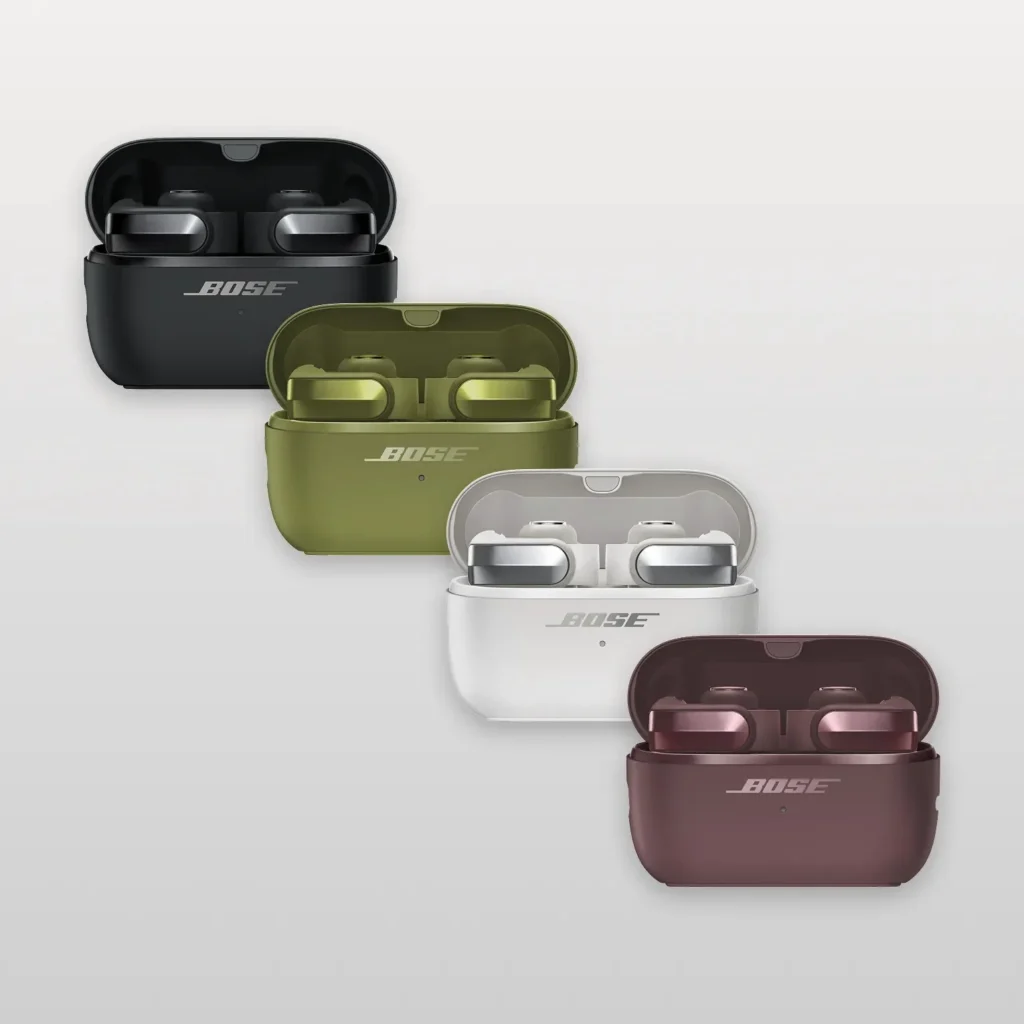
Sound hardware. Bose fitted a new driver that it says delivers deeper bass and a higher maximum volume. Volume was a common gripe with open earbuds of every brand, because the speaker sits outside your ear canal and competes with street noise.

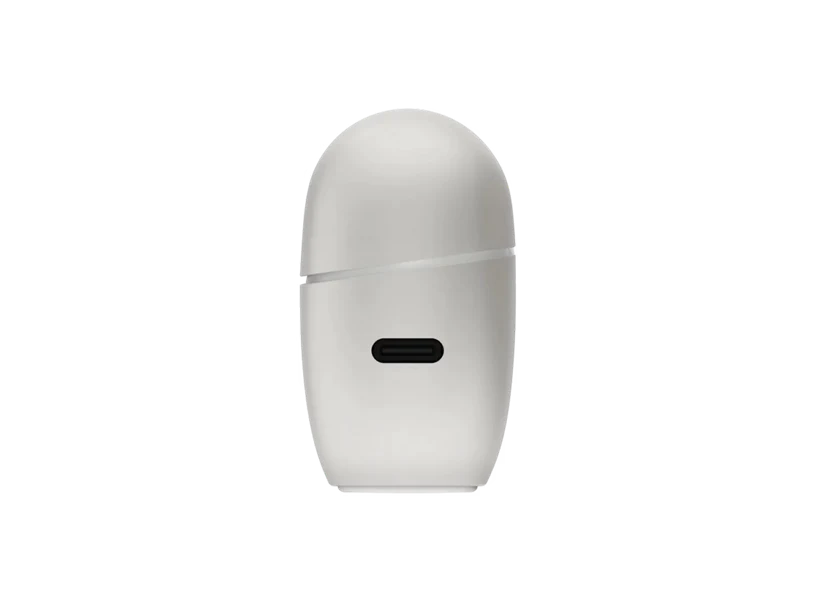
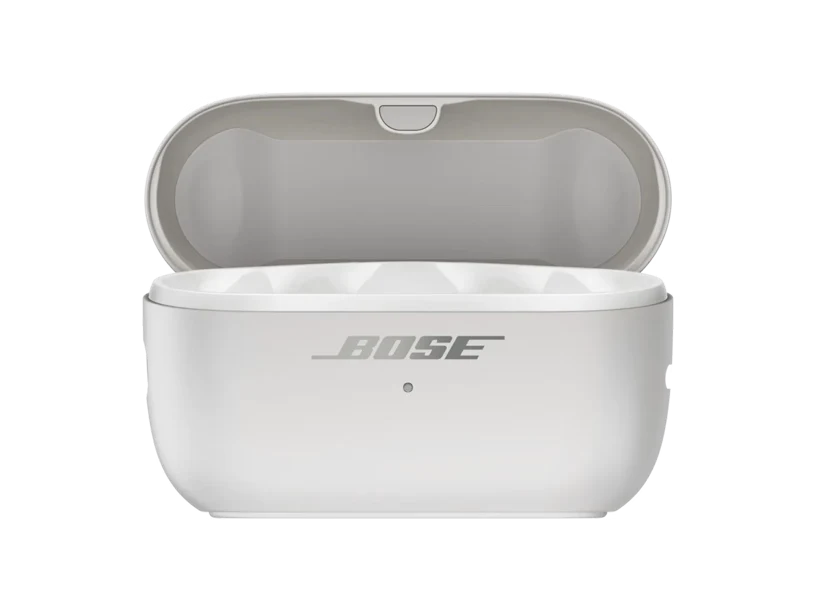
Battery and charging. Playback rises from 7 hours (Bose’s current figure for the Gen 1; early listings said 7.5) to 9 hours. The case now supports wireless charging and stands upright on a desk.
Features. A new Cinema Mode tunes the spatial audio for video. Bose also added SpeechClarity processing for calls, an Apple Music shortcut, and, through a launch-day firmware update, support for Google Find Hub and Alexa+.
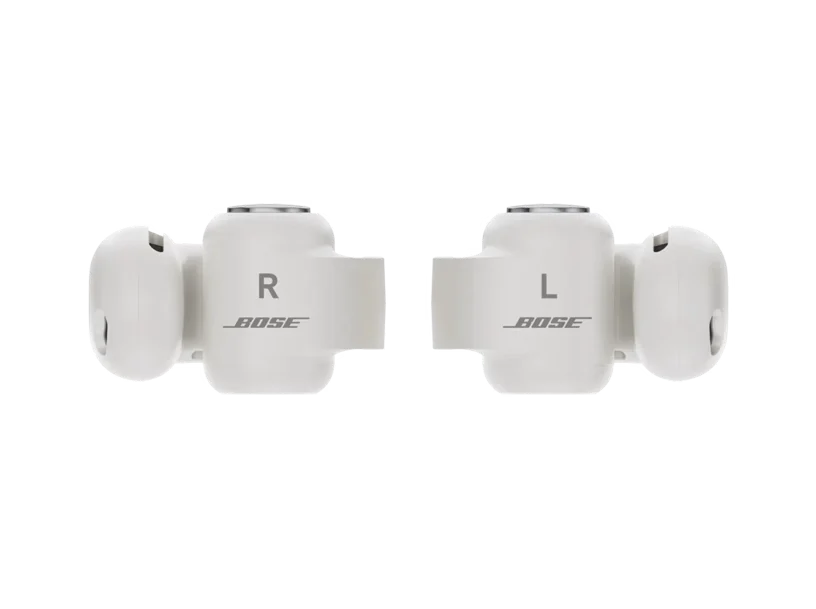
Design. The cuff shape stays the same. Bose simplified the flexible joint, gave the metal cap a beveled finish, and says the case is sturdier.
The price stays at $299, which matches the launch price of the original.
What stands out
The bass and volume upgrade targets the right weakness
Open earbuds trade a sealed fit for awareness, and that trade costs bass. In-ear buds build low-end pressure inside a closed canal. An open design can’t, so bass tends to thin out as soon as a bus passes. The first-gen Ultra Open already earned praise for sounding fuller than rivals like the original Shokz OpenFit, but owners still pushed the volume near maximum outdoors.
Bose’s new driver addresses both problems at once. We can’t measure the gain yet, so treat this as a claim. If it holds up, it matters most for the people who bought open earbuds for commuting and walking in cities, where the Gen 1 ran out of headroom.
Nine hours covers a full workday in stereo
Nine hours in standard stereo mode takes you from a morning commute through an afternoon of calls without a top-up. The case adds 19.5 hours, for a total of 28.5. Bose also says the buds hold a connection for up to 20 hours while idle, which suits people who wear them all day and play audio in bursts.
Add the 10-minute quick charge (2 hours of playback), and you rarely need to plan around the battery, as long as you stay in stereo. The fine print on that follows in the next section.
Wireless charging and a case that stands up
This sounds minor until you use earbuds every day. Tom’s Guide’s reviewer, who runs with the first-gen pair, put missing Qi charging at the top of their wish list. The 2nd Gen case drops onto any Qi pad, and Bose tells you to align the lower half of the case back with the charger’s center. The upright stance also keeps the case from sliding off a nightstand.
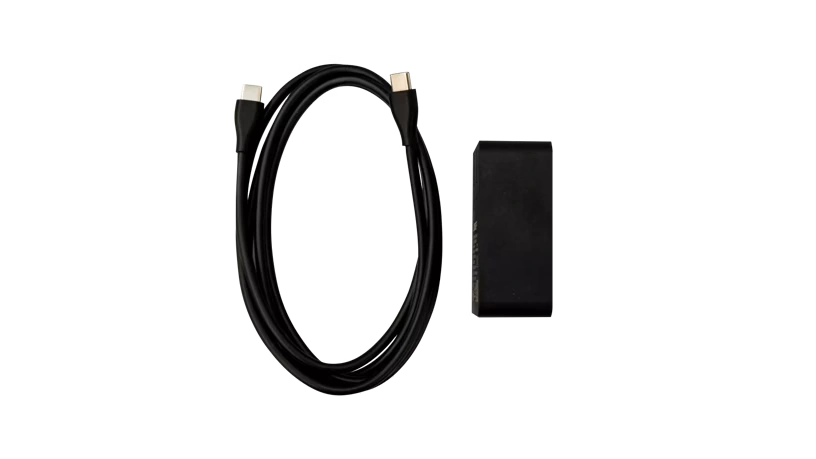
One catch: Bose does not include a power adapter in the box. Budget for one if your drawer is empty.
Cinema Mode gives spatial audio a clearer job
Immersive Audio on the Gen 1 impressed reviewers for music, but it drained the battery fast, so many owners switched it off and forgot it. Cinema Mode gives spatial processing a specific use: shows, films, and video podcasts on a phone or laptop. Because you tend to watch video sitting still and near a charger, the battery penalty hurts less here than it does on a run.
Calls should improve, and they needed to
Call quality drew mixed owner feedback on the first-gen model. Some owners reported that callers couldn’t tell they were on earbuds, while others described the microphone as poor even in a quiet office. Open designs struggle here because nothing blocks the wind and room noise reaching the mics.
The 2nd Gen adds SpeechClarity, a voice-isolation engine that Bose says separates your voice from background noise. Bose still lists two microphones. Until independent tests arrive, count this as a promise aimed at a known weakness.
The cuff fit works with glasses, hats, and most piercings.
The cuff clips around the middle of your ear rather than hooking over the top, so it leaves room for glasses arms and hat brims. Bose’s own FAQ adds a detail most coverage skips: the magnets can interact with jewelry that contains ferromagnetic metals such as nickel. If you wear a conch or helix piercing, try the fit within the return window and shift the bud slightly if you feel a tug.
Where it falls short
The 9-hour figure shrinks fast in the modes you’re paying for
Bose’s support page lists the full battery breakdown, and it reads less rosy than the headline:
- Stereo, no extras: 9 hours per charge
- Immersive Audio or Auto Volume on: 5 hours
- Both on: 4 hours
The case follows the same pattern, dropping from 19.5 extra hours to 11, then 8.5. For comparison, the first-gen buds managed 4 hours with Immersive Audio on. So in the mode that most separates Bose from cheaper rivals, the upgrade amounts to about one extra hour. Auto Volume, a feature many owners liked because it raises volume as traffic noise rises, costs the same.
Our take: judge the 2nd Gen on its 5-hour immersive figure if you plan to use spatial audio regularly, and on 9 hours only if you listen in plain stereo.
No noise cancellation, and no way around it
This applies to every true open-ear design, but it needs stating before you spend $299. The Ultra Open cannot block a plane engine, an open-plan office, or a subway car. Bose’s own comparison chart puts it next to the QuietComfort Ultra Earbuds (2nd Gen) at the same $299, and those are the better buy if you fly often or work in noise. Many owners own both types for that reason.
Sound leakage exists at high volume
Reviews of the first generation split on leakage. TechRadar’s reviewer found very little. A Head-Fi owner noted slightly more leakage than AirPods at 50 to 65 percent volume, but no problem in daily use. A TikTok leak test on a mannequin head rated the Gen 1 as leakier than other headphones the creator had tried. Bose itself admits that at maximum volume in a quiet room, people nearby may hear sound, though not clear detail.
The louder driver in the 2nd Gen could cut either way. You may need less volume in noisy places, but at full volume in a library you’ll leak more. If you plan to use these in a quiet office, test that within the return window.
Fit during hard exercise remains a question
The Gen 1 cuff suited walking and desk work. Owner reviews show a split on running. Some said the buds stayed put through workouts, while one RTINGS commenter said they fell out on stairs despite careful adjustment. Bose’s move tells you something: it launched a separate Sport Open model with a C-arm cuff designed to survive head shakes, plus IP54 dust and water protection, while the Ultra Open keeps IPX4 splash resistance only. If you run hard or sweat a lot, the Ultra Open is the wrong model.
Codec support is unclear
The first-gen model carried Snapdragon Sound certification and aptX Adaptive for Android phones. Bose’s 2nd Gen product page and FAQ don’t mention either. If you bought the Gen 1 partly for aptX on a Galaxy or Pixel, check before you pre-order. iPhone users can ignore this, since iPhones use AAC regardless.
Volume on the buds takes a two-step gesture.
Each bud has one button on top of the barrel. To change volume, you press once, then press and hold; the left bud lowers the volume, and the right raises it. It works, but it’s slow and easy to misfire while walking, and some Gen 1 owners never found the gesture at all. Expect to use your phone or watch for volume more often than the buds.
How it compares to named rivals
Prices below reflect list prices at the time of writing.
| Feature | Bose Ultra Open (2nd Gen) | Bose Ultra Open (1st Gen) | Bose Sport Open | Shokz OpenDots One | Shokz OpenFit 2+ |
| Price | $299 | $199 on Bose.com | $199 | $199.95 | $199.95 |
| Style | Ear cuff | Ear cuff | Ear cuff (C-arm) | Ear cuff | Ear hook |
| Battery (buds) | 9 hr (5 immersive) | 7 hr (4 immersive) | 7 hr | 10 hr | 11 hr |
| Total with case | 28.5 hr | 26.5 hr | 29 hr | About 40 hr | About 48 hr |
| Wireless charging | Yes | No | Yes | Yes | Yes |
| Spatial audio | Yes, with Cinema Mode | Yes | No | Dolby Audio | Dolby Audio |
| Water/dust rating | IPX4 | IPX4 | IP54 | IP54 | IP55 |
| Physical buttons | One button per bud | One button per bud | Yes | No | Yes |
Ultra Open 2nd Gen vs. 1st Gen
This is the decision most shoppers face. For $100 more you get wireless charging, 2 extra hours in stereo (1 extra in Immersive), a louder driver with more bass, Cinema Mode, SpeechClarity for calls, and Bluetooth 5.4. If you listen mostly at home or at a desk, charge nightly, and rarely take calls, the Gen 1 at $199 remains the better value while stock lasts. If you commute on foot, take calls outdoors, or want one charging pad for phone and earbuds, the 2nd Gen earns the premium.
Ultra Open 2nd Gen vs. Bose Sport Open
Same $100 gap, different buyer. The Sport Open drops spatial audio and the metal finish in exchange for a grippier C-arm, physical controls, and IP54 protection. Bose says it holds on through cartwheels. Pick the Sport Open for training and the Ultra Open for daily wear, where looks and sound quality weigh more.
Ultra Open 2nd Gen vs. Shokz OpenDots One
The OpenDots One copies Bose’s cuff idea and undercuts it by about $100, with a longer 10-hour battery and wireless charging. Bose carries the stronger reputation for sound and spatial audio, though we haven’t compared the two side by side yet. If battery life and price top your list, the Shokz wins. If sound quality comes first, Bose looks like the safer bet.
Ultra Open 2nd Gen vs. Shokz OpenFit 2+
The OpenFit 2+ hooks over the ear rather than clipping onto it, which suits runners and people who distrust clip designs. It offers the longest battery in this group and IP55 protection. In its OpenFit Pro review, SoundGuys rated the first-gen Bose ahead on spatial audio and polish but behind Shokz on battery. The hook design can clash with thick glasses frames, where the Bose cuff avoids the conflict.
Who it’s for
Buy the Ultra Open 2nd Gen if you:
- Wear earbuds for 6 or more hours a day and need to hear coworkers, kids, or traffic
- Commute on foot or by bike in a city and found earlier open earbuds too quiet
- Wear glasses or hats most of the day
- Want one Qi pad for your phone and earbuds
- Watch video on your phone often enough to use Cinema Mode
Skip it if you:
- Fly often or work in loud spaces (get the QuietComfort Ultra Earbuds 2nd Gen or another ANC pair)
- Run, lift, or train hard (get the Sport Open or the Shokz OpenFit 2+)
- Plan to leave Immersive Audio on all day and need more than 5 hours
- Can buy the first-gen model for $199 or less and don’t need wireless charging
A practical buying tip: Bose offers a 30-day return window on purchases made direct from Bose.com. Use it. Within the first two weeks, wear the buds on a noisy walk, take a call outdoors, run one full day with Immersive Audio on, and sit in a quiet room with the volume high while someone sits next to you. Those four tests cover the weak points above, and they tell you more than any spec sheet.
FAQs
Q. When do the Bose Ultra Open Earbuds 2nd Gen come out?
A. Pre-orders opened September 19, 2026, on Bose.com, and general availability starts October 1, 2026.
Q. How much do the Bose Ultra Open Earbuds 2nd Gen cost?
A. $299 in the US, the same launch price as the first generation. The first-gen model now sells for $199 on Bose.com.
Q. Do the Bose Ultra Open Earbuds 2nd Gen have noise cancellation?
A. No. The open design leaves your ear canal uncovered, so active noise cancellation isn’t possible. Bose’s in-ear QuietComfort Ultra Earbuds (2nd Gen) cover that need.
Q. How long does the battery last with Immersive Audio on?
A. Up to 5 hours per charge with Immersive Audio or Auto Volume on, and 4 hours with both. The case adds 11 extra hours with one feature on, or 8.5 with both.
Q. Are the Bose Ultra Open Earbuds 2nd Gen good for running?
A. They handle light jogging for many people, but Bose designed the $199 Sport Open Earbuds for running, with a more secure C-arm cuff, physical buttons, and IP54 protection. The Ultra Open carries IPX4 splash resistance only.
Q. Can I use one earbud at a time?
A. Yes. Either bud works alone for music or calls and switches to mono audio when the other sits in the case.
Q. Do they work with iPhone and Android?
A. Yes. They pair with any Bluetooth phone, tablet, or computer and connect to two devices at once through multipoint. The Bose app runs on iOS and Android.