

If you’ve spent any time investigating email marketing tools, you’ve probably come across the same name over and over: ActiveCampaign. It shows up in “best email marketing software” roundups, it’s the tool half the marketing subreddit recommends, and your competitor’s “this email made me click” newsletter was probably built inside it.
So what is ActiveCampaign, really, and does a platform built for serious automation make sense for you?
This guide tells what ActiveCampaign is really about, who it is built for, what it costs in 2026, and how it is compared to other options you’re likely to be looking at as well. No fluff or affiliate spin, just a straightforward, honest look at the platform.
What Is ActiveCampaign?
ActiveCampaign is a customer experience automation (CXA) platform that combines email marketing, marketing automation, and a built-in sales CRM into one system. Instead of just sending newsletters, it’s designed to track what each contact does; opens, clicks, page visits, and purchases, and then automatically respond with the right message at the right moment.

Instead of thinking of it less as a glorified email scheduler and more as a digital assistant that’s watching your audience’s behavior and nudging them along, whether that means sending a discount code after a cart abandonment or calling the salesperson the second a lead gets hot or letting you know when they’re getting hot.
The company is headquartered in Chicago and has been in the marketing automation space for years, building a reputation around one specific strength: automation depth. Plenty of platforms can send a pretty email, but fewer can create the kind of branching, multi-condition workflows that ActiveCampaign handles by default.
Who Is ActiveCampaign For?
ActiveCampaign isn’t really aimed at someone who just wants to send out a monthly newsletter. It’s for people who want their marketing to do something while they’re not watching it.
You’ll likely get the most value from ActiveCampaign if you’re:
- A small business or solopreneur who wants lead nurturing and follow-up sequences running on autopilot.
- An ecommerce store that needs abandoned cart emails, post-purchase flows, and win-back campaigns.
- A B2B company with a sales team that needs lead scoring and CRM-to-marketing handoff.
- A coach, consultant, or agency managing client funnels, bookings, or onboarding sequences.
- A growing team that’s outgrown a basic tool like Mailchimp’s free plan but isn’t ready for HubSpot’s price tag.
If your needs are really simple, a small list, or the occasional broadcast email, ActiveCampaign’s automation muscle might be more than you need. That’s something you should be honest with yourself about before you sign up.
Core ActiveCampaign Features
ActiveCampaign gets its reputation here. The platform is built on five main pillars.
1. Email Marketing
Drag-and-drop email builder, hundreds of templates, A/B testing, and dynamic content that changes based on who’s reading it. Not revolutionary in and of itself, this is table stakes for any email marketing platform in 2026, but stable and reliable.
2. Marketing Automation
This is the core of the platform. ActiveCampaign has hundreds of pre-built automation recipes, welcome sequences, abandoned cart flows, and re-engagement campaigns that you can deploy in minutes and then customize. You can create automations with multiple branches, conditional logic (if they clicked this link, do this; if not, do that), and triggers from dozens of associated apps.
3. Sales CRM
ActiveCampaign, unlike email tools, has a built-in CRM with deal pipelines, contact and company records, and task reminders for your sales team. It’s not meant to replace Salesforce for an enterprise sales organization, but for smaller teams it does not require a separate CRM at all.
4. Active Intelligence (AI Tools)
ActiveCampaign’s AI suite, called Active Intelligence, has grown considerably. It now has an AI campaign builder that can create an entire workflow from a simple-English prompt, predictive sending that determines the best time to email each individual contact, lead scoring based on real-time behavior, and an “Autonomous Insights” feed that brings performance recommendations for you on your dashboard every week without you asking for them.
5. Segmentation and Site Tracking
Tagging, custom fields, and behavioral tracking allow you to divide your audience by almost anything: what they bought, what they clicked, and which page they’re sitting on right now. That data feeds back into your automations, and thus personalization is less generic and more “this company actually gets me.”
ActiveCampaign Pricing in 2026
ActiveCampaign doesn’t offer a free plan but does offer a 14-day trial to test the platform before committing. Pricing is based on what plan tier you choose and how many contacts you have. Annual billing for a list of 1,000 contacts is about 20–25% more than monthly billing.
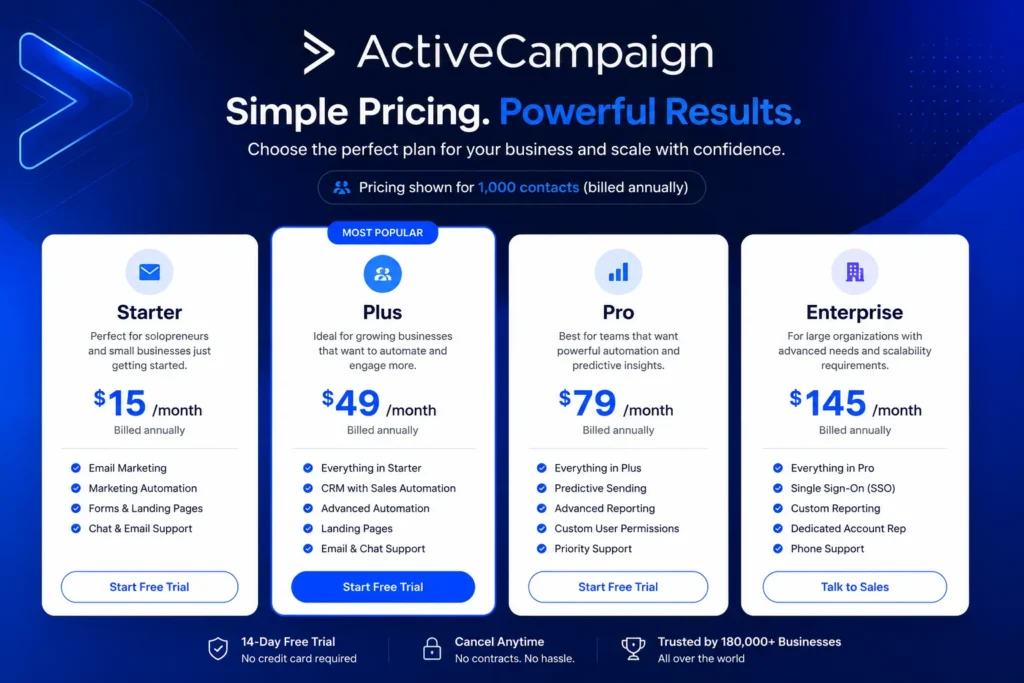
| Plan | Starting Price (Annual Billing) | Best For | Key Limitations |
| Starter | $15/month | Solo creators, freelancers, and businesses needing basic email marketing and automation | No CRM, no landing pages, no SMS marketing |
| Plus | $49/month | Small businesses looking for CRM integration and advanced automation | Limited advanced AI tools and reporting capabilities |
| Pro | $79/month | Growing teams, agencies, and scaling businesses | Some predictive AI features and advanced capabilities are capped |
| Enterprise | $145/month | Large organizations requiring SSO, custom reporting, and enterprise-grade support | Higher pricing with contact-based scaling costs |
A few things you should know before you pick a plan:
- The price scales with your contact list. A Starter plan with 10,000 contacts costs significantly more than the entry-level price; budget for that growth.
- Add-ons aren’t included. SMS credits, additional user seats, and advanced reporting can be charged separately.
- Annual billing saves around 20% compared to paying monthly.
- Most advanced AI features (e.g., predictive sending and win probability scoring) are reserved for Pro and Enterprise, while generative tools such as the AI campaign builder are available in all plans.
If your list is small and your needs are basic, Starter is enough to get going. Most small businesses end up on Plus when they need CRM functionality, landing pages, or real lead scoring.
How ActiveCampaign Actually Works
Here is a simplified version of what a real ActiveCampaign workflow looks like in practice, using an online course creator as an example:
- A visitor downloads a free guide from a landing page and gets tagged as “Lead Magnet: Guide.”
- That tag triggers a five-email nurture sequence introducing the creator’s paid course.
- ActiveCampaign tracks every open and click and quietly elevates or reduces that contact’s lead score.
- If the contact clicks the course link twice without buying, an automation branches off to send a personal-sounding follow-up or notifies the sales team to contact the customer directly.
- Once they buy, they are automatically removed from the nurture sequence and moved to an onboarding flow.
None of that requires the creator to lift a finger after the initial setup. That’s the whole pitch behind ActiveCampaign: build the logic once and let behavior drive what happens next.
ActiveCampaign vs Competitors
This is usually the part that people care about most: how does ActiveCampaign actually compare to the other names on your shortlist?
| Platform | Strongest At | Weakest At | Free Plan? |
| ActiveCampaign | Advanced automation, behavioral triggers, built-in CRM, customer journey mapping | Steeper learning curve for beginners | No (14-day free trial) |
| Mailchimp | Simplicity, ease of use, beginner-friendly email marketing | Automation capabilities are more basic compared to competitors | Yes |
| HubSpot | All-in-one CRM, sales, marketing, and customer service platform | Pricing increases significantly as usage and features grow | Yes (limited features) |
| Klaviyo | Ecommerce-focused personalization, segmentation, and SMS marketing | Less suitable for non-ecommerce and B2B businesses | No (free trial only) |
| Constant Contact | User-friendly interface, strong customer support, and phone assistance | Limited automation and advanced marketing workflows | No (free trial only) |
The honest thing is if you want the simplest possible starting point, Mailchimp’s free plan is hard to beat. HubSpot is the better option if you want the combination of CRM and marketing suite and don’t mind paying for it, but Klaviyo‘s e-commerce-first design works best when you’re running an online store. But if automation and behavioral targeting are key, and if you’re willing to learn the platform on your own, This is often the best option at that price point.
ActiveCampaign Pros and Cons
Pros:
- More powerful automation builder, even on lower-tier plans.
- Built-in CRM removes the need for a separate sales tool.
- Strong segmentation and behavioral tracking.
- A growing AI toolkit that keeps adding practical, not gimmicky, features.
- Hundreds of pre-built automation templates to start with.
Cons:
- No free plan, only a trial.
- Pricing rises a lot as your contact list grows.
- The sheer number of features can feel overwhelming for total beginners.
- Some advanced AI and reporting tools are locked to higher tiers.
- Landing pages and SMS aren’t included on the entry-level Starter plan.
What’s New: ActiveCampaign Updates in 2026
ActiveCampaign has been investing heavily in its Active Intelligence platform this year, and the pace of updates has been noticeably faster than in previous cycles. A few developments worth knowing about:
- AI Performance Intelligence is now constantly reviewing campaign and automation data for what is working and what is quietly underperforming, and now you don’t have to go to the report yourself.
- Even more automation triggers are now connected to scheduling tools, payment processors, document signing, and call tracking software so workflows can start from much more real-world events.
- Autonomous Insights offers an organized, personalized feed of recommendations on your account homepage every week, and they can now be tailored to what you’re actually doing and what you really care about.
- Connecting to AI assistants as well so that account data can be read and acted on from outside the platform itself.
- As an AI prompting, file-aware AI can now help Active Intelligence to be in context when an uploaded file is being read, whether that’s brand guidelines or campaign briefs.
The general trend is clear: This is positioning itself less as an email tool with some automation bolted on and more as an AI-assisted marketing operations platform. For existing users, most of these updates are rolling out gradually across plan tiers rather than all at once.
Is ActiveCampaign Worth It?
It depends entirely on what you are trying to do.
If your marketing strategy is “send a nice-looking email every couple of weeks,” ActiveCampaign’s depth will likely seem overkill, and a simpler tool will save you both money and setup time.
But if you are looking to build a system, a system in which a new lead is nurtured, scored, and delivered to sales automatically, or where a customer’s purchase history quietly shapes every future email they receive, This is one of the few platforms at this price point built specifically for that job. The learning curve is real, but so is the payoff once your automations are running.
Conclusion
ActiveCampaign got its reputation the hard way: by being truly good at the one thing that is hardest to fake, automation that actually responds to what your audience does. It’s not the cheapest tool on the market, and it’s not the simplest either. But for businesses that want to move beyond just email blasts and into marketing that runs itself in the background, it is one of the most capable platforms in 2026.
If you’re still considering your options, the trial is the smartest move. Fourteen days is enough to build one actual automation and to see if the platform’s depth feels like power, or just noise.
Frequently Asked Questions (FAQs)
Q. Is ActiveCampaign good for beginners?
A. It’s beginner-friendly in user interface design, but there is a big learning curve in the process as the number of features is huge. And most new users start with the pre-built automation recipes rather than building workflows from scratch, so it’s a lot shorter learning curve.
Q. Does ActiveCampaign have a free plan?
A. No. ActiveCampaign doesn’t have a permanently free tier, but it does have a 14-day free trial to get some hands-on experience with the platform before paying.
Q. How much does ActiveCampaign cost per month?
A. Pricing starts at $15/month for the Starter plan (billed annually, 1,000 contacts) and scales up through Plus, Pro, and Enterprise tiers, and costs increase with the contact list size and the features you need.
Q. What’s the difference between ActiveCampaign and Mailchimp?
A. Mailchimp is generally easier for beginners and has a free version, but ActiveCampaign has much more automation, behavioral tracking, and a built-in CRM, features that matter more once your marketing needs go beyond basic newsletters.
Q. Can ActiveCampaign replace a CRM?
A. For small to mid-sized teams, yes – ActiveCampaign’s built-in Sales CRM handles deal pipelines, contact records, and task management well enough that many businesses skip a separate CRM tool entirely. Larger sales organizations with complex pipelines may still prefer a dedicated platform like Salesforce.