
Think about this: It’s a Tuesday afternoon, and somewhere in your company, a sales rep is quietly updating a spreadsheet that hasn’t been properly synced in five days. Three leads from last week’s campaign are sitting unopened in someone’s inbox. A follow-up that was supposed to go out Monday? Nobody sent it.
If it sounds uncomfortably familiar, you know you need a CRM. The harder question, the one that has you reading this right now, is which one.
Zoho CRM is in every comparison, every Reddit post, every “best CRM for small business” roundup. And there is a reason for that. With over 300,000 businesses using it worldwide and a free tier that works, Zoho CRM has quietly become one of the most competitive platforms in the market.
But it’s 2026. The CRM landscape has evolved. HubSpot has gotten more aggressive. Salesforce keeps lowering entry prices. AI is a part of almost every tool now. So the question isn’t simply whether Zoho CRM was good or not, it’s whether it’s still good and if it’s the right fit for your business.

This review cuts through the noise. We have pricing, features, the latest 2026 updates, real user feedback, and honest comparisons— everything you need to make a confident decision.
What Is Zoho CRM? A Quick Overview
Zoho CRM is a cloud-based customer relationship management platform designed to help companies manage their entire sales cycle—from the first point of contact through the close of a deal and post-sale support. Zoho Corporation, an Indian technology company that has built deep and affordable software, competes with Silicon Valley giants.
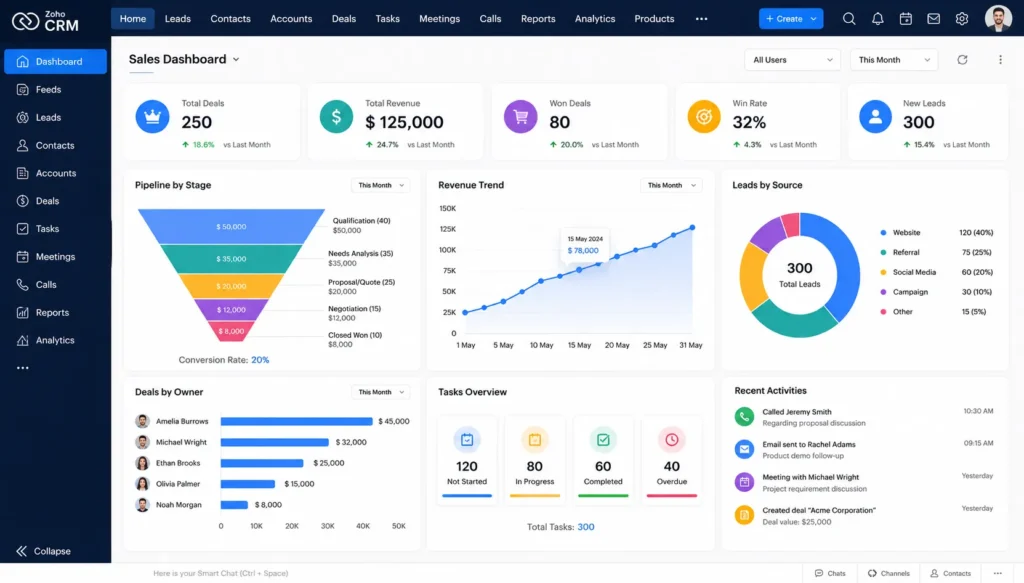
Zoho CRM is designed to:
- Track leads, contacts, and deals in one place
- Automate repetitive sales tasks and follow-ups
- Give managers and reps real-time visibility into pipeline health
- Connect with external tools (Gmail, Slack, Shopify, Meta Ads, and thousands more)
- Scale with a business from a solo founder to an enterprise team.
What separates Zoho CRM from most competitors is that it doesn’t exist in isolation. It sits at the center of Zoho’s ecosystem of 45+ integrated apps, marketing, finance, HR, customer support, etc. This level of integration depth is something no other comparable platform can match.
Zoho CRM Price 2026: Every Plan Explained
All prices are per user, per month, billed annually. Monthly billing adds approximately 30%.
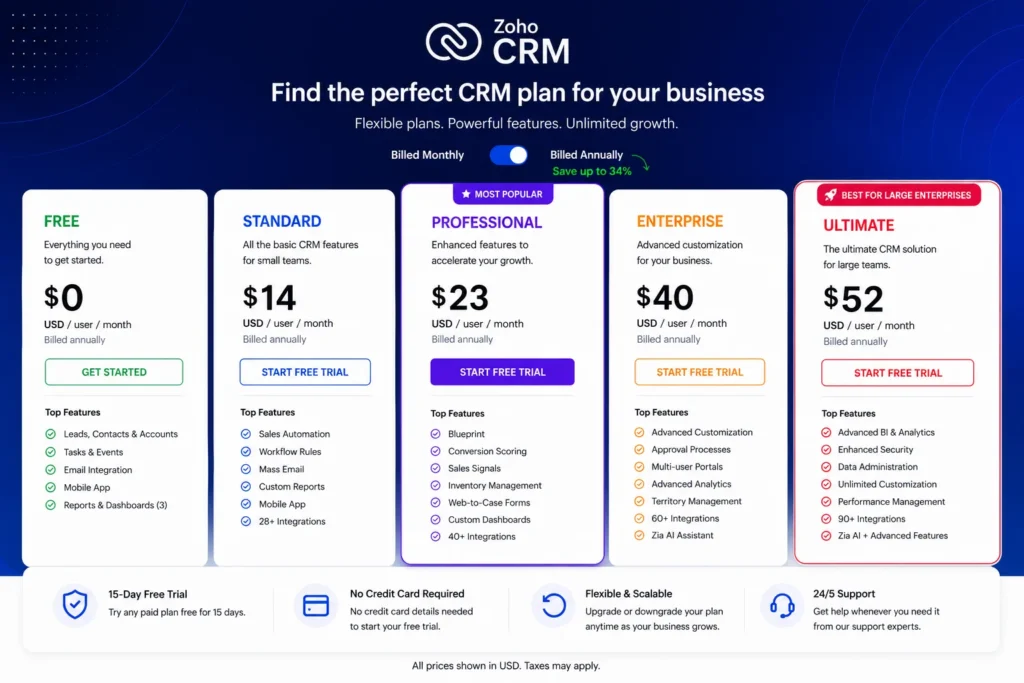
| Plan | Price |
| Free | $0 (up to 3 users) |
| Standard | $14/user/mo |
| Professional | $23/user/mo |
| Enterprise | $40/user/mo |
| Ultimate | $52/user/mo |
| Team (CRM For Everyone) | $9/user/mo |
Zoho CRM in 2026: What’s New?
Zoho CRM in 2026: What is New? We have seen significant updates to the platform, and they are worth being aware of before signing up.
CRM For Everyone: The Big 2025/2026 Shift
One of the most important changes to hit Zoho CRM recently is the “CRM For Everyone” initiative. Zoho CRM was primarily a sales tool until it was updated. Now, the platform is available to every department – marketing, customer success, operations, HR – through the launch of “Team” user licenses at $9/user/month. Now a marketing lead activity can automatically trigger a sales task. A support ticket resolution can update a deal record. This cross-department orchestration was once a costly middleware to do. Now it’s native.
Upgraded Zia AI
Zia, Zoho’s AI assistant, has been made much more sophisticated. Most significantly, Zia’s churn scoring model now can also ingest external usage data from API, URL, or file import. That means churn risk scores for SaaS businesses or subscription services that take into account actual product usage patterns, not just CRM activity. That’s a huge leap from what most AI-enhanced CRMs offer at this price point.
There’s also a rather useful new feature: Users can upload an image or sketch of their CRM layout and Zia will recreate it as a Canvas view. No need to learn the Canvas editor from scratch.
NVIDIA Partnership
Zoho has teamed up with NVIDIA to create business-specific AI models. Early results are still being rolled out, but this indicates that AI development at Zoho is accelerating, not slowing down.
Mobile App Improvements
Android users can now close a Zoho account directly from the app. iOS users benefit from better email domain authentication validation. Small improvements, but the kind that reduces daily friction for remote and mobile-first teams.
Portal Signup Forms
Signup forms for CRM portals have been added for the onboarding process of external stakeholders – helpful for agencies and businesses managing client portals.
Zoho CRM Features
Sales Automation & Pipeline Management
At the heart of Zoho CRM is a sales pipeline that is truly customizable and does not require a developer. You can build multiple pipelines for different products, regions, or customer segments.
The Blueprint feature is where Zoho gets serious about the enforcement process. With Blueprint, you can specify which actions must take place before a deal is even close to getting to the next stage. Reps can’t skip qualification steps. Managers can’t just accept deals that have not been properly studied. This level of guardrailing is typically only in enterprise systems.
Automated task creation and follow-up emails, field updates, and notifications based on trigger-based processes are done by Workflow automation. Scheduled automations can also act on records based on date conditions— for example, flagging a lead if no activity has occurred in seven days.
Zia AI
Zia will be available from the Enterprise plan up and get its place. Key capabilities include:
- Lead and deal scoring: Zia analyzes past win/loss data to determine current leads and deals and helps reps focus where it matters most.
- Sales predictions: AI-driven predictions based on pipeline data and historical trends.
- Anomaly detection: Zia sees unusual behavior in sales activity: an unexpectedly low volume of calls, a deal that’s already been in place for too long.
- Conversation intelligence: Zia can listen to call recordings and send emails to draw on that information.
- Churn prediction: The new model for 2026 takes external data and improves on it.
The honest caveat: Zia is powerful, but it takes time to train on your data. Teams who have been using Zoho CRM for six months or more will see dramatically better results than new users.
Canvas Design Studio
This is one of Zoho CRM’s most underrated features. Canvas is a no-code interface builder that makes CRM records look truly different across teams, roles, or use cases. A sales rep’s contact view is very different from a customer success manager’s. You can add branding, reorder fields, add conditional logic, and remove clutter.
A 2026 update will allow Zia to generate Canvas views from uploaded images or sketches, so if you’ve mocked up your ideal layout in a napkin sketch or Figma, you can literally hand it to the AI.
Multichannel Communication
Zoho CRM centralizes communication across:
- Email: native integration with Gmail, Outlook, and Zoho Mail.
- Phone: built-in telephony with call logging and recording.
- Social media: Facebook, Instagram, Twitter/X monitoring and response.
- Live chat and web forms: Visitor tracking and chat-to-lead conversion.
- WhatsApp: Business messaging integration.
Every interaction is immediately logged into the relevant contact or deal record, and the entire team is given context before any call takes place.
Analytics & Reporting
Zoho CRM has a great reporting suite with pre-built dashboards and customizable reports. The Ultimate plan has advanced analytics enabled by Zoho Analytics, which is essentially an integrated BI tool within the CRM.
The standard reporting is pipeline health, lead conversion rates, activity metrics, and revenue forecasting. More advanced cohort analysis, trend lines, and attribution modeling need to be done at higher levels.
Zoho One: When You Need More Than a CRM
If your business is outgrowing point solutions and juggling multiple SaaS subscriptions, Zoho One is worth the investment. Zoho’s all-in-one business operating system offers 45+ apps (CRM, marketing, HR, finance, support, projects, analytics) under a single license.
Pricing is around $37/user/month (paid annually for all employees). For a company already paying separately for a CRM, an email marketing tool, a project management platform, and accounting software, the math is in Zoho One’s favor.
The tradeoff is complexity. Zoho One is not something you flip on in the afternoon. But for businesses looking to consolidate their tech stack, it’s an unusual value.
Zoho CRM vs. Competitors
Zoho CRM vs. HubSpot
HubSpot has great marketing tools and a very polished onboarding experience. But the price escalation is steep. HubSpot Professional costs around $100 per month, which is nearly three times the cost of Zoho Enterprise at $40/user/month with similar features. Teams on HubSpot Professional can often access everything they need in Zoho Enterprise and save 60% in the process.
HubSpot wins on UI polish and ease of use for non-technical teams. Zoho wins on depth, customization, and value.
Zoho CRM vs. Salesforce
Salesforce is the overall leader for enterprise deployment. But for small businesses, it’s like buying a freight truck when you need a pickup. Salesforce Professional is $80/user/month compared to Zoho Professional at $23 for roughly comparable core functionality.
The Salesforce ecosystem is broader, AppExchange is huge, and its enterprise integrations are unparalleled. But small businesses don’t really need any of that, and the admin overhead is huge.
Zoho CRM vs. Pipedrive
Zoho CRM vs. Pipedrive. Pipedrive is a clean, focused sales CRM that is easy to learn. Pipedrive is a great choice for small teams who only need pipeline management and nothing else. It doesn’t have the depth of Zoho CRM, no marketing tools, no AI at lower levels, and no broad ecosystem.
Pipedrive Professional is around $49/user/month and has fewer capabilities than Zoho Enterprise at $40. If you need sales and marketing functionality within one place, Zoho is by far the better value.
Who Should Use Zoho CRM? (And Who Shouldn’t)
Zoho CRM is a strong fit if you:
- Run a small to mid-sized business (5-200 users)
- Want enterprise-level features without enterprise pricing
- Want full customization without hiring a developer
- Have, or can allocate, a part-time admin to customize and maintain the system. Have or are planning to use other Zoho products.
- Are cost-conscious but don’t want to sacrifice functionality.
It’s probably not the right fit if you:
- Need a CRM your team can live on in 2 hours with zero training
- Have a purely non-technical team with no appetite for learning
- Need very deep Salesforce AppExchange integrations
- Are running an enterprise at 500+ users with complex compliance requirements.
The simple truth is that Zoho CRM rewards investment. A good setup (Blueprint pipelines, Zia scoring and clean Canvas layouts) is a real sales tool. A default out-of-the-box setup with no customization is mediocre. The value of your platform is proportional to the work you put into it.
Real User Reviews: What People Actually Say
Across G2 and Capterra, Zoho CRM has an average rating of 4.0-4.3 with thousands of reviews. The feedback in general is consistent:
What users love:
G2 reviewers repeatedly highlight cost savings after switching from Salesforce to the startup model, with agencies running for $40–45 per user monthly. The level of customization and the diversity of the ecosystem are repeatedly praised. The free plan is particularly appreciated by early-stage teams.
What users struggle with:
The learning curve is the most common complaint— and this is valid. New users often say they feel overwhelmed in the beginning. The customer support response time is mixed, with some users saying technical issues are slow to be resolved. Some reviewers dislike that advanced features like Zia and Blueprint automation are locked behind higher tiers. And the cost of adding modules has also been an issue.
Starting at $14 per user is reasonable— but if your team also needs Zoho Campaigns, Zoho Desk, and Zoho Analytics, the costs can be high before you have considered Zoho One as the more economical package.
Pros and Cons
Pros
- Exceptional value across all pricing tiers vs. competitors
- Great free plan (up to 3 users, genuinely functional)
- Deep customization with Canvas Design Studio
- Blueprint process enforcement— rare at this price
- Zia AI is real sales intelligence in the Enterprise tier
- 45+ native Zoho app integrations
- Strong multichannel communication (email, phone, social, WhatsApp)
- CRM For Everyone update brings cross-departmental utility
- Active development cadence with meaningful 2026 updates
Cons
- Steeper learning curve than HubSpot or Pipedrive
- The default interface is less polished than competitors
- Zia AI needs time to train on your data before providing insights
- Customer support quality varies
- More advanced features are locked behind higher tiers
- Monthly billing adds ~30% cost premium.
Conclusion: Is Zoho CRM Still Worth It in 2026?
Yes, and it’s not a close call for most small businesses. Zoho CRM in 2026 has more than ever: a stronger AI layer with Zia, cross-departmental utility via CRM For Everyone, and pricing which still undercuts HubSpot and Salesforce by a wide margin. The learning curve is real, and your default setup won’t impress anyone. But make the setup work and you get enterprise-grade CRM at a fraction of enterprise price.
Upgrade when you’re ready. If you are a growing business that values depth over hand-holding, Zoho CRM is still the best value in the market.
Frequently Asked Questions (FAQs)
1. What is Zoho CRM and who is it best for?
Ans. Zoho CRM is a cloud-based CRM for sales and customer relationship management. This is the best for small and mid-sized businesses looking for the best automation, choice and AI at a low price.
2. How much does Zoho CRM cost in 2026?
Ans. Plans range from Free (up to 3 users) to $52/user/month (Ultimate). Most small businesses choose Professional at $23/user/month, while AI features start with Enterprise at $40/user/month.
3. Is Zoho CRM better than HubSpot or Salesforce?
Ans. Zoho CRM provides the best value for most SMBs, with similar core features at a lower cost. HubSpot is easier to use, while Salesforce is better for large enterprises.
4. Does Zoho CRM have AI features?
Ans. Yes. Its AI assistant Zia does lead scoring, sales forecasting, churn analysis, and conversation insights. Enterprise and advanced plans have AI features.
5. What is Zoho One, and how does it differ from Zoho CRM?
Ans. Zoho CRM focuses on sales and customer management. Zoho One has 45+ business apps (CRM, finance, HR, marketing, etc.) under a single subscription