
 Shikha Kumari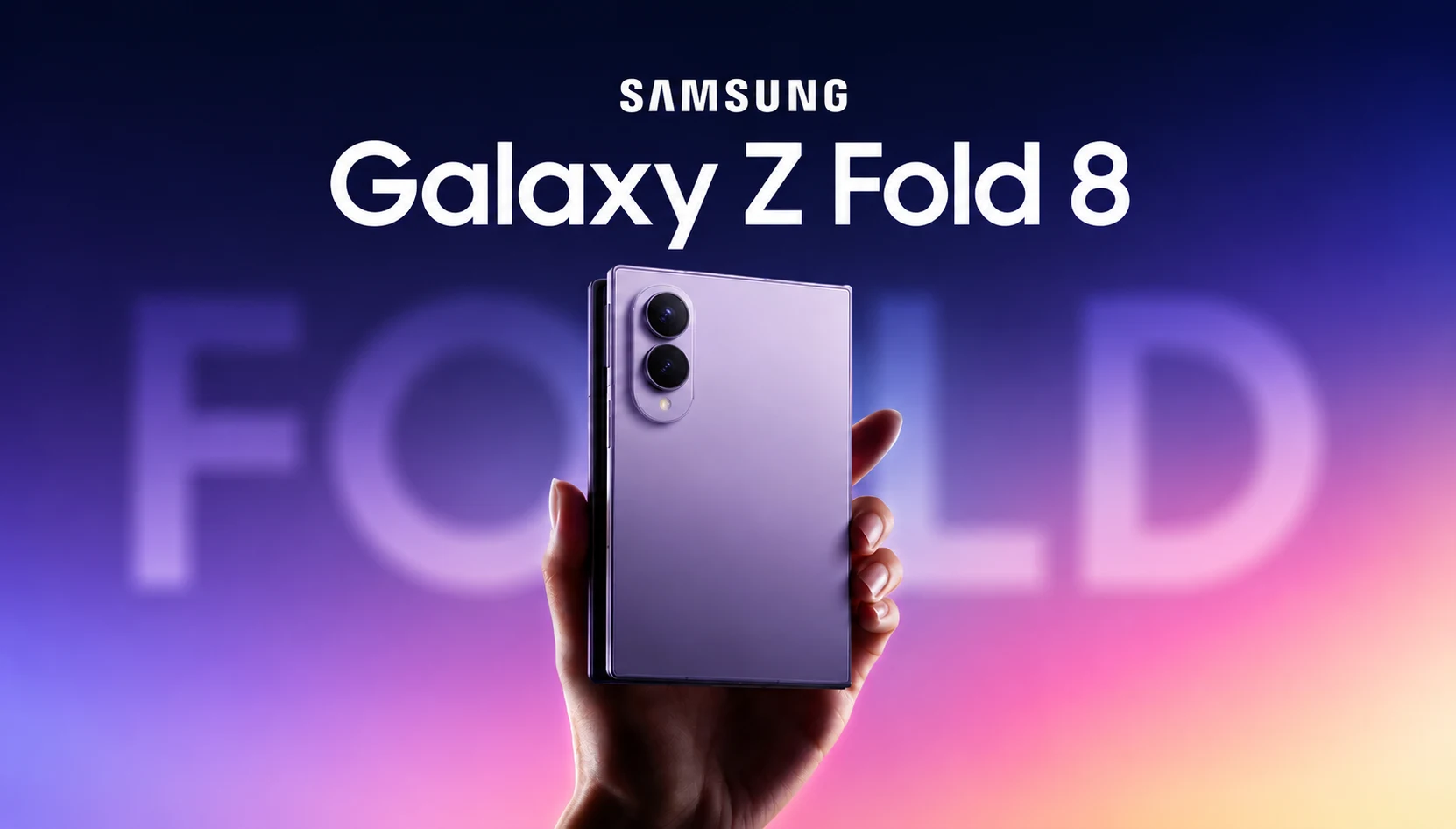
If you thought you knew what a “Galaxy Z Fold” was, Samsung just complicated things. The Samsung Galaxy Z Fold 8 that launched at Unpacked in London on July 22, 2026, isn’t the phone most Fold fans wanted to buy. It is shorter, wider, and shaped a little like a passport, sitting next to a second phone, the Z Fold8 Ultra (which is the real heir to last year’s Fold7). So before anyone asks whether the Samsung Galaxy Z Fold 8 is worth buying, there is a more fundamental question to answer: which Galaxy Z Fold 8 are we even talking about?
That is the whole point of this article. This generation is the biggest identity shift the Fold line has ever had since the second model, and the changes go well beyond a spec bump. Let’s untangle it.
The naming twist nobody warned you about
Here is the part that trips people up. For seven years, “Z Fold” meant one thing: a tall, narrow candy-bar-ish slab that opened into a small squarish tablet. The number on the end just told you the year.
Samsung broke that rule in 2026. The lineup now splits in two. The Samsung phone called the plain Samsung Galaxy Z Fold 8 is a new wide foldable that is closer to a small tablet than any Fold before it. The tall book-like design that Fold-hardy fans know is still there, but it now bears an “Ultra” badge: the Samsung Galaxy Z Fold 8 Ultra. That Ultra is the successor of the Galaxy Z Fold 7. The regular Fold 8 is a new species.
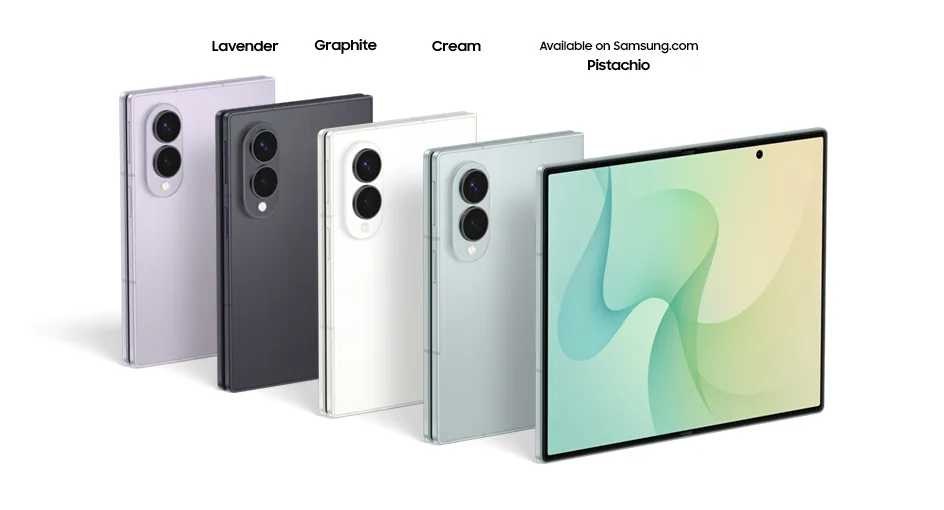
We were even in agreement that the naming scheme is a headache, even for the reviewers at the launch. If you buy on autopilot and select the cheapest Fold8, you will not get a slightly refined Fold7. You will get a very different phone with a different screen ratio and a worse main camera. Worth knowing before you click “buy.”
For the rest of this piece I will keep it simple. “Galaxy Z Fold 8” is the new wide model unless I say “Ultra.”
What the Samsung Galaxy Z Fold 8 actually is
Imagine the Fold 7 standing up tall and narrow; then turn that idea on its head and turn it around. The Samsung Galaxy Z Fold 8 is squatter and broader. Folded, it seems less like a TV remote and more like a chunky passport and that was exactly what stuck to it after launch.
The point of the redesign is the open state. A wider body means a wider inner screen, and a wider inner screen means what the phone is good at. More videos occupy the screen. Games have room to breathe. Split-screen multitasking stops feeling like you are peering through a mail slot. Samsung is clearly targeting this shape at the rumored foldable iPhone, and the 4:3 inner display it landed on is the same ratio Apple uses on the iPad. That is not a coincidence.
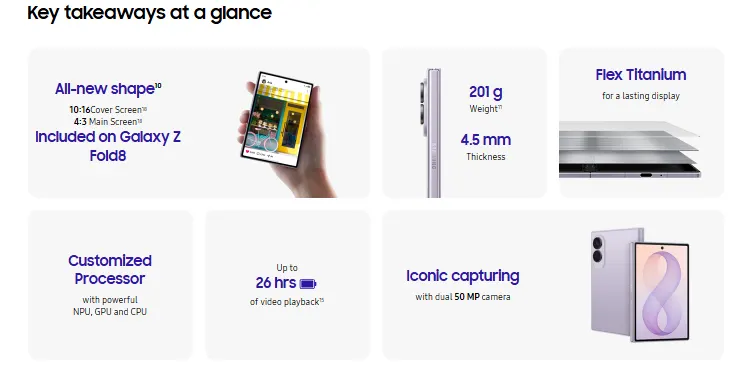
If you have used any recent Fold, the Samsung Galaxy Z Fold 8 will feel familiar in the hand and foreign on the screen. The Samsung foldable phone formula is intact. The canvas is the thing that moved.
Display: a passport, not a paperback
This is where the Samsung Galaxy Z Fold 8 display makes its case.
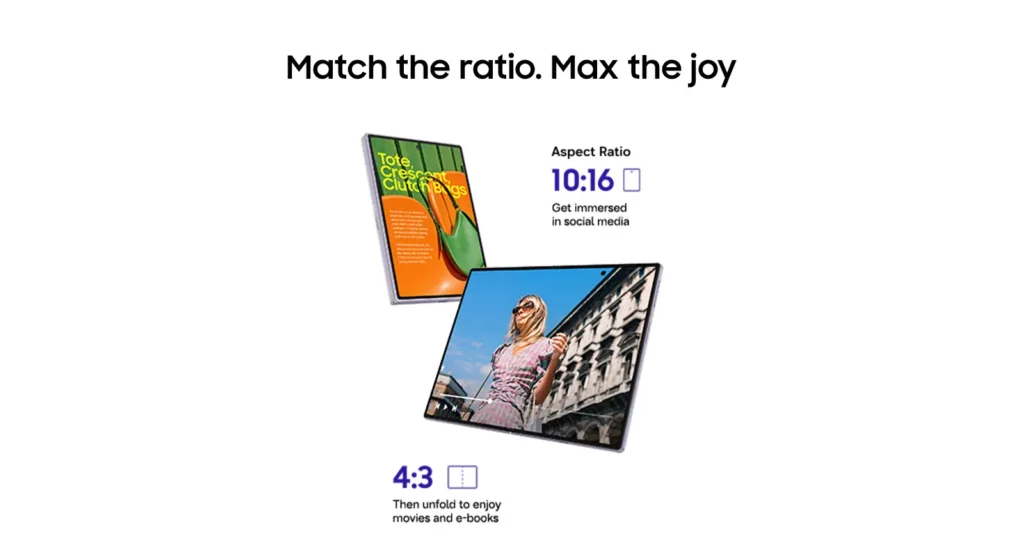
Turn it open and you get a 7.6-inch main panel with a 4:3 aspect ratio. That squarer shape is actually better for reading. Documents, web pages, and ebooks all have more usable width without the letterboxing that plagued older, narrower Folds. Photos taken on the phone are also 4:3, so what you capture fills the screen edge to edge. If your day is email, PDFs, and long articles, this layout was made for you.
The cover screen tells the other half of the story. At 5.5 inches in a 16:10 ratio, the outer screen is short and wide, close to the 16:9 shape of most online video. That makes the closed phone a surprisingly good little media and gaming device before you ever unfold it. The Ultra, by contrast, has a tall 21:9 cover screen that is more like a normal phone front.
Both 2026 Fold models share the panel technology: Dynamic AMOLED 2X, up to 120Hz adaptive refresh, and a peak brightness that Samsung is predicting to be roughly 15 percent higher than the Fold7 (around 3,000 nits). In other words, these are the brightest and smoothest screens Samsung has ever shipped on a foldable, and outdoor visibility is no longer an issue.
Camera: the honest downgrade
Time for the part of the marketing pages to soft-pedal.
The Samsung Galaxy Z Fold 8 camera is a step back from the Fold 7 on paper, and pretending otherwise would be a disservice. Fold7 carried a 200MP main sensor. The new wide Samsung Galaxy Z Fold 8 has a dual setup instead: a 50MP main and a 50MP ultra-wide, plus a 10MP selfie camera. There is no dedicated telephoto and a main sensor with a quarter of the headline resolution.
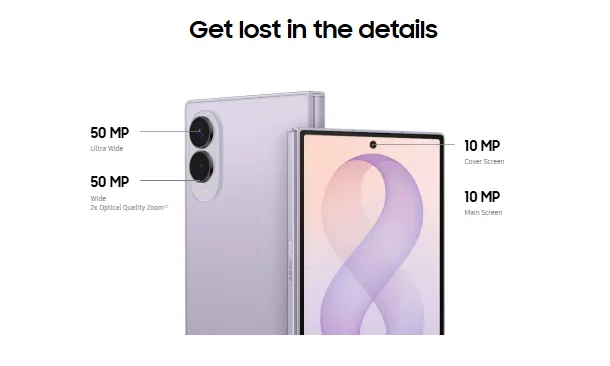
Why? Because the plain Fold 8 is no longer the flagship of the family at the moment. That job was taken by the Ultra, which has the 200MP main but adds a 50MP ultra-wide with a wider aperture for cleaner low-light shots and a proper zoom lens. Samsung positioned the wide Fold8 as the lifestyle, everyday-sharing model and priced the camera hardware to match.
Is 50MP bad? Not at all. Samsung’s image processing is good to have, and for social posts, daylight snaps, and video calls, the results hold up fine. But if photography is the reason you’re buying a thousand dollars plus phone, the cheaper Fold8 is the wrong Fold8 for you. This is the single biggest thing where reading the model name carefully prevents disappointment.
Battery life and charging: the silicon-carbon jump
Here is the upgrade that actually improves daily life, and it applies across the whole 2026 lineup.
Samsung finally went to silicon-carbon batteries. That chemistry provides more capacity into the same physical space; that’s what has held foldables back for so long. So the Samsung Galaxy Z Fold 8 has a 4,800mAh cell, up from the 4,400mAh cell that the Fold 7 was stuck with. The Ultra goes up to 5,000mAh. Neither will scare the big Chinese foldables, but they’re real, useful gains, and the Samsung Galaxy Z Fold 8 battery life comfortably covers a full day of normal use.
Charging got the bigger glow-up. Fold7 achieved a frankly modest 25W wired power. The Samsung Galaxy Z Fold 8 supports 45W wired, enough to refill 63 percent in half an hour. The Ultra does the same wattage a touch faster, on average 67 percent in 30 minutes, and includes faster 20W wireless charging with reverse wireless to fill earbuds or a watch. That alone will sell the phone for anyone who has had an older Fold and lamented its slow charging.
Performance and software
There is no drama here, which is the point.
The Samsung Galaxy Z Fold 8’s performance comes from the Snapdragon 8 Elite Gen 5 for Galaxy, which is the same tuned flagship chip inside the Galaxy S26 Ultra. It is equipped with 12GB of RAM as standard and storage that scales up to 1TB, so it eats up everything: heavy multitasking, demanding games, on-device AI, all of it. Foldables live or die on smooth multitasking, and this chip has the headroom to keep three apps and a video running without stutter.
On one hand, the Samsung Galaxy Z Fold 8 features are available in Android 17 and One UI 9 out of the box and are one of the first phones that will run Android 17. The Galaxy AI toolkit is built into it: smarter multitasking, an improved Now Brief, natural language Bixby and AI writing and image tools that are more appropriate on a big folding canvas than a conventional phone. Samsung is going to give its long-term support period around 7 years in terms of updates so the Samsung Galaxy Z Fold 8 software will stay up to date well into the 2030s.
Galaxy Z Fold 8 vs Z Fold 7 vs Z Fold 6: the specs at a glance
Sometimes a table does it better. How does the new wide Samsung Galaxy Z Fold 8 stack up against the two Folds that most buyers are upgrading from?
| Spec | Galaxy Z Fold 8 (Wide) | Galaxy Z Fold7 (2025) | Galaxy Z Fold6 (2024) |
| Main Display | 7.6-inch, 4:3 aspect ratio | 8.0-inch, tall aspect ratio | 7.6-inch, tall aspect ratio |
| Cover Display | 5.5-inch, 16:10 aspect ratio | 6.5-inch, 21:9 aspect ratio | 6.3-inch display |
| Main Camera | 50MP | 200MP | 50MP |
| Ultra-Wide Camera | 50MP | 12MP | 12MP |
| Battery | 4,800mAh (silicon-carbon battery) | 4,400mAh | 4,400mAh |
| Wired Charging | 45W | 25W | 25W |
| Chipset | Snapdragon 8 Elite Gen 5 | Snapdragon 8 Elite | Snapdragon 8 Gen 3 |
| Software | Android 17 with One UI 9 | Android 16 with One UI 8 | Android 15 with One UI 7 |
| Starting Price | ~$1,899 | ~$1,999 (at launch) | ~$1,899 (at launch) |
The pattern is clear. The Samsung Galaxy Z Fold 8 wins on charging, battery chemistry, ultra-wide camera, and screen shape for reading. The Fold 7 still wins on raw main camera resolution. And the Fold 6 now looks a generation behind on nearly everything.
Galaxy Z Fold 8 vs Honor Magic V6 and Pixel Fold
Samsung no longer owns the book-style foldable category, so the Samsung Galaxy Z Fold 8 vs Honor Magic V6 question is a fair one. Honor’s foldables have pushed hard on thinness and battery size, and the Magic V6 in particular tends to out-muscle Samsung on raw endurance. Where Samsung answers is software polish, longer update commitments, and the wider ecosystem of Galaxy accessories and DeX desktop mode.
Against Google, the Samsung Galaxy Z Fold 8 vs Google Pixel Fold comparison comes down to temperament. Pixel’s Fold leans on Google’s computational photography and clean software. Samsung counters with a broader multitasking suite, more form-factor choices inside a single lineup, and that new, wider screen ratio. If you live in Google’s apps, the Pixel is tempting. If you want the most flexible big-screen workhorse, the Galaxy foldable phone still has the deepest bag of tricks.
Calling any single one the best foldable phone of 2026 depends on what you weigh most: cameras, battery, software, or price. There is no universal winner this year, and anyone who tells you otherwise is selling something.
Price, release date, and who should actually buy it
The release date for the Samsung Galaxy Z Fold 8 was August 7, 2026, after the July 22 announcement, and pre-orders opened on the day of Unpacked. The Samsung Galaxy Z Fold 8 price is $1,899 for 256GB and increases with storage, while the Ultra is $1,999 and the wide one is $1,999. Discounts at launch to trade in at launch are as much as $1,200, so the real damage depends heavily on what you hand in.
Is the Samsung Galaxy Z Fold 8 worth buying? A few honest reads:
- The wide Samsung Galaxy Z Fold 8 is the best phone I can buy if I want a tablet-like reading and media machine; I love the new squarer screen and do not care that the camera is a step down from the Fold 7. It is the more interesting, more novel phone of the two.
- You can go for the Fold8 Ultra instead if you want the best camera, the biggest battery, and the classic tall fold shape. This is the phone Fold7 owners were waiting for.
- Keep your Fold7 if you’ve got one, and mainly take photos. You’d have to trade a 200MP sensor for a 50MP sensor to get a wider phone but not necessarily better for you.
- Skip the Fold6 upgrade math and go all in for 2026. They charge well and have battery life, so why would you do so?
Verdict
The Samsung Galaxy Z Fold 8 is the most divisive phone Samsung’s foldable line has produced, and I mean that as a compliment. By splitting the family into a wide everyday model and a tall Ultra flagship, Samsung stopped pretending one shape fits everyone. The wide Samsung Galaxy Z Fold 8 is a genuine rethink: a better screen for reading, a much better battery and charging story, and a lower barrier to entry, paid for with a plainer camera.
The catch is the one we opened with. This is the first Fold generation where the name on the box does not tell you what you are getting. Read the model line, decide if you want the camera or the canvas, and you will land on the right phone. Ignore it, and you may unwrap a surprise. For a lineup that spent seven years playing it safe, a little confusion in exchange for real choice seems like a fair trade.
Frequently Asked Questions (FAQs)
Q. Is the Samsung Galaxy Z Fold 8 the same as the Samsung Galaxy Z Fold 8 Ultra?
A. No. The plain Samsung Galaxy Z Fold 8 is a new, wide, passport-shaped foldable with a 4:3 inner screen and a dual 50 MP camera. The Z Fold8 Ultra is the tall, book-style phone and the true successor to the Fold7 with a 200MP main camera and a bigger battery. Two very different phones, same name, two very different phones.
Q. What is the biggest difference between the Samsung Galaxy Z Fold 8 and the Fold 7?
A. Two things. The shape changed (the wide Fold8 is shorter and broader than the tall Fold7), and the battery moved to silicon-carbon chemistry with much faster 45W charging. The difference is the camera; the wide model drops from the Fold7’s 200MP main sensor to 50MP.
Q. When did the Samsung Galaxy Z Fold 8 come out, and how much does it cost?
A. Samsung announced it at Unpacked in London on July 22, 2026, and it went on sale August 7, 2026. The wide Samsung Galaxy Z Fold 8 starts around $1,899 for 256GB, and the Ultra starts around $1,999, before trade-in discounts.
Q. Does the Samsung Galaxy Z Fold 8 have good battery life?
A. Yes, better than any Fold before it. The 4,800mAh silicon-carbon battery covers a full day of normal use, and 45W wired charging refills about 63 percent in half an hour, a big jump over the Fold7’s slow 25W.
Q. Should I buy the Samsung Galaxy Z Fold 8 or wait?
A. If you want the new form factor and the charging upgrade, there is little reason to wait because it is already on sale. If cameras matter most, look at the Samsung Galaxy Z Fold 8 Ultra rather than the wide model or hold onto a Fold7 you already own.