

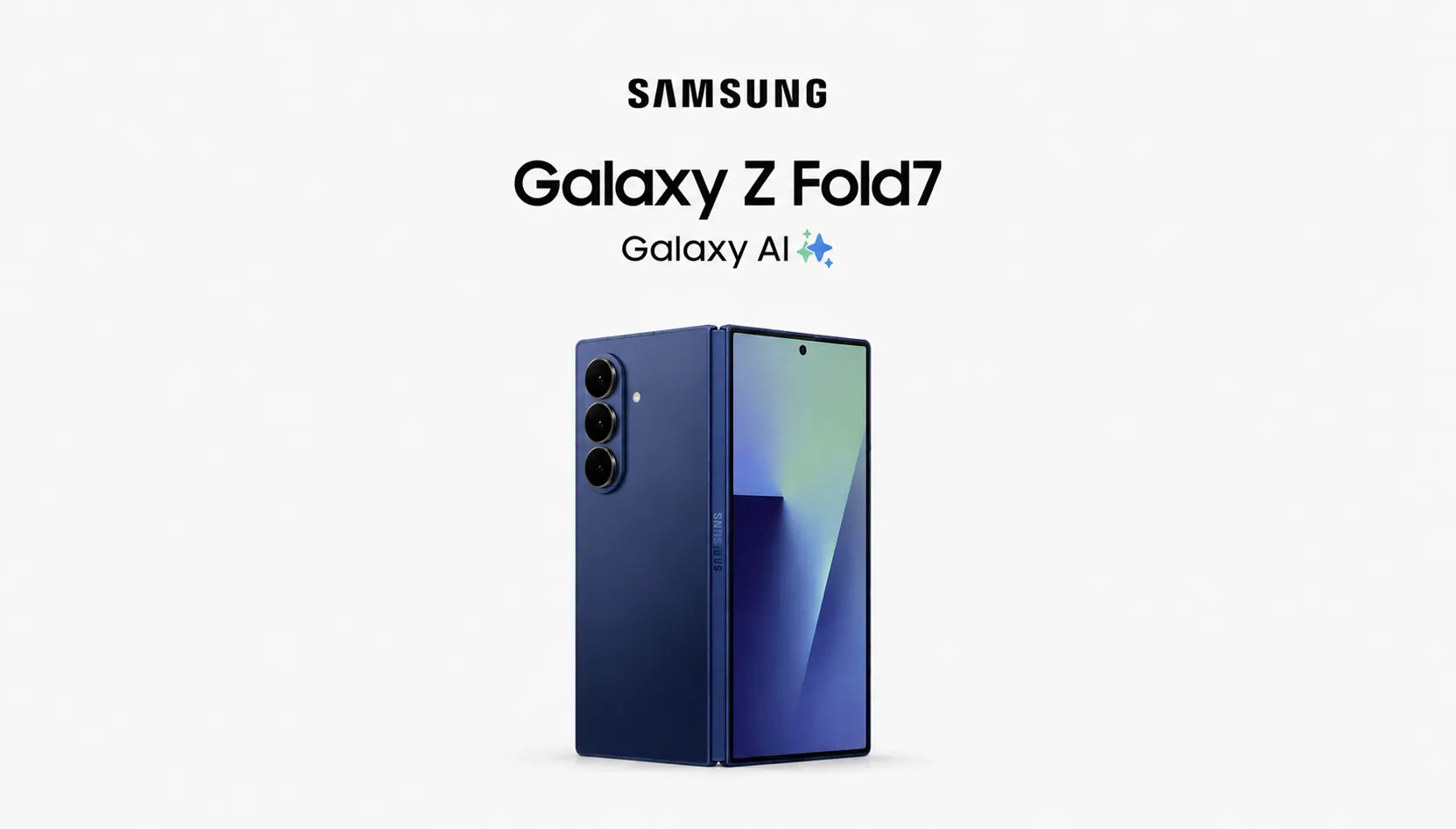
When you pick up the Samsung Galaxy Z Fold 7 for the first time, you truly have to rethink what your smartphone can be. It’s not just the huge 8-inch canvas that opens up in your hands; it’s the shocking thinness, the whisper-quiet hinge, and the sense that Samsung really did get the foldable that the world has been waiting for.
The Samsung Galaxy Z Fold 7 launched in July 2025 along with its sibling, the Galaxy Z Flip 7, and by mid-2026, it’s one of the best foldable smartphones ever made. After two years of incremental updates that left fans wanting more, Samsung made bold steps: a dramatically slimmer body, a flagship-grade 200 MP camera, and a bigger display with Snapdragon 8 Elite for Galaxy chips for phones.
But is this $2,000 price tag justified? We break down every aspect of this device in our review of the Samsung Galaxy Z Fold 7.
Samsung Galaxy Z Fold 7 Price
The Samsung Galaxy Z Fold 7 is now available at$2,000 / £1,799 / AU$2,899 for the 256GB model, which is $100 more than the Fold 6. Storage tiers are priced as follows:

| Variant | Expected Price |
|---|---|
| 12GB + 256GB | $1,899 |
| 12GB + 512GB | $2,019 |
| 16GB + 1TB | $2,259 |
Local pricing may vary depending on the region, taxes, import duties, and chipset availability.
It’s available in Jet Black, Blue Shadow, and Silver Shadow from Samsung directly, major carriers, and authorized retailers around the world.
Samsung Galaxy Z Fold 7 Camera System: The 200MP Leap
The Samsung Galaxy Z Fold 7 camera is where the device makes its most dramatic statement.
Rear Camera Array:
| Camera Lens | Resolution | Aperture | Notes |
| Wide (Main) | 200MP | f/1.8 | Massive upgrade from Galaxy Z Fold 6’s 50MP main camera |
| Ultra-Wide | 12MP | f/2.2 | Similar hardware to the previous generation |
| Telephoto | 10MP | f/2.4 | Supports 3x optical zoom for detailed distant shots |
Front Cameras:
- Cover display selfie: 10MP
- Under-display inner camera: 10MP (better clarity than Fold 6)
The jump from 50MP to 200MP on the main wide lens is transformative. Photos show such spectacular detail even when it’s cropped aggressively. Low-light performance is much better with the wider f/1.8 aperture and Samsung’s ProVisual Engine processing. Colors come out more natural and not artificially saturated than in previous Samsung flagships, a welcome change for those who felt earlier Galaxy cameras over-processed.
The ultra-wide and telephoto cameras are solid but don’t make the same leap. The telephoto’s 3x optical zoom is functional rather than spectacular, and zooming beyond 10x makes quality degrade quickly.
Video capabilities are excellent across all camera 8K recording is available on the main sensor, and Samsung’s Audio Eraser AI feature, which can remove unwanted background noise from clips in one tap, is really useful for content creators.

The under-display camera is still the weakest link. Selfies taken through the inner display can be used for video calls but are noticeably softer than those from the cover camera.
Samsung Galaxy Z Fold 7 Design & Build Quality
If you have held a Z Fold 6, you’re going to be genuinely surprised. Fold 7 is 26% thinner than its predecessor; folded dimensions are only 8.9mm, down from a chunky 12.1mm on the Fold 6. Folded down to 4.2mm thick, it is one of the thinnest foldables ever made. At 215 grams, Samsung’s own Galaxy S25 Ultra is lighter by this margin, which seems almost paradoxical for a phone with this much screen real estate.
The new ArmorFlex hinge also relies on a waterdrop rail structure to distribute stress across the fold and reduce the visible crease that has been the Achilles’ heel of foldable phones for many years. A grade-4 titanium lattice is used under the inner display, and Samsung also made Ultra-Thin Glass (UTG) 50% thicker. The side rails are made out of Advanced Armor Aluminum, Samsung’s toughest.
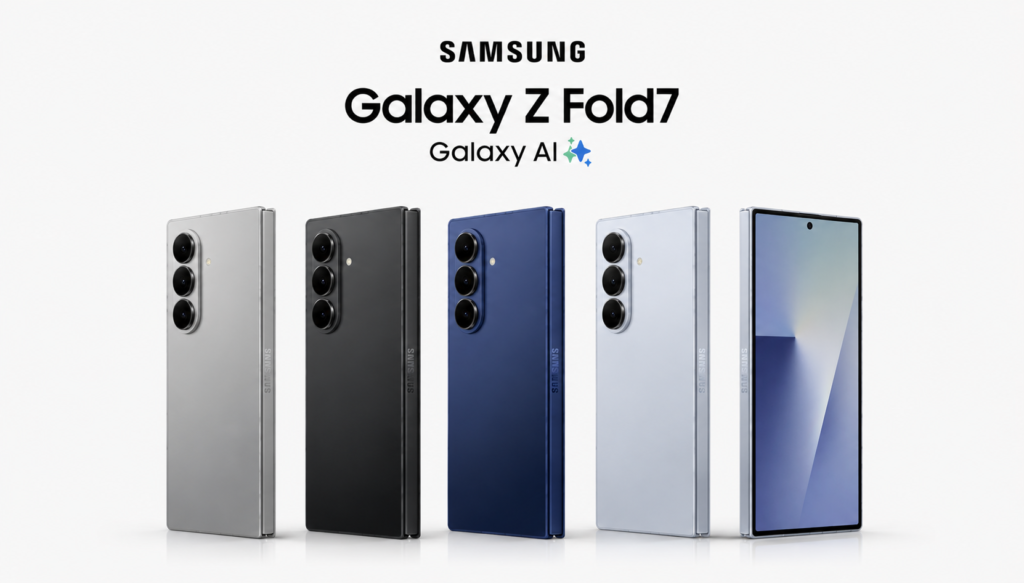
The device comes in three colorways: Jet Black, Blue Shadow, and Silver Shadow. All three look premium, though the Blue Shadow has a particular elegance that photographs well and ages even better.
One major compromise: Samsung removed the S Pen holster and S Pen support completely. The trade-off was necessary to achieve the slimmer profile and larger displays, and most users won’t miss it, but power users who relied on the stylus will feel the absence.
Samsung Galaxy Z Fold 7 Display: Inside and Out
The Samsung Galaxy Z Fold 7 has two displays, and both were also upgraded significantly.
Cover Display:
- 6.5-inch Dynamic AMOLED 2X
- 2520 x 1080 resolution
- 120Hz refresh rate
The cover screen was expanded from 6.3 inches on the Fold 6 to 6.5 inches and then the Fold 6 screen was far more user-friendly as a stand-alone screen for day-to-day use. Scrolling through social media, sending messages and reading articles feels more natural without having to open the phone.
Main Foldable Display:
- 8.0-inch Dynamic OLED 2X
- 2184 x 1968 resolution
- 120Hz refresh rate
- Up to 2,600 nits peak brightness
The inner screen was extended from 7.6 to 8 inches; that’s not just a spec sheet number. In practice, it makes a real difference when watching video, editing documents in split screen, or just browsing. Samsung’s ProScaler technology enhances upscaled content, giving lower-resolution video a crisper look on that large canvas. HDR support is excellent, colors are punchy but accurate, and outdoor visibility has never been better on a foldable.
The crease is still visible from some lighting angles. Samsung has made it much less visible in the new hinge design, so if that is your main concern, then you’re going to be able to manage expectations in this case.
Samsung Galaxy Z Fold 7 Performance: Snapdragon 8 Elite Unleashed
The Qualcomm Snapdragon 8 Elite for Galaxy (Samsung’s overclocked version of the Snapdragon 8 Elite) drives the whole thing. Based on a 3nm chip, it has two high-performance Oryon V2 cores at 4.47GHz and six efficiency cores at 3.53GHz.
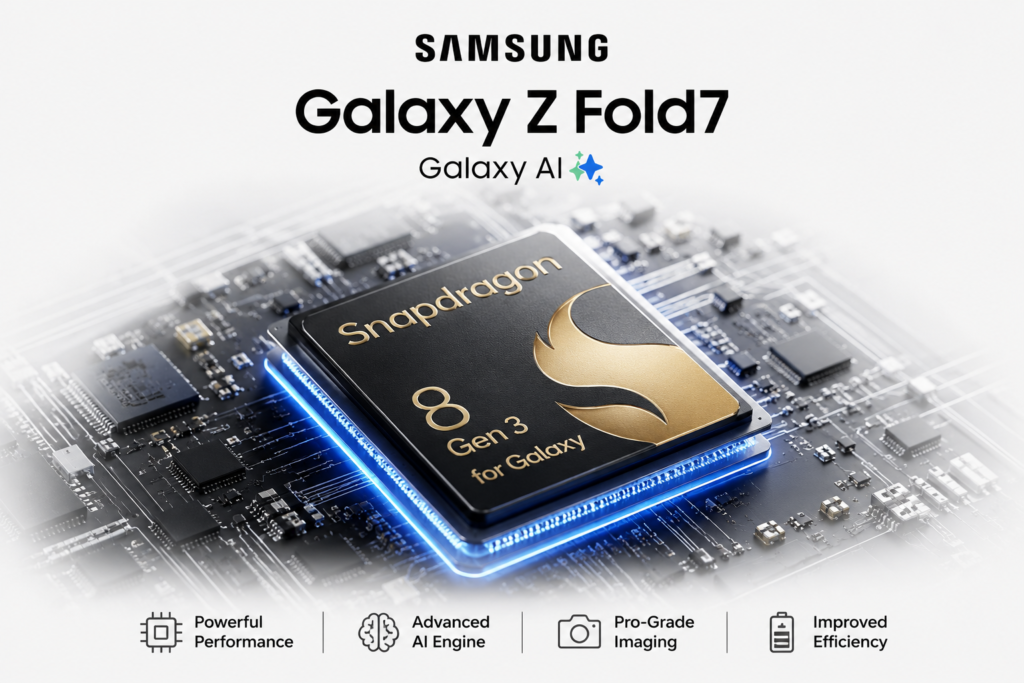
The benchmark scores are quite notable: 41% better NPU performance, 38% faster CPU speed, and 26% better GPU performance than the previous generation. Samsung Galaxy Z Fold 7 Real-world usage is what is reflected there. Multitasking across three split-screen apps is seamless. Gaming at max settings feels easy. Even AI inference tasks that would not have been able to run on older foldables are handled well.
RAM is 12GB on the base and mid-tier models, and the 1TB model is up to 16GB for real power users. Storage has 256GB, 512GB and 1TB options, all of which run on fast UFS 4.0.
Thermal management is handled better here as compared to earlier Fold models, partly due to the larger vapor chamber. Longer gaming sessions won’t result in the same throttling issues users have experienced with the Fold 6 in the past.
Samsung Galaxy Z Fold 7 Battery Life & Charging
And here’s where Samsung’s engineering achievement gets hit with some real-world friction.
The 4,400mAh battery is unchanged from the Fold 6. Because the phone is so much thinner and lighter, you don’t have to reduce capacity, but it’s still an engineering feat. The Snapdragon 8 Elite’s efficiency gains and the more power-efficient displays provide about 55 minutes longer battery life than the original. Samsung says it has tested a battery life of at least 50 hours in daily use.
With day to day use, moderate users will be able to make it through a full day comfortably. Even heavy users who live on the big inner display, streaming, gaming, and multitasking, should expect to top up before bedtime.
The charging, however, is a real frustration. 25W wired charging on a $2,000 phone in 2026 is difficult to defend. Full charge from zero takes about 75-90 minutes. Wireless charging is 15W and 4.5W reverse wireless charging is included but slow.
Competitors like OnePlus offer 80W+ charging, and even Samsung’s own S-series lineup charges at 45W. It’s an area that needed an upgrade and didn’t get one.
Samsung Galaxy Z Fold 7 Features & Software
The Fold 7 features Android 16 and One UI 8 optimized for the foldable form factor. Samsung promises seven years of OS updates and security patches, one of the longest software support windows in the Android ecosystem and a compelling reason to invest at this price point.
Galaxy AI features worth highlighting:
- Generative Edit: Remove, resize, or reposition objects in photos with a tap and hold.
- Audio Eraser: Quickly remove background noise in videos
- Now Brief & Now Bar: AI-powered scheduling glanceable from the cover screen
- Photo Assist: AI editing in-person for editing and subject separation and background swap
- Live Translate & Circle to Search: Facilitated real-time translation and visual search from the display
The big inner screen makes Galaxy AI features feel purpose-built for this device
Photo Assist on the 8-inch display, previewing edits side by side, this is the foldable use case Samsung envisioned.
One UI 8’s taskbar, multitasking gestures, and Flex Mode (which allows apps to be adapted when the phone is half-folded) are mature and useful. This is no longer a gimmick OS on folding glass; it’s a polished, productivity-oriented environment.
Connectivity
The Samsung Galaxy Z Fold 7 covers all the connectivity bases expected from a 2025-26 flagship:
- 5G (Sub-6GHz and mmWave on select models)
- Wi-Fi 7 (802.11be)
- Bluetooth 5.4
- NFC
- USB-C 3.2 Gen 2 (data transfer and video output)
- UWB (Ultra-Wideband)
- GPS, Galileo, BeiDou, GLONASS
Wi-Fi 7 support is an important addition for anyone in a router-compatible environment, and real-world speed of transfer of files and cloud syncing is much faster. 5G performance is reliable on supported networks.
At this tier the absence of a 3.5mm headphone jack can be expected. The USB-C port provides display output and fast data transfer, which is necessary for using the Fold 7 as a desktop replacement via DeX mode.
Samsung Galaxy Z Fold 7 vs Competition
| Feature | Galaxy Z Fold 7 | Google Pixel 9 Pro Fold | OnePlus Open 2 |
| Price | $2,000 | ~$1,799 | ~$1,699 |
| Inner Display | 8.0-inch AMOLED | 8.0-inch LTPO OLED | 7.8-inch AMOLED |
| Main Camera | 200MP | 50MP | 48MP |
| Chipset | Snapdragon 8 Elite | Tensor G4 | Snapdragon 8 Gen 3 |
| Battery Capacity | 4,400mAh | 4,650mAh | 4,805mAh |
| Charging Speed | 25W | 21W | 67W |
| Software Updates | 7 Years | 7 Years | 4 Years |
| Weight | 215g | 257g | 245g |
The Fold 7 wins on design, camera resolution, and software lifespan. It loses on charging speed and battery capacity. OnePlus Open 2 is a good value alternative; the Pixel 9 Pro Fold is good for those who have invested in Google’s ecosystem.
Pros and Cons
Pros:
- Dramatically thinner and lighter than any previous Fold
- Exceptional 200MP main camera, best on a foldable
- Snapdragon 8 Elite delivers elite performance
- Larger 8-inch inner display and improved 6.5-inch cover screen
- 7 years of OS and security updates
- Mature, feature-rich Galaxy AI and One UI 8
- Reduced crease with ArmorFlex hinge
Cons:
- 25W charging is inexcusably slow at this price
- There is no support for the S Pen, which is a loss for stylus users
- Under-display inner camera remains soft
- Ultrawide and telephoto cameras lag behind the main lens
- $2,000 starting price is a significant commitment
- 4,400mAh battery unchanged, good but not great.
Conclusion
The Samsung Galaxy Z Fold 7 is the best foldable smartphone Samsung has ever made, and the most polished book-style foldable available in 2026. The extreme thinness, the 200MP camera leap, the stunning inner display, years of software support, and the promise of that make it a good package for anyone who is willing to spend $2,000 on a device that actually transforms your phone.
But that said, it’s not perfect. The 25W charging is a stubborn holdover that Samsung needs to solve in the next generation. The battery capacity is unchanged. S Pen devotees will be disappointed. And at $2,000, every compromise feels sharper.
But if you want a foldable that doesn’t feel like a compromise, one that works as a proper phone when folded and a tablet when open, then the Samsung Galaxy Z Fold 7 is worth its flagship price more convincingly than any predecessor. For foldable fans, this is the one.
Frequently Asked Questions (FAQs)
Q. Is the Samsung Galaxy Z Fold 7 worth buying in 2026?
A. Yes, if you want the best foldable with the best design and camera hardware, the Fold 7 is a must buy. If charging speed or S Pen support is more important than all other features, you could wait for the Fold 8 or try another.
Q. How does the Samsung Galaxy Z Fold 7 camera compare to the S25 Ultra?
A. The 200MP main lens is competitive with the S25 Ultra in resolution and detail. The S25 Ultra still has an edge in telephoto versatility (with 5x and 10x optical zoom), but for day-to-day shooting the Fold 7 holds its own impressively.
Q. What is the battery life of the Samsung Galaxy Z Fold 7?
A. Samsung’s tested estimate is at least 50 hours of typical use. Moderate users enjoy a full day, while heavy users (especially those who use the inner display) may need a top-up at night.
Q. Does the Samsung Galaxy Z Fold 7 support the S Pen?
A. No. Samsung removed S Pen support on the Fold 7 completely to achieve the slimmer design and larger displays. No S Pen holster or stylus compatibility.
Q. How long will the Samsung Galaxy Z Fold 7 receive software updates?
A. Samsung has committed to 7 years of OS upgrades and security patches for the Fold 7, which is among the best (at least in the Android ecosystem).