


Picking a billing platform is a decision you don’t think about until it goes wrong. A failed payment retry, a broken proration calculation, a tax rule you didn’t know applied to you: any one of these can quietly bleed revenue out of a subscription business. That’s why Recurly was built to solve, and that’s why the platform appears on shortlists next to Chargebee, Stripe Billing, and Zuora.
This review breaks down what Recurly actually does well, where it falls short, what it costs, and who should (and shouldn’t) consider it in 2026.
Most billing decisions are made after a particular pain point arises: a spike in failed payments, a finance team drowning in manual revenue recognition, or a board asking for MRR numbers that don’t match what’s in the bank account. If any of that sounds familiar, you’re already the audience for this review.
What Is Recurly?
Recurly is a subscription management and recurring billing platform for companies that sell on a subscription/usage-based model. Instead of simply processing payments, it handles the messier parts of a subscription lifecycle: trials, upgrades, downgrades, dunning, tax compliance, and revenue reporting.

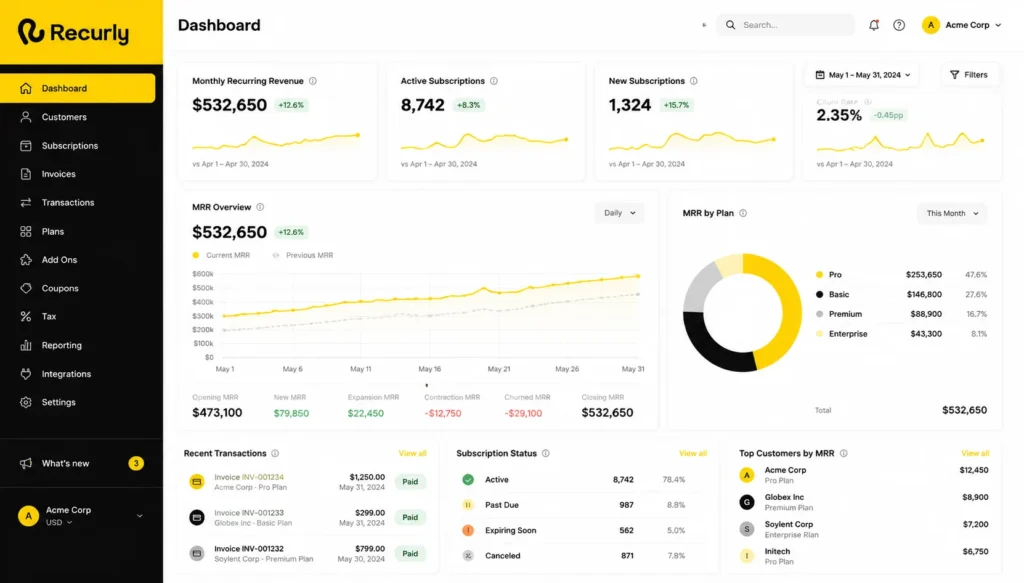
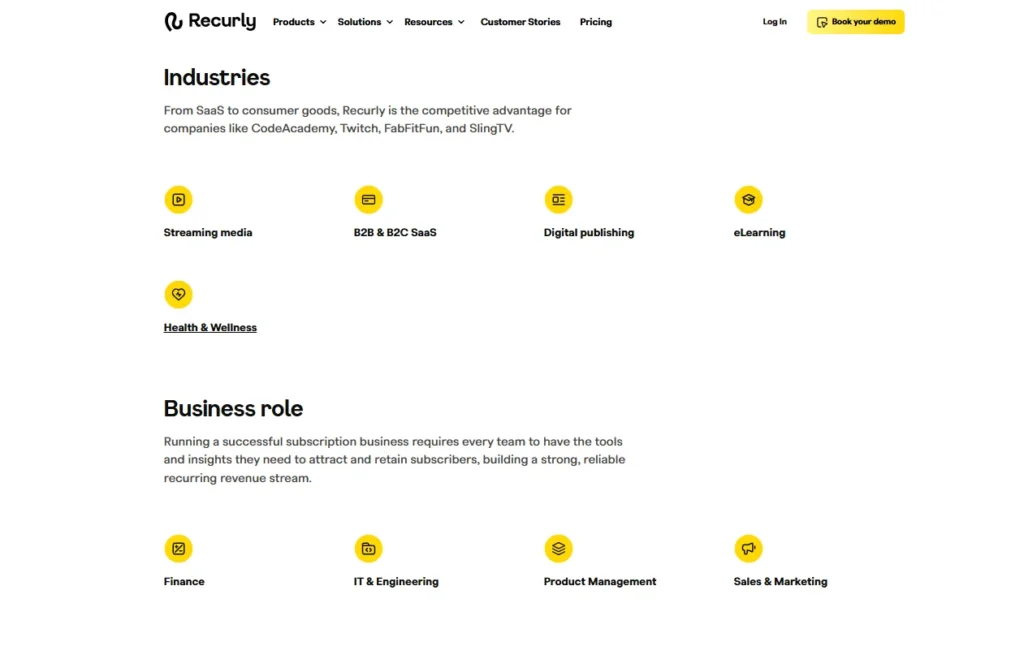
Recurly has been here for well over a decade, since 2009, and has focused for more than a decade on one job: keeping recurring revenue flowing without engineering teams having to craft billing logic for recurring revenue from scratch. Media companies, SaaS platforms, streaming services, and DTC subscription brands make up a huge number of its customers.
If we’re comparing it to a raw payment gateway like Stripe or PayPal, there is a difference. Recurly doesn’t replace your payment processor; it sits on top of one (or multiple) and handles the billing logic while your existing processor moves the money.
How Recurly Fits Into Your Stack
Imagine a subscription business. The customer signs up, the payment gateway charges their card, and a dozen small decisions must be made correctly every single billing cycle. Did the trial convert on time? Did the coupon only appear once? Did the card expire, and if so, did anyone try to fix it before the customer just churned quietly?
Recurly fills this gap. It talks to your payment gateway on one side of the equation and your accounting, CRM, and analytics tools on the other, and it’s the system of record for every subscription event coming and going in between. That’s a far different job than a payment processor, and in the long run, a real subscription volume company will need both a processor and a platform like Recurly working together.
Recurly’s Core Features
Subscription and Billing Management
At its core, Recurly automates the billing cycle: invoicing, proration when a customer upgrades mid-cycle, coupon and discount logic, and support for multiple pricing models (flat-rate, usage-based, tiered, and hybrid plans).
Dunning and Failed Payment Recovery
Recurly earns a lot of its reputation here. Its dunning management employs configurable retry logic and card-updater services to recover payments that would otherwise fail silently. For subscription businesses, involuntary churn from expired cards or declined transactions is often a bigger revenue leak than voluntary cancellations, so this feature alone can justify the platform for some teams.
The card-updater piece deserves its own mention. Rather than waiting for a customer to notice their card failed and update it themselves, Recurly can pull updated card details directly from card networks in many cases, closing the loop before the customer even realizes there was a problem. For a company processing thousands of renewals a month, that quiet background recovery adds up to real revenue that would otherwise disappear.
Revenue Recognition
Recurly has built-in revenue recognition tools in place and aligned with ASC 606 and IFRS 15 standards, which is important for finance teams that need audit-ready reporting without having to export data to a separate system.
Multi-Currency and Tax Compliance
The platform supports billing in multiple currencies and integrates tax calculation for global sales tax, VAT, and GST obligations. For companies expanding into new markets, this removes a genuinely painful compliance burden.
Integrations
Recurly connects with the tools most subscription businesses already run: Salesforce, HubSpot, NetSuite, Xero, QuickBooks, and various payment gateways, including Stripe, Braintree, and Adyen. It also offers a documented API and webhooks for custom workflows.
Analytics and Reporting
Dashboards are for things like MRR, churn rate, LTV, and cohort retention. They’re not as deep as a dedicated business intelligence tool, but they’re so strong that most teams never need to add an analytics layer in the middle.
Where Recurly Is Headed in 2026
Subscription billing as a category is increasingly moving to usage-based and hybrid pricing, and Recurly has been rolling out support for metered billing to keep pace with that shift. We expect continued investment in AI-assisted dunning (predicting which failed payments are worth an aggressive retry versus a soft one) and deeper reporting around net revenue retention, which has become the metric investors actually care about more than raw MRR growth. None of this is unique to Recurly, but it reflects where the whole recurring billing space is moving, and it’s worth knowing before you lock into any platform for the next few years.
Recurly Pricing in 2026
The honest answer: Recurly doesn’t publish flat, self-service pricing on its website, and that hasn’t changed. Instead, it quotes based on your monthly billing volume, transaction count, and which modules you need (revenue recognition, PayPal support, advanced dunning, etc.).
| Plan / Tier | Approx. Monthly Price | Pricing Model | Best For |
| Starter / Subscriptions Plan | $249 – $599 / month + 0.9% of billing volume | Usage + platform fee | Startups & small SaaS |
| Professional Plan | $600 – $1,200 / month (approx.) | Custom + usage-based | Growing SaaS / mid-market companies |
| Elite / Enterprise Plan | $1,200+ / month (custom quote) | Custom enterprise contract | Large enterprises |
| Revenue Recognition Add-on (RevRec) | From ~$1,200/month+ | Add-on module | Finance-heavy SaaS |
| Enterprise High Volume Tier | $2,000 – $10,000+/month (estimate) | TPV-based pricing | Large global SaaS platforms |
Recurly pricing is usage-based and varies depending on billing volume, features selected, and contract terms. The final cost may differ from the approximate figures mentioned and should be confirmed directly with Recurly sales.
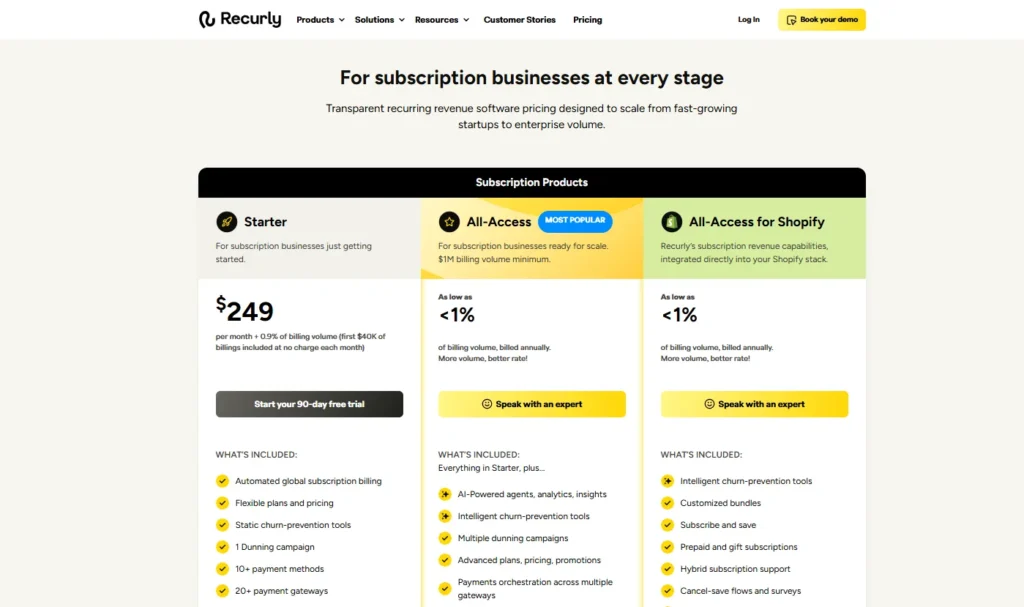
That structure has an upside and a downside. The upside: you’re not paying for enterprise features you’ll never touch if you’re a small subscription business. The downside: you can’t budget for it the way you can with a platform that lists its tiers publicly, and you’ll need a sales conversation to get an actual number.
What we can say with confidence, based on how Recurly has historically structured plans:
- Starter-level plans are aimed at smaller subscription businesses with less monthly transaction volume and fewer advanced needs.
- Growth or professional-tier plans provide revenue recognition, more integrations, and higher volume allowances.
- Enterprise plans are custom designed with volume discounts, dedicated support, and advanced compliance needs.
Because exact figures change and Recurly negotiates based on your specific volume, the only reliable way to get a number you can plan around is to request a quote directly from their sales team. Any third-party number you see (even flat dollar figures floating around comparison sites) is a rough estimate at best.
Recurly Free Trial
Recurly has offered a free trial period before signing up in the past, so teams can test the platform on their own billing scenarios before committing to date. Trial availability and length can change, so it is worth checking the current offer on Recurly’s pricing page before committing. When you check, if a free trial isn’t active, ask your sales rep. Vendors in this space often accommodate a pilot period for serious prospects even outside a trial program.
Pros and Cons
Pros
- Strong dunning and payment recovery that actually helps to reduce involuntary churn, which is the single biggest source of hidden revenue loss in a subscription business.
- Revenue recognition that saves finance teams from manual ASC 606 work and messy spreadsheet reconciliation at quarter-end.
- Global tax and currency support that scales with international expansion instead of requiring a bolt-on tax tool.
- Built into an existing integration ecosystem with big CRM, accounting, and payment tools so it fits in a stack of tools instead of having to be a complete rebuild.
- Reliable uptime and enterprise-grade infrastructure with over a decade of billing experience and a customer base that includes a lot of big businesses dealing with significant transaction volume.
Cons
- No public pricing makes it difficult to compare costs upfront against competitors, which slows down the evaluation process for smaller teams.
- Steeper learning curve for teams without a dedicated RevOps or billing engineer already on staff.
- Less flexible for highly custom pricing models compared to some newer, API-first competitors built for unusual billing logic.
- Onboarding and migration from another billing system can take real time and internal resources, especially if you’re moving years of subscriber history.
Recurly vs Chargebee
Since “Recurly vs Chargebee” is one of the most common comparisons buyers look for, we take a side-by-side look at where each platform tends to win.
| Feature | Recurly | Chargebee |
| Best for | Mid-market to enterprise subscription businesses | Startups through enterprise, broader tier range |
| Pricing model | Custom quote only | Public tiers plus custom enterprise plans |
| Revenue recognition | Built-in | Available, often as an add-on |
| Dunning management | Strong, mature | Strong, comparable |
| Global tax support | Yes | Yes |
| Ease of setup | Moderate to complex | Generally faster to onboard |
| Integration depth | Deep with finance/CRM tools | Deep with finance/CRM tools |
Neither platform is objectively “better” in a way. Chargebee tends to appeal to teams that want a quicker setup and a transparent starting price point. Recurly tends to appeal to teams with more complex revenue recognition needs or higher transaction volumes where a custom-negotiated rate makes more financial sense.
Who Should Use Recurly?
Recurly makes the most sense for
- Subscription businesses that have meaningful monthly volume, not just a handful of customers.
- Companies that need audit-ready revenue recognition without a separate finance tool.
- Teams selling internationally and dealing with multi-currency, multi-tax-jurisdiction billing.
- Organizations that have already outgrown a basic Stripe or PayPal billing setup.
So it’s probably not the best fit if you’re an early-stage startup with few customers and a tight budget. In that case, a simpler, cheaper billing tool with transparent pricing will probably serve you better until you scale.
Recurly Alternatives
If Recurly doesn’t feel like the right fit after reading this, here are a few platforms worth comparing:
- Chargebee: a strong all-around competitor with more transparent entry-level pricing and a quicker typical onboarding process.
- Stripe Billing: a good fit if you’re already deep into the Stripe ecosystem and want billing built into the same platform you already use for payments.
- Zuora: geared toward large enterprises with complex and highly customized billing needs and dedicated implementation teams.
- Paddle: handles billing and merchant-of-record tax compliance together, which is ideal for worldwide software sellers who want to offload tax liability entirely.
- Chargify (Maxio): was built specifically for B2B SaaS billing complexity, including usage-based and hybrid pricing models.
Each of these makes tradeoffs in a different direction, so the right choice usually comes down to your transaction volume, technical resources, and how much control you want over pricing logic versus how much you would rather hand off to the vendor.
Conclusion
Recurly earns its place in the recurring billing conversation for a specific reason: it takes the operational grind out of subscription revenue, from failed payment recovery to revenue recognition to global tax compliance. That depth comes with a tradeoff, a pricing model you can’t check without talking to sales, and a setup process that rewards teams with some billing or RevOps expertise already on staff.
If you are running a subscription business with real volume and complexity, especially across borders or currencies, it’s worth getting a quote and testing it against your actual billing scenarios. If you’re just starting, it might be worth growing into rather than starting from scratch.
The bigger takeaway, if you’re on Recurly or one of its competitors, is that recurring billing software stops being optional as soon as your manual processes start costing you more in lost revenue than a platform would cost in fees. That crossover point comes sooner than most founders expect.
Frequently Asked Questions (FAQs)
Q. Is Recurly good for small businesses?
A. It can work for small businesses with growing subscription volume, but the lack of public, low-tier pricing and the moderate setup complexity mean very early-stage companies often find simpler tools more cost-effective to start with.
Q. Does Recurly integrate with Stripe?
A. Yes. Recurly works with Stripe as one of its payment gateways, so you can keep Stripe as your processor while Recurly handles the subscription logic on top of it.
Q. How much does Recurly cost per month?
A. Recurly doesn’t publish flat monthly pricing. Costs depend on transaction volume and what features you need, so you’ll need to get a quote directly from Recurly to get an accurate number.
Q. Is Recurly better than Chargebee?
A. Neither is universally better. Recurly tends to suit companies with complex revenue recognition and higher billing volume, while Chargebee often appeals to teams wanting faster onboarding and clearer starting price points.
Q. Does Recurly handle sales tax and VAT automatically?
A. Yes, Recurly provides tax calculation and compliance support for different global tax types such as VAT, GST, and US sales tax so companies selling across various countries can remain compliant with the tax mechanisms.