

Some years ago, one of my friends that I’ve been working with (a backend engineer who was tired of his enterprise day job) spent three weekends polishing up his LinkedIn profile. He received two recruiter messages about positions that he had already turned down twice. Then someone mentioned Wellfound. Within a week he was on a call with the actual co-founder of a 12-person seed-stage startup and talked equity and roadmap instead of corporate buzzwords.
That’s why Wellfound keeps popping up when the topic of startup hiring is discussed, not just because it’s flashy, but also because it addresses a problem LinkedIn was never created to solve: connecting small, fast-moving companies directly with the people who actually want to work at them.
This guide breaks down what Wellfound is, why it’s earned such a loyal following among startup job seekers, what it costs, where it falls short, and how to use it without wasting your time.
What Is Wellfound?
So, what is Wellfound? In short, it is a job board and recruiting platform that is entirely centered around startups, from pre-seed teams of three to companies preparing for an IPO. Wellfound deliberately kept it narrow: tech, product, design, and growth roles at venture-backed companies.

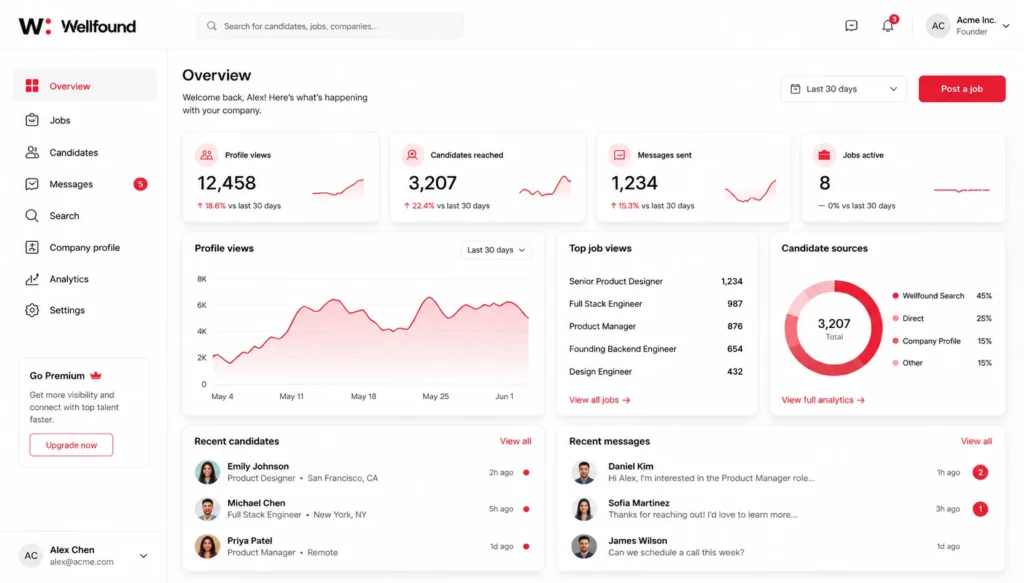
The platform lists more than 130,000 jobs from tens of thousands of startups, and there are more than 10 million profiles of candidates currently. Every listing comes from a founder or in-house hiring manager: no staffing agencies, no recruiter spam, and no job postings scraped from somewhere else and reposted five times.
That focus is the whole appeal for job seekers. You’re not going to be able to sift through thousands of irrelevant listings to find the three startups that are actually worth your time.
Why Job Seekers Actually Choose Wellfound
Ask around in startup-adjacent corners of Reddit or Twitter, and a few reasons come up again and again:
Salary and equity are visible before you apply. This sounds small until you have spent an hour interviewing for a job only to discover the comp doesn’t work for you. Wellfound listings show salary ranges and equity upfront, which matters even more now that several states require pay transparency by law anyway.
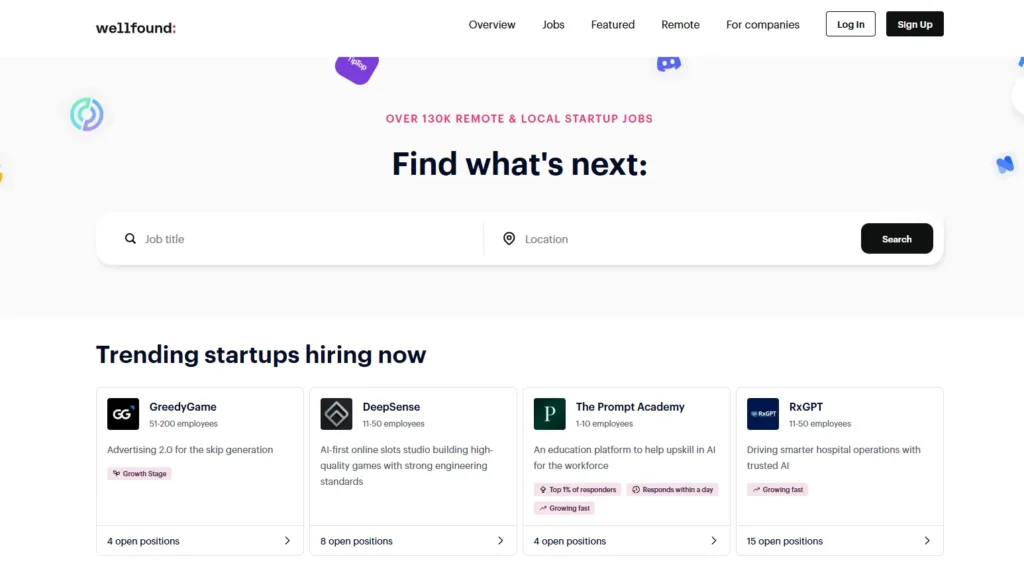
You talk to founders, not gatekeepers. Applications on Wellfound often come directly from the person who decides the hiring process, sometimes the CEO themselves, at the very early-stage companies. There is no corporate ATS swallowing your resume into a black hole.
The listings are genuinely startup-only. No Fortune 500 postings mixed in, no recruiter-aggregated noise. If you are specifically looking for startup jobs, that filtering does real work for you.
It costs nothing to use. For job seekers, That has always been completely free: no premium tier, no paywalled features, and no “upgrade to message recruiters” upsell. That’s a real point of difference from platforms that gate basic functionality behind a subscription.
Wellfound Features Worth Knowing About
Besides the job board itself, Wellfound has quietly built out a fuller toolkit on both sides of the hiring equation:
- AI Job Match / AI Copilot: surfaces roles based on your profile and stated preferences rather than making you scroll endlessly.
- Salary Calculator: benchmarks pay by title, industry, and company size; it’s useful when you’re negotiating an offer at a startup with no public paybands.
- Resume Builder: turns your profile into a shareable resume without needing a separate tool. Company profiles: show funding stage, team size, culture notes, and tech stack so you can vet a startup before you ever talk to anyone there.
- Free ATS for employers: unlimited job postings, candidate pipeline tracking, and interview scheduling, all included at no cost.
- RecruiterCloud / Autopilot: an AI-plus-human sourcing layer for companies that want it’s team to actively find and vet candidates rather than just posting and waiting.
It’s worth noting Wellfound isn’t trying to be an all-in-one HR suite. There’s no onboarding software, no performance management, no payroll. It does one thing, startup hiring, and keeps expanding around that one thing instead of sprawling into adjacent categories.
Wellfound Pricing: What It Actually Costs
This is where a lot of confusion shows up online, so let’s be direct about it.
For job seekers, Wellfound is 100% free. There’s no paid tier, no premium account, no feature locked behind a fee. Browsing, applying, messaging, building a profile — all free, always.
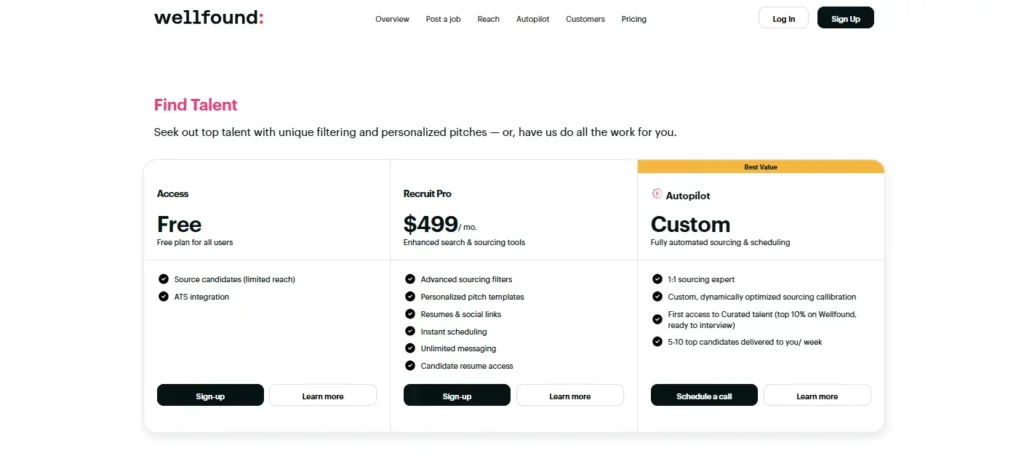
For companies and recruiters, pricing depends on the tier:
| Wellfound Plan | What It’s For | Typical Cost |
| Free / Wellfound Recruit | Unlimited job postings, free applicant tracking system (ATS), and a basic candidate pipeline for managing applications. | Free ($0) |
| Recruit Pro | Advanced candidate search filters, outbound messaging, and team collaboration features for active recruiting. | Typically a few hundred USD per recruiter seat per month (varies based on contract and region). |
| Promoted Jobs | Boosts job visibility and improves placement in candidate search results to attract more qualified applicants. | Add-on fee in addition to the base recruiting plan. |
| Curated | Access to Wellfound’s vetted candidate network with hands-on sourcing support for faster hiring. | Premium pricing, often including a success fee based on the hired candidate’s salary. |
| Autopilot / RecruiterCloud | AI-powered sourcing and automated recruitment workflows for high-volume hiring. | Custom pricing available upon request (quote-based). |
A quick honest note: published pricing for employer plans varies noticeably across review sites and even Wellfound’s own pages, likely because plans get revised and regionalized over time. If you’re a founder evaluating this seriously, the safest move is to request current pricing directly from it is rather than relying on any single number you find online, including this one.
There’s technically no traditional “Wellfound free trial” because the free tier itself is permanent and fully functional, not a time-limited preview. You can run a real hiring process on the free plan indefinitely before ever considering an upgrade.
Wellfound vs LinkedIn Jobs: Which One Should You Use?
This comparison comes up constantly, and the honest answer is it depends on what you’re hiring for or applying to.
| Factor | Wellfound | LinkedIn Jobs |
| Focus | Startups only | Every industry and company size |
| Listing Quality Control | No recruitment agencies; founder-direct job listings | Mixed listings, including agencies and job aggregators |
| Cost for Job Seekers | Always free | Free to apply, with optional Premium features |
| Best For | Early-stage tech, product, design, marketing, and startup roles | Senior, executive, non-tech, and enterprise hiring across industries |
| Salary & Equity Visibility | Salary and equity details shown upfront on most listings | Salary transparency is improving but remains inconsistent depending on employer and region |
| Candidate Pool Size | Smaller, startup-focused talent community | Massive global talent network across all industries |
Wellfound Alternatives Worth Considering
Wellfound isn’t the only startup-hiring recruitment platform out there, and depending on your needs, one of these might fit better:
- Built In: strong for tech positions in specific metro markets, even with more employer branding.
- Hired: curated two-sided matching, similar in spirit to Wellfound’s Curated tier.
- Dice: tech-oriented job board with deep skills filtering, less startup-specific.
- Stack Overflow Jobs: based on developer community profiles and project history.
- LinkedIn Jobs: the default choice when you need scale, seniority, or non-tech roles.
None of these fully replace it’s startup-only focus, they each trade that narrowness for something else, whether it’s geography, candidate curation, or sheer reach.
The Honest Downsides Reviews Don’t Always Mention
Most Wellfound reviews focus on the upside, so here’s the part that’s easy to miss.
Indeed, independent analyses of applicant outcomes have shown that, on average, a large percentage of Wellfound applications will expire and never get reviewed by the employer, and only a small fraction of applicants will be interviewed. Part of that’s due to “ghost listings” that startups hang on to for investor optics and future hiring plans, not an active search. It’s a frustrating reality for job seekers who put in real effort into tailored applications.
As for the roles that are actually active, we also find startup-specific callback rates are much higher than the same sort of search on LinkedIn, based on community discussion on forums like r/cscareerquestions. The takeaway isn’t “don’t try to avoid Wellfound” but “don’t treat every listing as the same,” and you’re to make a judgment.
How to Actually Use Wellfound to Land a Startup Job
Some of the practical habits differ from people who don’t:
- Filter by funding stage and team size. Pre-seed and seed-stage firms with 1-20 employees are typically most active in hiring and responsive.
- Sort by recent activity. A listing posted yesterday gets far more attention than one sitting for three months.
- You should include quantifiable results, not just job titles, in your profile; startups want to be impactful rather than pedigree-oriented.
- Check if the founder is active on the platform. Recently active company profiles are faster to convert into real conversations.
- Don’t rely on Wellfound alone. Pair it with direct outreach; a short message to a founder with a single, specific note to a founder is frequently far better than a queued application.
How to Actually Use Wellfound to Land a Startup Job
From the employer side, the appeal is just as clear. A founder hiring their first few engineers can post unlimited jobs and run a full pipeline for free, something that would cost thousands of dollars on LinkedIn if sponsored posts and recruiter seats were included. It’s audience is already self-selecting for that mindset for companies looking to hire people that are attracted to equity and early-stage ambiguity rather than brand-name stability.
It still has a ceiling, though. When a company needs to hire outside tech-adjacent roles, a VP of Sales, a finance lead, a marketing executive, or Wellfound’s talent pool quickly empties out, and a wider platform usually becomes necessary.
Conclusion
Wellfound‘s popularity isn’t an accident of branding; it’s the direct result of staying narrow while everyone else tried to go broad. By refusing to be a general job board, it became the default destination for a very specific kind of search: people who want to work at a startup and startups that want people who actually want to be there.
It won’t replace LinkedIn for every kind of hire, and it isn’t free of frustration; ghost listings and low review rates are real complaints worth taking seriously. But for the audience it was built for, It is still does something almost no other platform manages: it gets a job seeker and a founder talking to each other directly, without ten layers of process in between.
Frequently Asked Questions (FAQs)
Q. Is Wellfound really free for job seekers?
A. Yes. There’s no premium tier, no paywalled messaging, and no cost to browse, apply, or build a profile. It’s been free for candidates since its AngelList Talent days and remains that way.
Q. What happened to AngelList Talent?
A. It was rebranded and spun out as an independent company called Wellfound in November 2022, while AngelList’s investing side continued separately as AngelList Venture.
Q. Does Wellfound have a free trial for employers?
A. Not in the traditional sense; the free plan itself is permanent, not a time-limited trial. Companies can post jobs and manage a full pipeline on the free tier indefinitely before considering a paid upgrade.
Q. Is Wellfound better than LinkedIn for startup jobs?
A. For startup-specific tech, product, and design roles, most job seekers find Wellfound’s focused listings more efficient. For senior, non-tech, or high-volume hiring, LinkedIn’s scale generally wins.
Q. How much does it cost for companies to use Wellfound?
A. Posting jobs and using the basic ATS is free. Paid add-ons, advanced sourcing, promoted listings, and managed recruiting through Curated vary in price, so it’s worth confirming current rates directly with Wellfound rather than relying on third-party estimates.