
 Shikha Kumari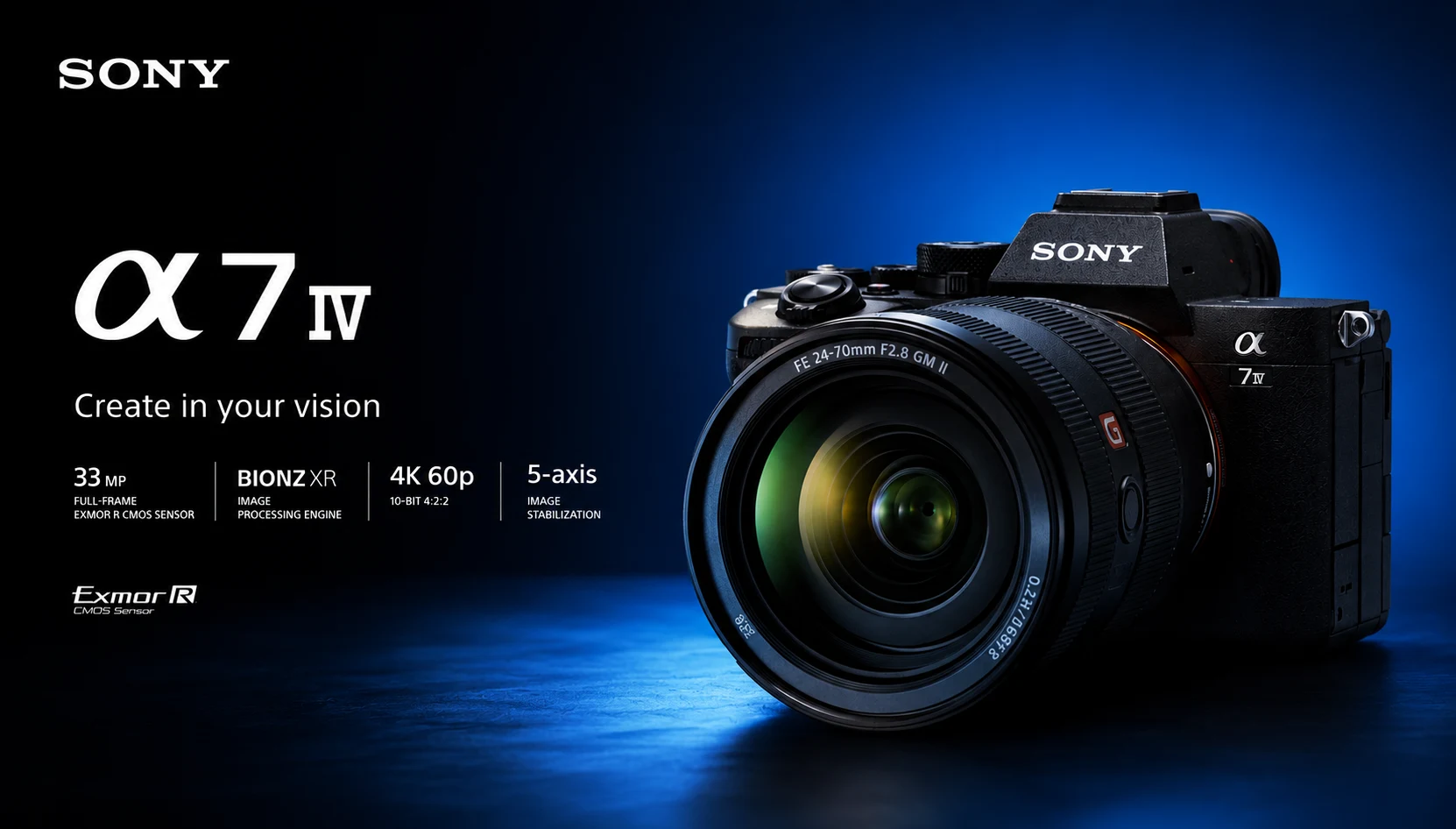
Introduction: Is the Sony A7 IV Still Worth It?
At the moment everyone’s had their camera bodies on a rack, the heart is pounding as to whether this is the one. The Sony A7 IV has been causing that very feeling since its release, and really? It still does.
The Sony A7 IV is more than just a camera. It is Sony’s courageous assertion of what a full-frame mirrorless body can do at a “prosumer” price point. A 33MP sensor, a 4K 60fps film, and real-time tracking autofocus are magic, which fills in the blanks that cameras priced at twice as much just a couple of years ago hadn’t quite managed to reach. But is 2026 right for you?
If you are a wedding photographer, a travel vlogger, a hybrid shooter who straddles both worlds, or someone who wants to find a budget stretch in a used Sony A7 IV, this is the best step-by-step, in-depth guide. a travel
We’re diving deep here: specs, performance vs. the real world, battery quirks, what the best lenses to pair it with are, some firmware updates that completely changed the game, and how it stacks up against the newer Sony A7V. No fluff. Just everything you need to make a good decision.
Sony A7 IV Specs Breakdown
| Feature | Specification |
| Sensor | 33MP full-frame BSI CMOS (Exmor R) |
| Processor | BIONZ XR |
| Autofocus Points | 759 phase-detect / 425 contrast-detect |
| ISO Range | 100–51,200 (expandable to 50–204,800) |
| Continuous Shooting | Up to 10 fps (mechanical) / 10 fps (electronic) |
| Video | 4K up to 60fps (Super35 crop), 4K 30fps (full-frame), 1080p 120fps |
| Image Stabilization | 5-axis in-body (5.5 stops) |
| Shutter Speed | 1/8000s (mechanical), 1/8000s (electronic) |
| Viewfinder | 3.68M-dot OLED EVF, 0.78x magnification |
| LCD Screen | 3-inch fully articulating touchscreen, 1.03M dots |
| Weather Sealing | Yes (dust and moisture resistant) |
| Memory Slots | Dual: SD UHS-II + CFexpress Type A / SD |
| Connectivity | Wi-Fi 5GHz/2.4GHz, Bluetooth 5.0, USB-C (USB 3.2 Gen 2) |
| Battery | NP-FZ100 |
| Weight | 658g (with battery and card) |
| Dimensions | 131.3 × 96.4 × 79.8 mm |
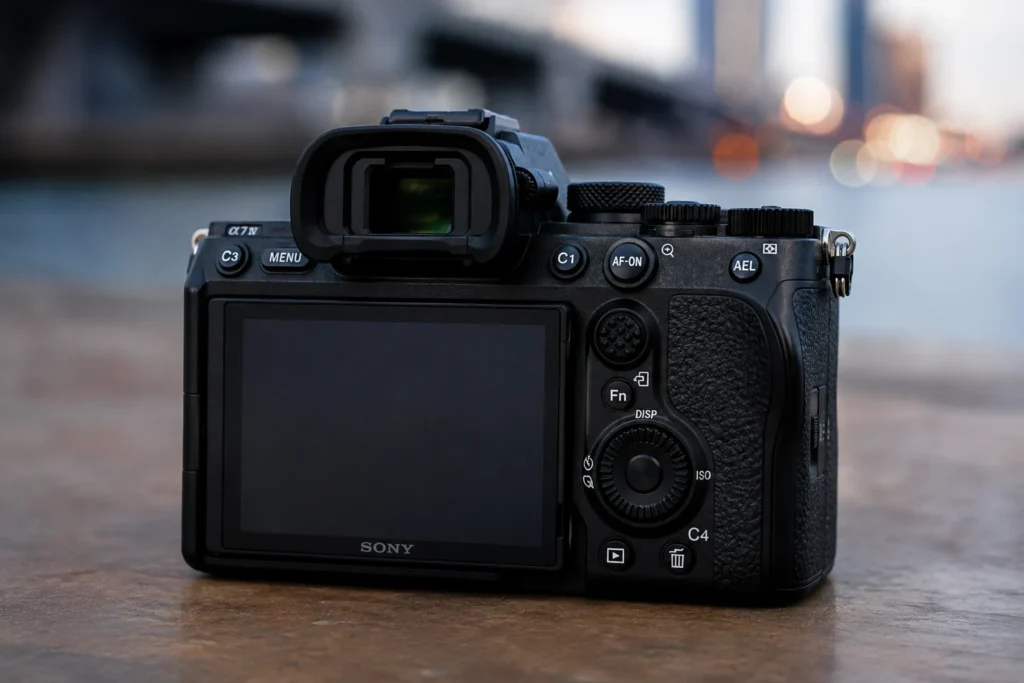
Sony A7 IV Price: New vs. Used
At launch the Sony A7 IV price was $2,499 USD (body only) and has been relatively stable in this range at authorized retailers. As of 2026, a range currently sits at about $2,299–$2,499 new, with occasional promotions offered to promote the device by Sony itself and major retailers.
Buying a Sony A7 IV Used
There is already an active used market for the Sony A7 IV in the market if you want something budget-friendly and need something of value for money. On sites such as MPB, KEH, B&H Used, and eBay, you’ll generally be finding:
Excellent/Like New condition: $1,700–$1,950
Very Good condition: $1,500–$1,700
Good condition: $1,300–$1,500.
What to check when buying used:
- Shutter count (Anything less than 50,000 times is usually low-use, so check out all necessary equipment.)
- Sensor condition (Ask sample RAW files to check and see for dust or hot pixels.)
- Weather sealing integrity (look out for evidence of large quantities of moisture exposure)
- Firmware version (after it comes in, you can update)
- Additional extras (battery, charger, strap, original box)
Purchasing from a good, return-policy discount used-gear dealer is a lot safer than what you can afford to buy in the private marketplace. MPB specifically provides graded descriptions with 6-month warranties.
Sony A7 IV Camera Performance: Stills and Video
Still Photography Performance
BSI CMOS sensor with 33MP provides images with good dynamic range; Sony maintains about 15 stops, while actual testing shows great latitude in RAW files. With this sensor, drawing detail from shadows or recovering blown highlights is genuinely forgiving.

High ISO performance is important with a 33MP chip. Images are clean and retain the correct amount of detail at ISO 3200 and ISO 6400. Even with ISO 12,800 good imagery can be used with adequate noise reduction. ISO 25,600 (and beyond) indicates a good amount of noise, though it takes care of this sort in today’s AI-powered software like Lightroom’s Denoise or DxO PureRAW.
Autofocus is where the true reputation of the A7 IV comes into play. The real-time eye tracking for humans and animals works fast, accurately, and with confidence. For portraiture, wildlife or event photography, or in such matters as shooting moving figures, it’s a real competitive plus. The subject recognition, which is based on AI technology, is able to accurately and even consistently follow faces when they are partly obscured, something that once required manual intervention on older systems. Burst shooting at 10fps with full autofocus tracking is offered in both mechanical and electronic shutter modes. The buffer goes over fairly quickly when shooting to a CFexpress Type A card.

Video Performance
No doubt the A7 IV is a powerful hybrid video tool. The headline specs are 4K at up to 60fps (Super35/APS-C crop), 4K at 30fps in full frame, and 1080p at up to 120fps for slow motion.
Available S-Log3 and S-Cinetone picture profiles allow videographers a great deal of flexibility in post-production. Borrowed from Sony cinema cameras, the S-Cinetone profile provides film-like color rendering to the screen that requires almost no grading in many applications.
NOTE: And for extra transparency, 4K 60fps employs a Super35 crop that gives your full-frame lens something more telephoto, akin to something else. For full-angle shooting at 60 fps, it is important to use this selection to guide lens setup. 4K 30fps is full sensor width and has no cropping.
The fully articulating screen with the autofocus performance that carries right to video mode really sets this camera up as an entry tool for solo video production, a task that was challenging with previous Sony models.
Best Lenses for the Sony A7 IV
The A7 IV features the Sony E-mount with built-in full-frame FE lenses. Standout picks by various types of images that work in a variety of shooting categories:
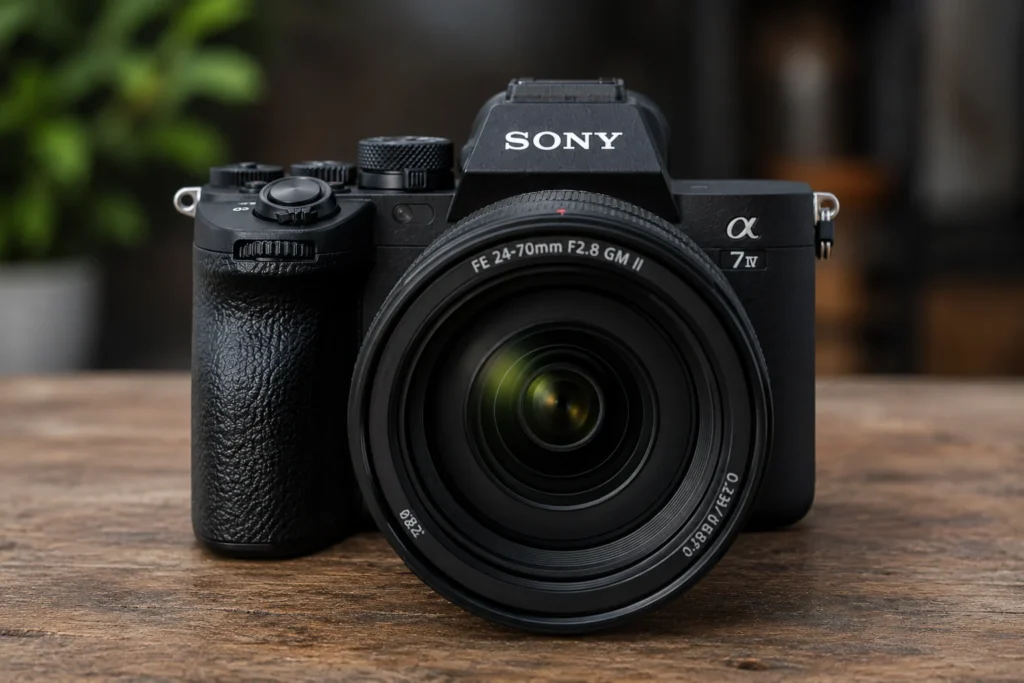
Portrait & General Photography
Sony FE 85mm f/1.4 GM: Outstanding crispness and bokeh, just taken out to the best level. The go-to portrait-making lens.
Sony FE 50mm f/1.2 GM: Versatile rendering that is stunning. Heavy but brilliant.
Sigma 85mm f/1.4 DG DN Art: A cheaper but superior optical quality alternative.
Travel & Versatility
Sony FE 24-105mm f/4 G OSS: The ultimate travel one-lens solution. Excellent stabilization.
Sony FE 28-60mm f/4-5.6: Compact kit option. Good for travel when size counts.
Tamron 28-75mm f/2.8 G2: Affordable zoom that is versatile but works as best it can when it comes to good optical performance.
Wildlife & Sports
Sony FE 100-400mm f/4.5-5.6 GM OSS: Sharp, fast-focusing telephoto. Complements A7 IV AF beautifully.
Sony FE 200-600mm f/5.6-6.3 G OSS: The wildlife photographer’s go-to. Excellent reach.
Video
Sony FE 16-35mm f/2.8 GM II: Wide zoom at fast aperture. Great for run-and-gun video.
Sigma 18-35mm f/1.8 DC DN Art (with adapter in Super35 mode): Widely used vlogging option.
Sony A7 IV Release Date and Background
The official release date for the Sony A7 IV was December 17, 2021, a launch that photography communities had been looking forward to for months. It succeeded the A7 III (launched in 2018), and the generational leap was instantly apparent: it introduced a brand-new 33MP BSI CMOS sensor instead of the previous 24MP chip, an overhaul to help improve the autofocus system, and it expanded video capabilities to a more powerful system than ever before.
Sony hailed the A7 IV as a new baseline in the realm of serious full-frame photography. Not an entry-level body, not a flagship, something comfortably middle of the road, intended for hobbyists and working-minded people who want something flexible without the flagship price tag. At launch, it came together with Sony’s FE 28-70mm kit lens for consumers to complement the body-only combo they had bought; however, most opted for the body-only setup to work with the available glass or pay for Sony G Master high-class lenses.
Since its debut, the A7 IV has received multiple firmware upgrades that have massively expanded its capabilities, which we’ll discuss later.
Sony A7 IV Weight: Is It Too Heavy?
The value sold with the Sony A7 IV, weighing 658 grams, can go up with a battery and an associated memory card to 658 grams—a total of roughly 574 grams in the body. At a mirrorless level, that puts it in the medium-heavy range, lighter than a Canon R5 (738g) and significantly heavier than entry-level mirrorless alternatives.
| Camera | Weight (with battery/card) |
| Sony A7 IV | 658 g |
| Sony A7 III | 650 g |
| Canon EOS R5 | 738 g |
| Nikon Z6 III | 760 g |
| Fujifilm X-T5 | 557 g (APS-C) |
Sony A7 IV Battery Life
But let’s face it, the Sony A7 IV battery life is one of the most frequent complaints of the camera and deserves its right to some straight-on confrontation. The CIPA rating for the NP-FZ100 battery from Sony is 520 shots in a charge, using the viewfinder, or 580 shots using the rear LCD. If you take the performance in the real world, to say the least, the behavior is massively different using two modes.
What actually drains the battery faster:
- Long-time video recording (notably 4K 60fps)
- Continuum of the EVF vs LCD
- Stabilize in body image
- Real-time eye AF / animal AF continually running
- Background Wi-Fi or Bluetooth in the background
- Cold weather shooting
In reality, serious all-day shooters report taking between 350 and 500 shots out of one charge in mixed shooting conditions. For a full wedding day or all-day event, you’re probably going to need two batteries; three is better.
The practical solution: Sony is the publisher of official NP-FZ100 batteries, and third-party brands, such as Wasabi Power, offer better battery performance at a significantly lower price. Getting a dual battery charger is worth it. Many professionals use a USB-C power bank for tethered charging between shots.
Good news: The USB-C charging port allows for charging while shooting, a real lifesaver if you are working in a long studio or video shoot with the camera on a rig.
Sony A7 IV Accessories Worth Having
Constructing a productive kit based around the A7 IV requires looking beyond the camera body:
Essential:
Extra NP-FZ100 Batteries (×2 minimum): Must-have for all-day shooting.
Dual Battery Charger: Charge two batteries simultaneously.
CFexpress Type A Card: Gets maximum buffer performance off the bat for burst and 4K recording.
Sony NP-FZ100 USB-C charger: The USB-C port in your camera charges directly.
Recommended:
SmallRig L-Bracket for A7 IV: Instantly increases tripod/rig mounting flexibility.
Peak Design Capture Clip: Great for hiking and travel access.
Sony GP-VPT2BT Bluetooth Grip: Good for remote shooting, more specifically for video vlogging.
Haida or Kase Variable ND Filter: Necessary for video in bright conditions.
Monitoring & Video:
SmallHD or Atomos Monitor: External monitor used for critical focus or exposure monitoring.
Rode VideoMicro or DJI Mic: The in-built mic is mediocre, but external audio is a win.
Sony A7V vs A7 IV: Which One Should You Buy?
In the mirrorless camera space, the comparison between the Sony A7V vs the A7 IV is one of the most searched questions. Here’s the honest breakdown:
| Feature | Sony A7 IV | Sony A7 V |
| Sensor | 33MP BSI CMOS | 40MP+ next-gen stacked CMOS |
| Video | 4K 60fps (crop), 4K 30fps (full-frame) | 4K 120fps full-frame |
| Autofocus | Excellent real-time tracking | Next-gen AI-enhanced tracking |
| In-Body Stabilization | 5.5 stops | 8+ stops (rumored) |
| Price | ~$2,299–2,499 | ~$3,299+ |
| Battery | NP-FZ100 | NP-FZ100 (improved CIPA rating) |
Buy the Sony A7 IV if:
- Budget comes into consideration, first and foremost.
- You often shoot stills, only occasionally video.
- You’re upgrading from an APS-C body or a 1st gen full-frame.
- You want good-quality images without paying too much for tools you won’t use.
Buy the Sony A7V if:
- Video is a primary use case, and you need 4K 120 fps.
- You want the absolute latest autofocus technology.
- Budget isn’t a significant constraint.
- 3–5 years of professional use needs future-proofing.
The A7 IV still provides a greater value proposition for most photographers. Its benefits are meaningful but gradual; unless video is your main income stream, the savings from the A7 IV can be reinvested into better glass, which almost always makes a greater contribution to image quality.
Conclusion
The sony a7 iv is not the shiny new kid on the block anymore but that is exactly why it is a very appealing purchase. It has evolved into a dependable, battle-tested machine with optimized firmware, a multitude of third-party lenses to choose from, and an overwhelmingly tempting price tag. In the end, the camera is still one of the best tools available that delivers breathtaking, magazine-quality imagery. Now, before you drop thousands on some new incremental upgrade, take a look at what the A7 IV offers, the new system could just be what your creative stack craves.
Disclaimer: The specifications, performance data, and pricing are for informational purposes only. Values may vary based on condition, originality, and market trends. Prices are estimates. For accurate details, consult the website and sources.
Frequently Asked Questions (FAQs)
1. Is the Sony A7 IV overheating over long recordings?
Ans. Early firmware had issues with overheating, but the majority of issues got solved in updates. Setting Auto Power OFF Temp to “High” helps for long shoots.
2. Do I need CFexpress Type A cards?
Ans. No, regular V30/V60 SD cards are fine for photos and 4K 30p. CFexpress Type A is particularly suited for RAW bursts and high-bitrate video.
3. How does the crop factor affect 4K 60p?
Ans. 4K 60p uses a 1.5x crop, so a 24mm lens behaves like 36mm.
4. Does the Sony A7 IV suit all newbies?
Yes, it’s beginner-friendly with intuitive menus and reliable autofocus.
5. As for the price of the Sony A7 IV, what is the current price?
Ans Body only cost about $2,499 at launch, but now discounts and used offers are available.