
If you searched for Writesonic expecting a simple “AI writing tool review,” you’re going to get something far more than you expected. This is not the same thing it was a year ago, and that is the real story behind every “Writesonic review” out there right now. What used to be a budget-friendly AI copywriting assistant has quietly evolved into something more like a brand-monitoring command center for the AI search era, and that change affects who should actually be paying for it.
This guide describes what it is today, how its pricing and features stack up in 2026, and whether it even makes sense if all you want is help writing a blog post. We will also discuss how it stands against Jasper and Copy.ai, what the GEO (Generative Engine Optimization) pivot actually means for users, and what type of buyer is getting it. No fluff, no recycled marketing copy, just straightforwardly seeing where it is at right now.
What Is Writesonic?
So, what exactly is Writesonic? This is an AI-based platform that helps brands and marketing teams develop content and monitor the visibility of their brand in AI-generated search results. It was launched early in 2020 as one of the earliest AI writing assistants, Jasper and Copy. ai were similar to it but not far behind, to help marketers write blog posts, ad copy, landing pages, and so on without hiring a full content team.
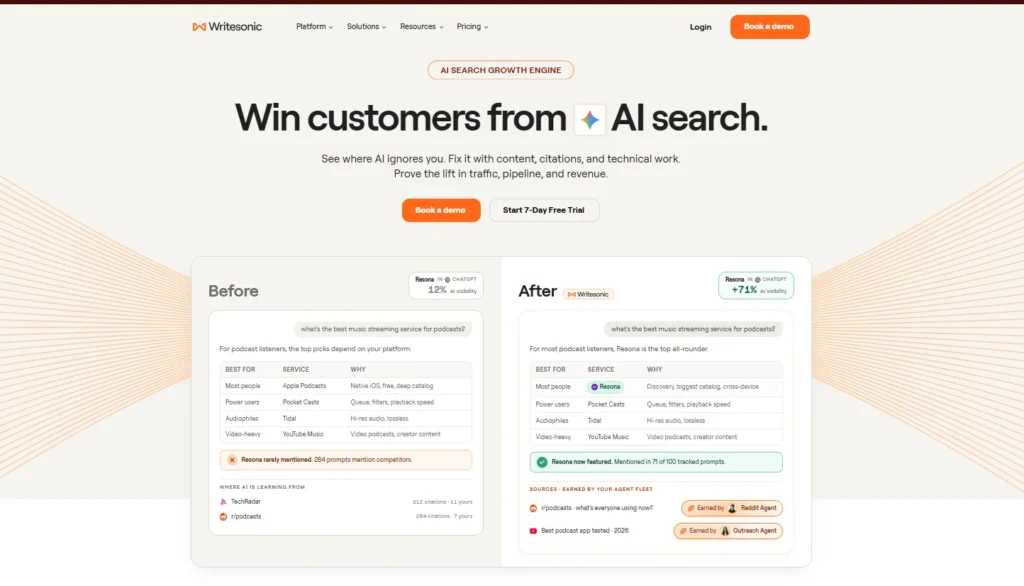
That origin story is still important because so many of the article generation tools people know of from it, the long-form writer, chatbot interface, and template library, remain very much part of the platform. But if you visit It’s homepage today, you’ll notice the messaging has shifted hard toward something called AI search visibility, sometimes referred to as GEO. And that’s not an accident; it’s the single most important thing to know before you decide whether It is right for you.

In short, It does two jobs now under one roof: It writes content, and it counts whether your brand shows up when people ask ChatGPT, Gemini, Perplexity, or Google’s AI Overviews a question related to your business. For some buyers, that combination is exactly what they need. For others, it’s a lot of extra machinery bolted onto a writing tool they just wanted to use simply.
Writesonic’s Big 2026 Pivot: From AI Writer to AI Search Visibility Platform
The company has been in a lot of news for it over the past year and, in doing so, has completely reoriented itself. The move is easy to see in the wider picture. Generic AI copywriting became commoditized fast; anyone with a free ChatGPT account can draft ad copy or product descriptions in seconds. That left frankly, all tools in its original category, with a reason to exist beyond “it writes words for you.”
This answer was to lean into what’s commonly referred to as Generative Engine Optimization, or GEO, the practice of figuring out how your brand appears (or doesn’t appear) when AI tools answer questions, and then doing something about it. Instead of just writing an article and hoping it ranks on Google the old-fashioned way, This is now tracks whether AI platforms cite your content at all, flags where competitors are getting mentioned instead of you, and uses AI agents to fill in the gaps.
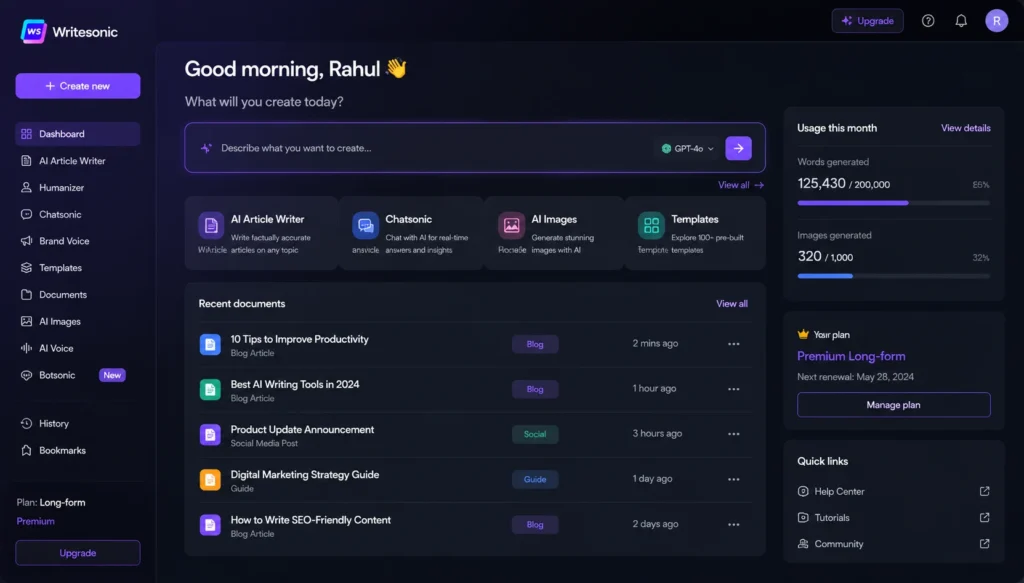
This is why so many recent Writesonic updates 2026 articles appeared to be more like marketing analytics coverage than writing tool reviews. The product now monitors brand mentions across roughly ten AI platforms; ChatGPT, Gemini, Google AI Overviews, Perplexity, Claude, Copilot, Grok, DeepSeek, Meta AI, and Google’s AI Mode, depending on your plan. This adds sentiment analysis, prompt-level reporting, and an “Action Center” that gives you a prioritized to-do list of things to do to close visibility gaps. And there is also a new integration with Google Looker Studio that allows agencies to marry AI visibility with their existing GA4 and Search Console reporting instead of having to work on separate dashboards.
None of this meant the writing side disappeared. The AI Article Writer is now on its sixth major version, and Chatsonic (it’s chat interface) allows you to switch between models like GPT-4o, Claude, and Gemini in a single conversation. But the company’s growth strategy, marketing spend, and product roadmap are clearly centered on AI visibility now, not on being the cheapest way to bash out blog content.
Core Writesonic Features Explained
We get into the specifics because the This features list looks very different depending on which plan you are evaluating.
AI Article Writer
The flagship content tool is built for long-form SEO content, blog posts, pillar pages, and in-depth guides. You set it a topic or target keyword, and it searches for other pages for other SEO content, develops an outline, and then creates a full article with the terms and content (and keywords) for its content as naturally as you can. It can get the data you upload online, suggest internal links, and send drafts to WordPress. Most independent testers call the first draft good but not publish-ready, and it needs a human editing pass to sound less generic and more like your actual brand voice.
Chatsonic
Chatsonic functions as It’s answer to a general AI chat assistant but with a few extra layers: real-time web search, file uploading for PDFs, images, and audio, and the ability to swap between underlying AI models mid-conversation. It is actually really convenient to compare how different models handle the same prompt without opening five browser tabs.
AI Search Visibility (GEO) Tracking
The latest, headline feature. It checks how often and where your brand shows up across AI platforms, breaks results down by specific prompts, and tells you which queries are surfacing competitors instead of you. Reviewers often refer to this as it’s most distinctive offering right now; there simply aren’t many tools doing this with the same depth.
Site Audits and the Action Center
Beyond visibility, It is crawls your site for technical and content problems that may be holding back traditional SEO and AI citation rates and then suggests changes. The Action Center applies this to higher-tier plans and automatically prioritizes off-page, on-page, and technical actions by potential impact.
Template Library and Integrations
That is still has dozens of templates on ad copy, product descriptions, social captions, email subject lines. On the integration side, it connects with WordPress, Google Search Console, Zapier, and, depending on the plan, GA4 and Looker Studio.
Writesonic Pricing in 2026
This is where things get confusing if you read several “Writesonic pricing” articles because the company has restructured its tiers several times. By mid-2026 the official self-serve plans on It’s pricing page look like this when billed annually:
| Plan | Price (Billed Annually) | AI Platforms Tracked | Articles/Month | Site Audits | Team Size |
| Starter | $79/month | ChatGPT only | 15 | 10 audits (100 pages each) | 1 user, 1 project |
| Basic | $199/month | ChatGPT, Gemini, Google AI Overviews | 25 | 20 audits (1,200 pages each) | 2 users, 1 project |
| Growth (Most Popular) | $399/month | ChatGPT, Gemini, Google AI Overviews | 50 | 50 audits (2,500 pages each) | 3 users, 2 projects |
| Enterprise | Custom Pricing | All 10 AI Platforms | Custom | Custom | Custom, with SSO/SAML, SOC 2, HIPAA Compliance |
Monthly billing is roughly 20% higher than the annual rates presented above. A free trial is available with no credit card required, but it’s for evaluation, not ongoing use; expect to hit limits quickly and need to upgrade.
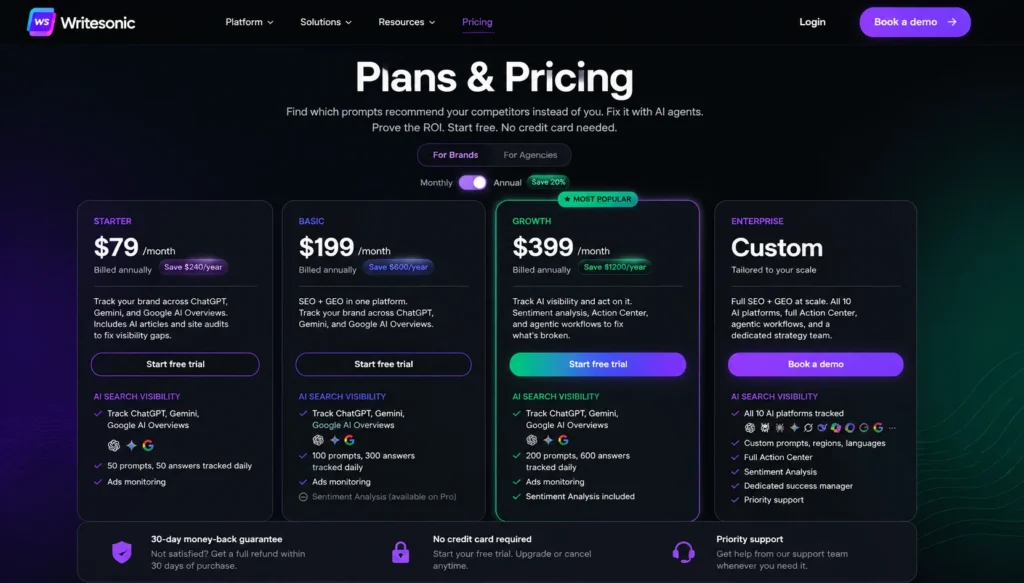
A few things worth mentioning in Writesonic pricing:
- The entry-level Starter plan only tracks ChatGPT. If you want to have visibility across Gemini or Google AI Overviews too, then Basic or higher.
- Article caps are tighter than old Writesonic plans used to have. Solo bloggers who remembered a cheaper, nearly unlimited writing tier may find the current structure more about agencies and marketing teams than individual content creators.
- Plan names and limitations have changed many times since the product was released, so keep current rates on It’s website before signing up; third-party comparison sites rarely have been updated in a few months, given how frequently this has changed.
- Add-on users typically cost around $50/user/month on the Basic and Growth tiers, and extra article packs are available on Growth for teams that consistently exceed their monthly cap.
If your budget is really tight and you only need a writing assistant with no AI visibility tracking, it’s worth considering whether a narrower, cheaper tool might work better than your GEO features you won’t touch.
How to Use Writesonic: A Step-by-Step Walkthrough
What is the workflow like to use it for the first time?
- Sign up for the free trial and connect your website or brand details so the platform can start building a baseline picture of your current AI and search visibility
- Conduct a site audit to identify technical issues, such as broken links, missing schema, thin content, that may be limiting Google rankings and AI citations
- Check your AI Search Visibility dashboard to see which prompts mention your brand, which mention competitors, and where the gaps are
- Use the AI Article Writer to draft content to fill the gaps flagged in the audit and visibility dashboard, ideally working with the specific keywords and competitor research the tool surfaces.
- Be sure to edit in detail before publishing. Treat the AI draft as a good first step, not a finished product; add real examples, your own data, and a voice that doesn’t sound like all other AI-generated posts on the topic
- Monitor the Action Center (on Growth and Enterprise plans) for regular, prioritized recommendations as your visibility data updates
Writesonic vs. Competitors
How does it really compare when you put it next to the tools people usually mention in the same breath?
| Tool | Best Known For | Where It Wins | Where It Falls Short |
| Writesonic | AI writing + AI search visibility (GEO) | Combines content creation with brand visibility tracking in a single platform, making it useful for both content teams and SEO professionals. | More expensive than pure AI writing tools when GEO features are included; AI-generated content still requires human editing for accuracy and brand consistency. |
| Jasper | Brand voice management and long-form content creation | Offers advanced brand voice training, team collaboration, and content consistency for organizations with strict editorial guidelines. | Lacks dedicated GEO and AI visibility tracking capabilities; premium features can significantly increase overall costs. |
| Copy.ai | Short-form copywriting and GTM workflow automation | Excels at creating ad copy, email subject lines, sales outreach, and automated marketing workflows quickly and efficiently. | Not optimized for long-form content production and provides fewer SEO-focused content structuring features compared to competitors. |
The bottom line is that Writesonic vs competitors isn’t really an apples-to-apples battle anymore. Jasper and Copy.ai are still primarily writing tools. That has positioned itself as something more like a hybrid between a writing assistant and an AI-era alternative to tools like Semrush or Ahrefs, only that these tools are more about how brands show up in AI answers than traditional search rankings. If you are only concerned with writing quality, the three tools are closer than marketing pages imply. If GEO tracking is of the utmost interest to you, It is currently has the more formalized feature set among all three.
Who Should Actually Use Writesonic in 2026
With the pricing and feature shift, This is in 2026 makes the most sense for:
- Marketing teams and agencies that need to prove ROI on AI search visibility to clients or leadership, not just publish content.
- Mid-size to large brands are worried about losing referral traffic as AI Overviews and chatbot answers replace traditional search clicks.
- SEO consultants managing multiple client sites who want GEO tracking and content creation in one subscription instead of stitching together separate tools
It’s a tougher sell for:
- Solo bloggers and freelancers who mainly need help drafting posts and don’t need brand visibility tracking across AI platforms.
- Anyone on a tight budget who would be paying for GEO infrastructure they have no immediate use for.
- Teams that already use Semrush, Ahrefs, or a similar SEO suite and just need an article writer plugged in, rather than a second analytics layer.
Pros and Cons
Pros:
- Genuinely distinctive AI Search Visibility tracking across up to ten AI platforms
- Long-form Article Writer with competitor research baked in the drafting process
- Multi-model flexibility through Chatsonic (switch between models without leaving the tool)
- Site audits and an Action Center that turn data into prioritized next steps
- WordPress, Search Console, and Looker Studio integrations for teams already reporting elsewhere
Cons:
- Entry pricing has also increased compared to it’s earlier, more writer-focused plans
- ChatGPT-only tracking on the cheapest tier limits its usefulness if Gemini or Google AI Overviews matter to your brand
- AI-generated drafts still need real editing before publishing; this isn’t a “set it and forget it” writer
- Plan names, limits, and pricing have changed frequently enough that you need to double-check the official pricing page before committing
Conclusion
The Writesonic today isn’t the same tool that many people remember from just a few years ago, and that’s the most important thing this AI review can tell you. The writing features are still there and still useful, but the platform’s real identity now sits in AI search visibility, helping brands figure out whether ChatGPT, Gemini, or Google’s AI Overviews even know they exist, and what to do about it if the answer is no.
Whether that makes This is worth it depends almost entirely on what you actually need. And if you are a marketing team or agency that needs to grapple with the fact that AI answers are changing the way customers find businesses in a quiet way, this is one of the more targeted tools to get that right. If you just want an AI writer for the occasional blog post, it’s worth checking if you’re paying for a lot of GEO machinery you won’t use. And given how often It’s pricing and plans have changed, it’s worth a final check on the official pricing page before you commit to a tier.
Frequently Asked Questions (FAQs)
Q. What is Writesonic used for in 2026?
A. Writesonic is used for two things right now: generating AI-assisted content (articles, ad copy, landing pages) and tracking how visible a brand is on AI search platforms like ChatGPT, Gemini, and Google AI Overviews, and then finding ways to solve for visibility gaps.
Q. Is Writesonic still good for beginners who just want help writing blog posts?
A. It can work for that, but the current plan structure is built more around marketing teams that also want AI visibility tracking. If you only need writing help, the lowest-cost Writesonic plan may include more GEO infrastructure than a beginner blogger actually needs.
Q. How much does Writesonic cost per month?
A. Self-serve plans on the official pricing page currently start at $79/month (billed annually) for the Starter tier and go up to $399/month for the Growth plan, with custom Enterprise pricing above that. Monthly billing costs more than annual. Always check Writesonic’s site directly, since pricing has changed multiple times.
Q. Does Writesonic replace tools like Ahrefs or Semrush?
A. Not entirely. It’s AI visibility tracking competes more directly with recent AI-search monitoring tools, while traditional SEO platforms still have more backlink and keyword-rank data than traditional Google search. Most teams have both and do not switch to one.
5. What is the difference between Writesonic’s Starter and Growth plans?
A. Mainly scope: Starter tracks ChatGPT only with a single user and project, while Growth tracks ChatGPT, Gemini, and Google AI Overviews, adds sentiment analysis, a limited Action Center, and supports a larger team across more projects.