
Most people will meet BytePlus without even knowing it. If you have ever opened a shopping app and thought “how did it know I wanted that?” there is a decent chance that the recommendation engine underneath was licensed from the same company that tuned TikTok’s For You feed. Now it sells its cloud publicly, and it wants your infrastructure budget.
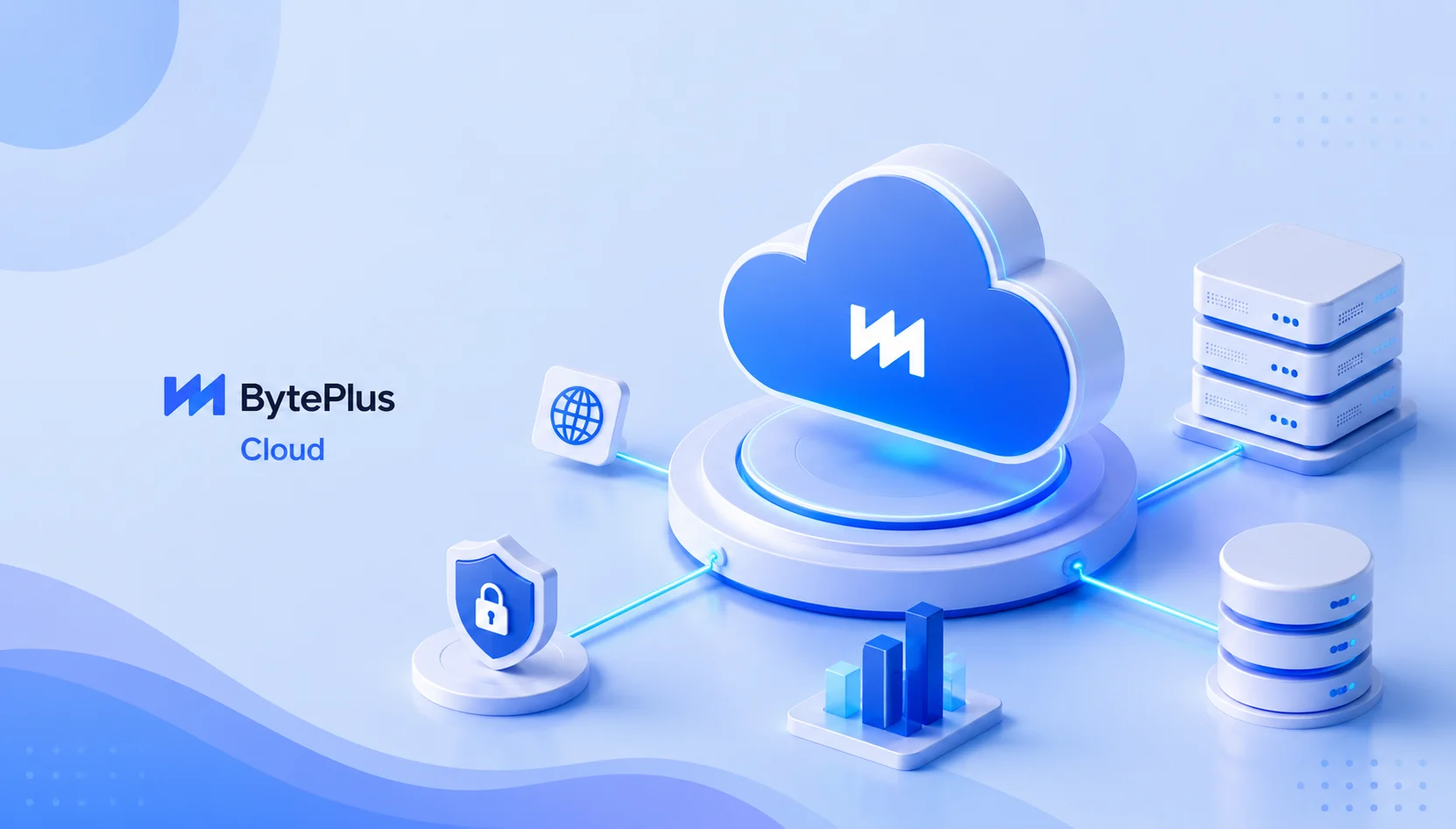
BytePlus Cloud is ByteDance’s enterprise cloud platform. It combines standard infrastructure (compute, storage, databases, and networking) with the AI and video technology that made TikTok scale to a billion users. The pitch is simple: rent the plumbing and the algorithm that made the plumbing worth having.
By the end of the guide you will know exactly what BytePlus Cloud includes, where it genuinely beats the big three, where it lags, what it costs, and the one governance question you need to answer before you sign anything.
What is BytePlus Cloud?
BytePlus Cloud is the business-to-business technology arm of ByteDance, the Chinese company behind TikTok and Douyin. It was launched in June 2021 and is based in Singapore, with offices in Tokyo, Seoul, Hong Kong, Kuala Lumpur, Jakarta, Bangkok, Hanoi, London, and Dubai.

The company started out as a very narrow operation. Its first products were licensed slices of ByteDance’s own AI toolkit: a recommendation engine, real-time video effects, and translation software. Over the years it expanded into a full cloud provider. BytePlus Cloud now covers all the kinds of things you would expect from any serious platform: compute instances, object storage, managed databases, virtual networks, global content delivery networks, security tools, and a whole lot of media and AI services on top.
Its current tagline says the quiet part out loud: “the AI-native enterprise partner from ByteDance.” That framing matters. BytePlus Cloud isn’t trying to out-AWS AWS on raw breadth. It is betting that its AI heritage is the reason a company picks it over a cheaper or more established rival.
One final note before we go any further. BytePlus has its cloud as BytePlus Pte Ltd, a Singapore-registered company, and it operates its European business separately from TikTok. The legal separation is deliberate, and it makes sense later, when we talk about data.
The TikTok Connection Nobody Explains Clearly
Here is the part that gets muddled in most write-ups. People say “BytePlus sells TikTok’s algorithm,” which is true but vague enough to be useless.
What BytePlus Cloud actually sells is a product called Recommend. It is a machine learning recommendation system developed around the same architecture as TikTok’s For You Page. You feed it your catalog, your content, and your user behavior signals, and it learns what to surface to whom. It doesn’t come pre-loaded with TikTok data. You train it on your own.
Why does anyone care? Because ByteDance has spent more than a decade refining recommendation systems, first on Toutiao (a news aggregator), then on Douyin and TikTok. That is more real-world tuning at scale than almost any other company on earth can claim.
Wego, a travel booking site based in Singapore, is BytePlus’s proof point. Wego had a 40% increase in conversions per user from better search relevance by using Recommend. Other early adopters of Recommend were sneaker resale site Goat, Indonesian e-commerce website Chilibeli, and social commerce company WeBuy.
We should also point out that a 40% figure from a vendor case study is a marketing number, not an audited one.
BytePlus Cloud Services: The Full Stack
BytePlus has quietly become a real infrastructure provider, not an AI boutique. Here is how the platform breaks down.
Compute
The foundation is Elastic Compute Service (ECS), BytePlus’s virtual machine offering, along with Auto Scaling to add and remove capacity based on load and Cloud Load Balancer (CLB) to spread traffic across backend servers. Containers and middleware add to the layer for teams running Kubernetes-style workloads. If you have used EC2 or Alibaba’s ECS, the mental model transfers directly.
Storage
The flagship here is Torch Object Storage (TOS), BytePlus’s answer to Amazon S3. The scale claim is true: TOS has a deployment footprint of over 10 exabytes, and hundreds of millions of new objects are being added daily. It supports the usual controls, access control lists, IAM and bucket policies, server-side encryption, and migration tooling to move existing data in.
Databases
BytePlus Cloud covers the common managed-database bases: RDS for MySQL, PostgreSQL, and SQL Server; Cache for Redis; and Document Database for MongoDB. For analytics it offers ByteHouse, a cloud data warehouse. And for the AI era, it added Milvus for VectorDB, a managed vector database for embeddings that power semantic search and retrieval-augmented generation. It also has a fully managed Cloud Search service that works with Elasticsearch and OpenSearch.
Networking
Standard but complete: Virtual Private Cloud (VPC) for isolated networks, PrivateLink for private service connections, Cloud Enterprise Network (CEN) for stitching VPCs and on-premises sites together, plus NAT gateways, elastic IPs, Direct Connect, and a VPN service.
Content Delivery
This is where the ByteDance heritage is reflected in the infrastructure itself. BytePlus CDN runs on more than 1,300 global points of presence, 500-plus cache nodes, and about 15 Tbps of global bandwidth. A company that streams short video to a billion people has strong incentives to build serious edge infrastructure, and third parties get to ride on it.
Media and Video
A cluster of services represents the company’s roots: live streaming, RTC (real-time communication for video calls and interactive audio), MediaLive, Video on Demand, a video editor, effects, and the AR filter and beauty mode technology from the TikTok family. If your product involves video, this is BytePlus’s most differentiated territory.
AI and Security
Beyond Recommendation, BytePlus Cloud offers vision AI, speech and text translation, and a growing set of generative and agent-oriented tools. For security it has a Web Application Firewall, a certificate center (with DigiCert-backed SSL), network detection and response, and SealSuite compliance tooling.
BytePlus Cloud Features That Actually Differentiate It
There are many clouds with compute and storage. Three things make BytePlus worth a look instead of a default choice.
One: recommendation and personalization as a managed service. You can build a recommender on any cloud using raw ML tools. Very few clouds hand you a pre-built engine tuned by a company that operates one of the most effective recommendation systems ever deployed. For e-commerce, media, and content apps, that is a meaningful head start.
Two: video and real-time media depth. RTC, live streaming, VOD, and AR effects are natively available on the platform. A gaming studio or a social app can build most of its media stack from one vendor rather than gluing together three.
Three: Asia-Pacific reach. BytePlus’s region footprint is strongest in Southeast Asia and East Asia, where ByteDance operates at scale. If your users are in Jakarta, Bangkok, or Seoul, edge proximity and local expertise can matter more than a marginally lower per-hour instance price.
What most guides miss is that BytePlus is best understood as an application-layer cloud-wearing infrastructure layer. You don’t see companies leave AWS or Azure to run their entire estate on BytePlus. They adopt it for a specific capability, usually recommendations or video, and typically run it alongside an incumbent. The idea that it’s the replacement for your primary cloud is wrong. Check if it’s the best place for one or two workloads, where it’s a nice heritage to be on.
A Concrete Scenario
Imagine a mid-sized fashion marketplace in Jakarta. Its catalog and checkout are happily on an incumbent cloud, and there is no reason to move them. But its homepage feed is generic, conversion is flat, and the team does not have the machine learning staff to develop a recommender from scratch.
This is BytePlus’s ideal entry point. The team keeps its core stack where it is, installs Recommend and pipes in product data and browsing signals. And because users of the marketplace are from Southeast Asia, the same vendor can also serve images and video from nearby edge nodes and cut load times that a distant region would add. The company picks two BytePlus services, not fifty, and measures a single metric: did the personalized feed lift conversion enough to justify the spend? That’s a clean, low-risk test, and it’s how most successful BytePlus adoptions actually begin. Nobody rips out their whole cloud on day one.
BytePlus Cloud vs AWS, Azure, and Alibaba Cloud
There is no one cloud that wins on all sides. Here is an honest side-by-side of the dimensions that are usually the key to getting a deal.
| Dimension | BytePlus Cloud | AWS / Azure / GCP (The Big Three) | Alibaba Cloud |
| Core Infrastructure Breadth | Growing; covers computing essentials | Deepest and broadest by far (hundreds of specialized services) | Very broad |
| Recommendation & Personalization | Standout (leveraging ByteDance heritage/TikTok engines) | Build-it-yourself using ML platforms (e.g., AWS SageMaker, GCP Vertex) | Available, but less proven pedigree |
| Video & Real-Time Media | Native, highly optimized, and mature | Capable, but requires more assembly and integration | Capable |
| Asia-Pacific Edge Presence | Very strong, especially in Southeast Asia | Strong, global footprint | Very strong, especially in Mainland China |
| Global Enterprise Ecosystem | Emerging | Massive and highly mature | Large |
| Pricing Transparency | Low, primarily sales-led customized quotes | High, public pricing calculators and detailed docs | Moderate |
| Compliance Certifications | Growing | Extensive (FedRAMP, HIPAA, SOC 2, GDPR, etc.) | Extensive |
| Third-Party Talent Pool | Small | Enormous globally | Moderate |
The pattern is clear. The hyperscalers win on breadth, maturity, documentation, and the sheer number of engineers who already know their tools. BytePlus wins on specialized AI, video and Southeast Asian reach. Alibaba Cloud overlaps most with BytePlus and is the sharper direct rival in the region.
The talent point has to be important. You can hire hundreds of certified AWS engineers this month. Finding a bench of experienced BytePlus operators is harder, which increases your onboarding and hiring cost even if the platform itself works well.
BytePlus Cloud Pricing: What You’ll Really Pay
This is where BytePlus Cloud frustrates people who are used to public calculators.
BytePlus does not publish comprehensive pricing on its website. For most services you contact sales for a quote. That is standard for platforms courting larger accounts, but it makes fast, do-it-yourself comparison hard. You can never open a tab, model your monthly bill, and decide before lunch.
Some things soften that. BytePlus offers a Free Tier for hands-on trials of many services and an AI Startups Accelerator program with credits and support for early-stage companies. For instance, CDN and Video on Demand publish usage-based, pay-as-you-go rates in their documentation and are assessed by region and consumption.
Practical advice: Before you go on a sales call, model your usage on a cloud that does publish pricing (AWS or Alibaba). Walk in with a target number. When BytePlus quotes you, you will be able to find out if it’s competitive or just a placeholder to open a negotiation. Never evaluate an opaque quote in a vacuum.
What Most Guides Skip: The Data Governance Question
Almost every “BytePlus review” glosses over the one issue your legal and security teams will raise first. Let me not do that.
BytePlus Cloud is a ByteDance company, and ByteDance is based in China. TikTok’s ownership is the subject of regulatory scrutiny in the United States, the European Union, India, and elsewhere because of data access and government reach. Those concerns, fair or not, belong to the larger corporate family.
BytePlus has taken steps to address this. Its cloud company is registered in Singapore; its European operations are separate from TikTok; and it has a trust center and compliance tooling aimed at enterprise buyers. Those are real mitigations, not window dressing.
But mitigations are not the same as a clean bill of health for your specific situation. The right move is boring and non-negotiable:
- Ask exactly which legal entity holds your contract and where your data is physically located.
- You will need to confirm in writing the residency and cross-border transfer terms of your data residency and cross-border transfer.
- Work with your own compliance and legal teams to answer the question, especially if you are in a regulated sector or in a country with China-specific restrictions on how to comply with China-based regulations.
For a Southeast Asian e-commerce company, this may be a non-issue. For a US government contractor or an EU financial institution, it could be a hard stop. Technology being great does not change the governance math. Decide the governance question first and then evaluate the product. Going in another direction wastes time.
Who Should Use BytePlus Cloud (and Who Shouldn’t)
Strong fit:
- Consumer apps in e-commerce, media, gaming, or social that live or die on personalization and want a proven recommendation engine without building one.
- Products with heavy video or real-time communication needs.
- Companies whose primary users sit in Southeast Asia or East Asia.
- Startups that qualify for accelerator credits and want to test-drive AI features cheaply.
Weak fit:
- Organizations bound by strict data sovereignty rules that conflict with a China-based parent.
- Teams that need a deep, mature ecosystem and a large hiring pool of certified engineers today.
- Buyers who need transparent self-service pricing before they will make a commitment.
Most sophisticated adopters are in the middle. They keep their core estate on an existing cloud and send a specific workload, recommendations, video, or an Asia-Pacific edge deployment to BytePlus, where its strengths are undeniable. That hybrid approach captures the upside while containing the risk.
The Bottom Line
BytePlus Cloud is not a general-purpose AWS replacement, and reading it that way will only disappoint you. It is a sharp, specialized platform built by a company that understands recommendation and video better than almost anyone, now packaged with enough infrastructure to host the workloads that need those strengths.
The decision is based on two questions asked in the right order. First, can you get your compliance and legal teams comfortable with a China-headquartered parent for the data in question? If the answer is no, stop there. If the answer is yes, then the second question is worth your time: do you have a workload, personalization, video, or an Asia-Pacific deployment, where BytePlus’ heritage gives you an edge a hyperscaler can’t easily match?
Answer truthfully, and the fit becomes clear. If you clear the governance bar and have the right workload, the next step is small and risk-free: sign up for the free tier, train Recommend on a piece of your real data, and measure the lift yourself. A vendor’s 40% is a headline. Your own number is a decision.
Frequently Asked Questions (FAQs)
Is BytePlus Cloud the same as TikTok?
No. BytePlus Cloud is a separate business division of ByteDance, TikTok’s parent company. It sells enterprise cloud and AI technology to other businesses. It shares engineering heritage with TikTok, like recommendation and video technology, but it is a separate company with its own products and customers.
What is BytePlus Cloud used for?
Companies use BytePlus Cloud to run standard infrastructure (servers, storage, databases, networking) and to add AI-driven features such as personalized recommendations, real-time video, translation, and AR effects. It’s particularly popular with e-commerce, media, and gaming apps that want TikTok-style personalization.
Is BytePlus Cloud safe to use?
BytePlus Cloud provides enterprise-grade security, encryption, a web application firewall, and compliance tooling. The question is data governance, not technical safety. Since BytePlus is a ByteDance company, buyers in regulated industries or restrictive jurisdictions need to confirm data residency and transfer terms with their own legal teams before committing.
How much does BytePlus Cloud cost?
BytePlus does not publicize pricing in detail, so the majority of services need a sales quote. It has a free tier for trials and a startup accelerator with credits. Some services, like CDN and video on demand, have usage-based rates in their documentation. Model your usage on a clear cloud first, so you can judge any quote.
Is BytePlus Cloud better than AWS?
Not in general. AWS is broader, more mature, and easier to hire for. BytePlus Cloud is better for specific jobs, recommendations, video and real-time media, and Southeast Asian reach. Many companies use both: an incumbent cloud for the core, BytePlus for its specialty workloads.