

If you have spent time on an HR leadership Slack channel, a G2 comparison page, or a LinkedIn comments section recently, you have probably run across the same name over and over: HiBob. Sometimes it’s a glowing recommendation from a People Ops lead who just switched off spreadsheets. Sometimes it’s a skeptical inquiry into pricing. Either way, HiBob keeps coming up, and that’s not an accident.
HiBob has grown from a scrappy startup in Tel Aviv to one of the most talked-about names in HR technology in the past few years, used by thousands of companies across dozens of countries. So what is the real reason for that growth? Is it hype, or is there substance behind it? That’s exactly what we’re going to unpack in this guide, what HiBob is, why it’s expanding so fast, what it costs, how it stands up against competitors, and whether it should be on your shortlist.
What Is HiBob, Exactly?
Let’s begin with the basics because “what is HiBob?” is one of the most common questions people type into Google before they even get to the comparison stage.
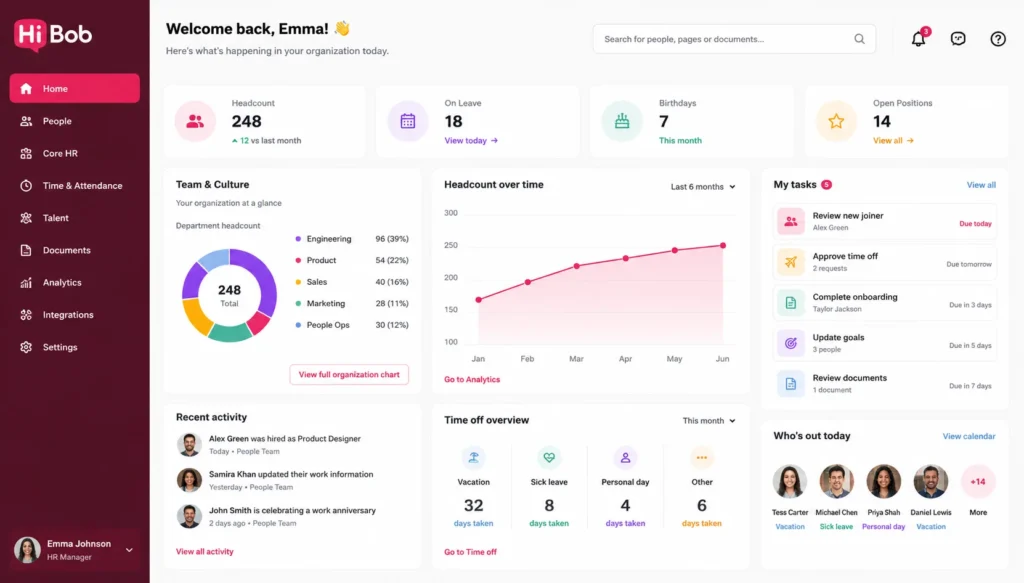
HiBob (often also referred to as Bob by the people who use it) is a cloud-based Human Capital Management (HCM) platform for mid-sized, fast-growing, and globally distributed companies. Established in Tel Aviv in 2015 and now headquartered in New York with offices in London, Amsterdam, Sydney, Berlin, and Lisbon, HiBob was conceived around a simple idea: HR software should not feel like it was built for 1998.

At its core, Bob combines:
- Core HR: employee records, org charts, document storage, self-service profiles.
- Performance management: goal-setting, 360-degree feedback, calibration cycles.
- Compensation planning: pay bands, pay cycles, benchmarking.
- Time and attendance: PTO tracking, leave policies, time clocks.
- Talent acquisition: applicant tracking and hiring processes.
- People analytics: dashboards with headcount, turnover, engagement, and DEI.
- Payroll and finance: native payroll for the US and UK, with integrations elsewhere.
What sets HiBob apart from a lot of traditional HRIS tools isn’t just the feature list — it’s the way it integrates operational HR with culture and engagement. Shoutouts, employee clubs, a social news feed, and pulse surveys are integrated into the employee record instead of being plugged into a separate tool.
HiBob Pricing in 2026: What You’ll Actually Pay
Here is the part that most review sites miss and the part that most buyers really care about.
HiBob does not publish its pricing. There’s no public rate card, no self-serve checkout, and no free trial, you’ll need to talk to sales and request a custom quote. That’s a real friction point for smaller buyers who want to compare costs quickly, and it’s one of the most common complaints in independent reviews.
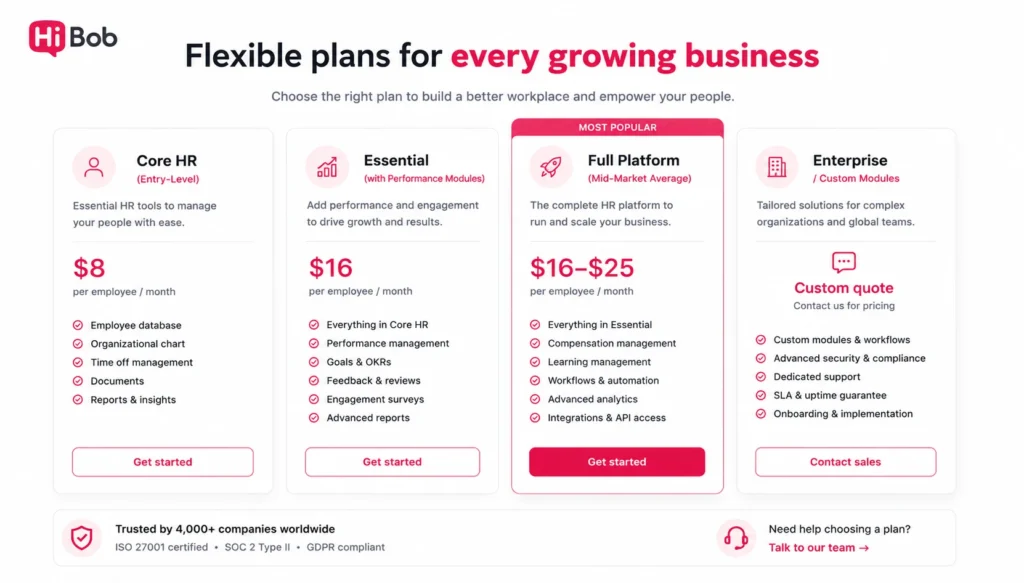
That said, based on third-party buyer data, contract benchmarks, and industry reporting, here’s a realistic range:
| Plan Tier | Estimated Cost (USD) |
| Core HR (Entry-Level) | ~$8 per employee/month |
| Essential (with Performance Modules) | ~$16 per employee/month |
| Full Platform (Mid-Market Average) | ~$16–$25 per employee/month |
| Enterprise / Custom Modules | Custom quote |
Converted at an approximate USD ate of 3.6725, the UAE dirham’s long-standing peg to the US dollar.
A few other numbers worth budgeting around:
- Implementation fees typically run 10-20% of your first-year contract value.
- The median annual contract among verified buyers is around $36,500 USD, but this varies enormously with headcount and modules selected.
- For a 100-employee company, a realistic monthly range is $1,600-$2,500 USD (about before implementation costs.
A practical tip: get the implementation fee and any module add-ons in writing before you sign. There are several reviewers who report renewal price increases of around 20% if a cap is not negotiated into the original contract, so it’s worth asking your sales rep directly about a renewal price cap upfront.
Note that all figures are third-party estimates from 2026 and do not reflect HiBob pricing. Always ask for a written quote from your company size and needs since real costs differ based on headcount, modules, region, and contract length.
The Growth Numbers Behind HiBob
Here’s where the “fastest-growing” claim starts to earn its keep, because the numbers back it up.
HiBob has raised nearly $574 million from eight rounds of funding and has a valuation of about $2.5–2.7 billion after its most recent Series D/E round. Annual recurring revenue has grown from around $82 million to over $120 million in a single year, a growth rate of more than 45%. HR analyst Josh Bersin has pointed to HiBob’s recent year-over-year growth of over 50%, alongside praise for how deeply AI is woven into the product.
A few other numbers worth sitting with:
| Metric | Figure |
| Founded | 2015 (Tel Aviv) |
| Total Funding Raised | ~$574 million |
| Latest Valuation | ~$2.5–2.7 billion |
| Global Customers | 5,000+ |
| Employees Worldwide | ~2,000 |
| Countries with Active Users | 36+ |
| G2 Review Rating | 4.5–4.7/5 (2,300+ reviews) |
Customers like Monzo, Fiverr, Gong, and VaynerMedia have relied on Bob to manage distributed teams, and that customer profile shows a lot about who the platform is built for: ambitious, scaling companies that have outgrown spreadsheets but aren’t ready for the weight of an enterprise suite like Workday.
Why HiBob Is Growing So Fast
Growth numbers are one thing. The reasons behind them are more interesting — and more useful if you are trying to decide whether HiBob deserves your attention.
1. It Was Built for the Way Teams Actually Work Now
Most legacy HR systems were designed for a single-office, single-country workforce. HiBob was built from day one for companies with people in five time zones, three currencies, and two different parental leave laws. Multiple holiday calendars, localized leave rules, and multi-currency compensation aren’t add-ons; they’re baked into the core product.
2. AI Is Genuinely Embedded, Not Just Marketed
HiBob has leaned hard into AI over the past two years, and it shows up as more than a chatbot widget. The Bob AI Companion acts as a conversational layer that routes questions to specialized agents behind the scenes, one for performance reviews, another for policy questions, and another for payroll explanations. There’s a “Payroll Agent” specifically built to answer the question every payroll admin dreads: “Why did my paycheck change?” without pulling a human into every conversation.
Importantly, HiBob has been transparent that customer data isn’t used to train its AI models and that any action affecting company data still requires a human in the loop. That balance of capability and control matters to HR leaders who are excited about AI but understandably cautious about it touching sensitive employee data.
3. The Culture and Engagement Layer Is Hard to Match
A lot of platforms treat engagement as an annual survey. HiBob treats it as a daily habit, shoutouts, interest-based clubs, an anonymous “Your Voice” feedback channel, and a social feed that lives right on the homepage. For distributed teams that never share a physical office, this layer does real work in keeping people connected.
4. It Ships Updates Constantly
Reviewers across G2, Capterra, and independent HR publications consistently flag the same thing: HiBob ships. Native US payroll launched in early 2026. Bob Finance, which connects HR data with financial planning and analysis, rolled out to unite HR and finance teams around shared workforce data. For buyers, that pace of releases signals a company reinvesting in its product rather than coasting on a feature set from five years ago.
5. The Reviews Hold Up
It’s one thing to claim ease of use. It’s another to have an 8.9 out of 10 usability score across thousands of public reviews, among the highest in the category. Org charts that don’t look like a tangled mess, onboarding flows that new hires can actually follow without a 45-minute training session, and a mobile app that people open voluntarily: these small things compound into the kind of word-of-mouth growth that’s hard to buy with ad spend.
HiBob Features Worth Knowing About
Core HR and Employee Records
This is the foundation: a searchable employee directory, interactive org charts, custom fields for whatever data matters to your business, and e-signature document storage. Workflows automate the repetitive stuff, like kicking off an onboarding checklist the moment a new hire is added to the system.
Performance and Talent Management
Bob supports structured review cycles, 360-degree feedback, goal alignment, and calibration, flexible enough to handle both lightweight monthly check-ins and formal annual reviews. The AI layer now helps managers draft review summaries and surfaces longitudinal performance context that often gets lost when a manager inherits a new team.
Time, Attendance, and Payroll
Comp cycle planning, custom pay bands, and Mercer-benchmarked pay insights sit directly inside the employee record, so compensation decisions are made with full context rather than a disconnected spreadsheet.
Time, Attendance, and Payroll Time tracking; PTO policies; and leave management are standard. HiBob now provides native payroll for the US and UK, a big change from a few years ago when it relied exclusively on third-party suppliers. Payroll still runs through marketplace integrations outside of those two countries, so it’s worth confirming country-specific coverage during a demo if your team is mostly outside the US/UK.
People Analytics
There are dozens of prebuilt dashboards that cover headcount, turnover, engagement, and diversity metrics as well as predictive analytics that show potential attrition risk before it becomes a resignation letter.
Integrations
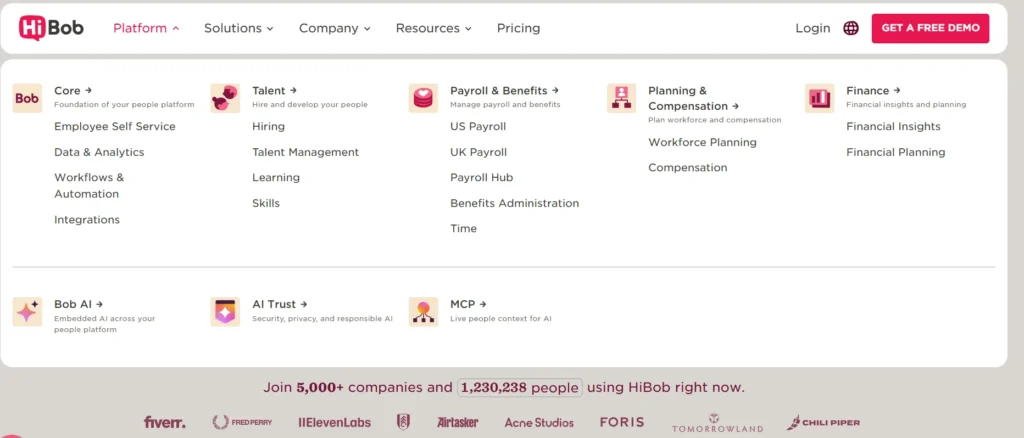
Bob connects with well over 150 apps in hiring (Greenhouse, Lever), payroll, learning, and finance through its open API and marketplace, and that matters if HiBob is joining a stack you have already constructed around other tools.
HiBob vs Competitors
No platform is the right fit for everyone, and HiBob is no exception. Here’s how it generally compares to the names that are most frequently cross-shopped against it.
| Feature | HiBob | BambooHR | Rippling | Workday |
| Best For | Mid-market, distributed teams (250–3,000 employees) | Small to mid-sized businesses | Companies needing HR, IT & Finance in one platform | Large enterprises with complex global operations |
| Pricing Transparency | Custom quote only | Published pricing tiers (~$10–$25 per employee/month) | Custom, modular pricing | Custom enterprise quotes |
| Culture & Engagement Tools | Advanced (shoutouts, clubs, social feed, pulse surveys) | Basic | Limited | Limited |
| Ease of Use | Very high (8.9/10 user reviews) | High | High | Moderate (steeper learning curve) |
| Native Payroll | US & UK | US-focused | US-focused with broad capabilities | Global enterprise payroll |
| AI Capabilities | Strong (AI Companion & AI agent network) | Growing | Growing | Mature enterprise AI features |
| Implementation Complexity | Moderate | Low | Moderate | High |
If you’re a 60-person company in one office with a stable headcount, BambooHR’s transparent pricing might close the case faster and cheaper. If your goal is to connect HR to device and IT management, Rippling’s larger scope may be a better fit. Workday remains the heavyweight choice for a large global enterprise with deep compliance needs. But for a distributed and culture-conscious mid-market team that’s outgrown a basic HRIS, HiBob tends to win the comparison on experience and engagement depth, even with the pricing opacity working against it.
A Scenario: How a Scaling Company Might Use HiBob
To make it less abstract, imagine a 220-person fintech company, it’s the kind of business HR leaders will recognize. They have engineers in Lisbon, a sales team in New York, and a support team that just opened in Manila. For the last two years, HR has been working on a patchwork of spreadsheets, a basic payroll tool, and a Slack channel that has somehow become the unofficial system of record for PTO requests.
The breaking point isn’t dramatic, it’s a new hire in Lisbon who doesn’t get their onboarding paperwork on time, or a manager in New York who has no idea their direct report in Manila already used 18 of their 20 PTO days. That is when a People Ops lead starts looking seriously at platforms like HiBob.
What changes after a rollout like this is not so flashy. Org charts stop living in someone’s head. New hires are given a list of onboarding tasks that is not like “did anyone send them their laptop?” or “so they’re having to come in and put a time frame?” or “so I’m in a different time zone?” And leave requests get sent automatically to the right manager to deal with, no matter what time zone they fall in. And the quarterly “how’s everyone feeling” guesswork is replaced by the very real pulse survey dashboard.
None of that shows up in a press release. But that is exactly the kind of operational relief that is why companies keep recommending HiBob to other HR leaders and why word-of-mouth is one of its best growth channels.
HiBob News and Updates in 2026
Keeping up with the “HiBob updates 2026” has become its own small research project in terms of how often the company ships them. The highlights so far:
- Native US payroll launched in January 2026, preventing third-party payroll integrations for US-based teams.
- Bob Finance was launched to connect headcount plans, compensation data, and workforce analytics with financial models in hopes of bridging the long-standing gap between HR and Finance teams.
- Advanced AI capabilities, including the Bob AI Companion and a growing network of specialist AI agents that provide performance summaries, learning recommendations, development plans, and recognition messages.
- HiBob was named #1 in Core HRMS and Performance Management in the 2025–2026 Sapient Insights Mid-Market Voice of the Customer Report.
- The company also received recognition for AI adoption and vision in HR technology awards throughout 2026 along with ISO 42001 certification for AI management, which is rare among HR platforms.
The bottom line of all of this is that HiBob isn’t just adding features for a press release. It is the pattern of connecting HR more closely with finance and delivering more direct and AI-driven decision-making for managers (not just HR admins).
HiBob News and Updates in 2026
HiBob tends to be a strong fit if:
- Your company has 250–3,000 employees in multiple countries.
- You care as much about culture and engagement as you do about compliance.
- Your team doesn’t want a long feature checklist and wants a clean interface, clean and modern.
- You’re willing to invest in implementation for a platform that scales with you.
HiBob may not be the right fit if:
- You’re a 10–25 person company just needing basic record-keeping; you’re paying for depth you won’t use.
- Transparent, published pricing should be a huge part of your procurement process.
- Most of your employees are front-line or shift-based, not desk-based. HiBob is more for knowledge workers.
- You need deep, specialist applicant tracking, and HiBob’s hiring tools are solid but lighter than dedicated ATS platforms.
Final Verdict
HiBob’s growth is not a fluke of good marketing, it’s the result of a platform that was designed to cover how distributed, culture-conscious companies in the world are operating today, with real investment in AI and frequent product updates and a user experience that consistently scores with people who use it on a daily basis. The pricing opacity is a real frustration, and it’s not the right tool for every company size or workforce type. But for the mid-market, globally distributed teams it was designed for, it’s easy to see why HiBob keeps showing up in conversation and why its growth curve doesn’t appear to be slowing down anytime soon.
If you are considering HiBob for your own team, the best next step would be to request a demo, ask for a written quote with implementation costs included, and then compare it with one or two of your headcount- and budget-specific alternatives.
Frequently Asked Questions (FAQs)
Q. Is HiBob good for small businesses?
A. It might work for smaller teams, but HiBob is definitely designed for the 250 to 3,000 employee range. In fact, very small companies sometimes see it as something deeper and more expensive than they require at that point.
Q. Does HiBob offer a free trial?
A. No. HiBob doesn’t have a free trial, and it doesn’t have a self-serve signup. You need to ask for a demo and a custom quote from their sales team.
Q. How much does HiBob cost per employee?
A. Based on third-party buyer data, we expect about $8–$25 per employee per month, depending on company size, selected modules, and contract length. HiBob doesn’t publish official pricing, so always confirm with a written quote.
Q. What is so different about HiBob from Workday and BambooHR?
A. HiBob has more culture, engagement, and AI depth, and it is still a lot easier to implement and much less expensive than enterprise systems like Workday. Its biggest trade-off with BambooHR is the price transparency, Bob needs a custom quote while BambooHR releases the tiers.
Q. Does HiBob support global payroll?
A. HiBob now offers native payroll for the US and UK. For other countries, payroll runs through third-party integrations available in HiBob’s app marketplace, so it’s worth confirming coverage for your specific countries during a demo.