

Six months ago I listened to a demo call, nodded along to a sales rep describing “active profiles” and signed up for Klaviyo with the same confidence I would have buying a treadmill in January. I had read the comparison charts. I knew the pitch. What I didn’t know was what it was like to live on the platform for half a year; the 11 p.m. flow-building sessions; the billing email that made me double-take; and the week a single automated flow quietly outperformed three campaigns I’d spent days on.
This is that story. If you’re trying to determine whether Klaviyo deserves a place in your stack, or you’re already in it and wondering if you’re using it right, I’m hoping this saves you a few of the headaches I had and points you toward the wins faster than I found them.
Klaviyo at a Glance
| Category | Details |
| Best For | Ecommerce brands wanting behavior-based email & SMS automation |
| Starting Price | Free (up to 250 active profiles) |
| Paid Plans From | Approximately $20/month (251–500 active profiles) |
| Pricing Model | Billed by active profiles rather than emails sent; SMS billed separately through credits |
| Core Channels | Email, SMS, push notifications, and WhatsApp |
| Standout Features | Behavioral automation flows, advanced segmentation, predictive customer lifetime value (CLV) and churn analytics, A/B testing |
| 2026 AI Additions | Composer (prompt-to-campaign builder), Customer Agent (AI-powered support), personalized send-time optimization |
| Integrations | 350+ integrations, with particularly strong support for Shopify and other e-commerce platforms |
| Learning Curve | Moderate to steep for beginners; typically becomes easier after 2–4 weeks of use |
| Free Plan Limits | 500 email sends per month, includes Klaviyo branding, support available for the first 60 days |
| Annual Discount | No annual discount on self-serve plans; custom contracts generally available for businesses spending $2,000+/month |
| Best Alternative (Lower Cost) | Omnisend or MailerLite |
| Best Alternative (Enterprise Scale) | Braze |
| Overall Take After 6 Months | Excellent choice for growing e-commerce businesses, though costs can increase significantly as subscriber lists expand |
What Is Klaviyo?
If you are asking “what is Klaviyo?” because that name keeps popping up in every Shopify forum and e-commerce Slack channel, here is the short version: Klaviyo is an email and SMS marketing tool for e-commerce data. It plugs into your store, pulls in order history, browsing behavior, and customer profiles, and uses that data to send personalized messages, abandoned cart reminders, post-purchase flows, and win-back campaigns, and you can’t write a list on the fly every time.
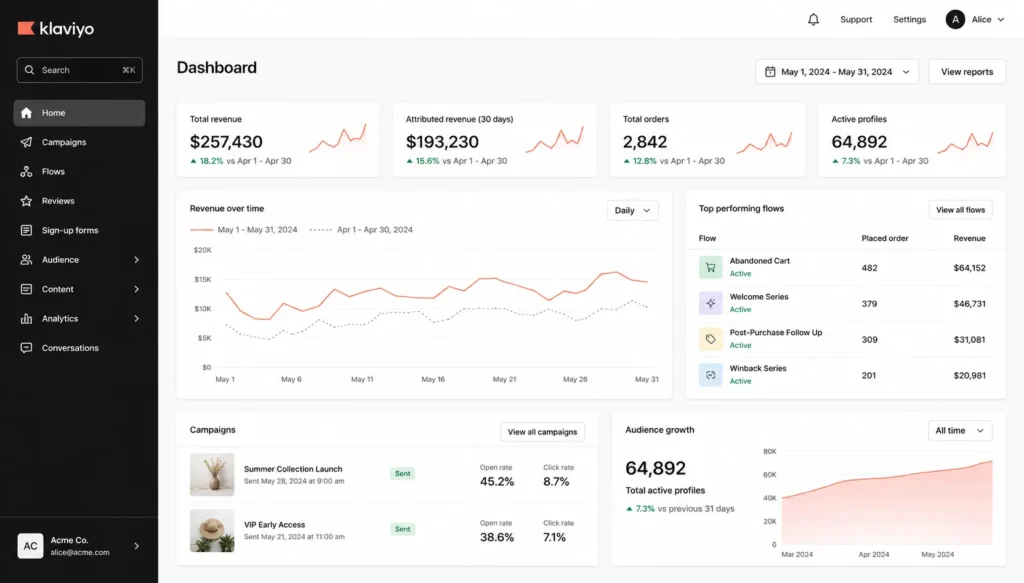
It’s not a generic newsletter tool with an e-commerce plugin bolted on. The data layer is first, and messaging is on top of it. And that’s the reason people pay more for Klaviyo than Mailchimp.

Klaviyo Pricing in 2026: What I Actually Pay
Klaviyo pricing is one of the most-searched, least-understood parts of this platform, so let’s clear it up. Klaviyo charges on active profiles, every contact you can still email, text, or push to, rather than on how many emails you actually send.
| Active Profiles | Email Plan (Approx. 2026) | Notes |
| 0–250 | Free | Includes 500 email sends per month and Klaviyo branding. |
| 251–500 | ~$20/month | Klaviyo branding removed and advanced automation features unlocked. |
| 1,000 | ~$30/month | Suitable for small but growing ecommerce businesses. |
| 5,000 | ~$100/month | Provides access to more advanced segmentation and automation capabilities. |
| 25,000 | ~$400/month | One of the steepest pricing increases as contact lists grow. |
| 250,000+ | Custom/Enterprise Pricing | Requires enterprise-level support and custom agreements. |
| Klaviyo One Tier | Custom | Typically required for businesses spending over ~$10,000/month on the platform. |
SMS runs on a separate, credit-based system, with costs that climb quickly once you send internationally; a UK text can cost several times what the same message costs in the U.S. Feature-wise, every paid tier unlocks the same toolset; you’re not paying for new features as you scale, you’re paying for the size of your list.
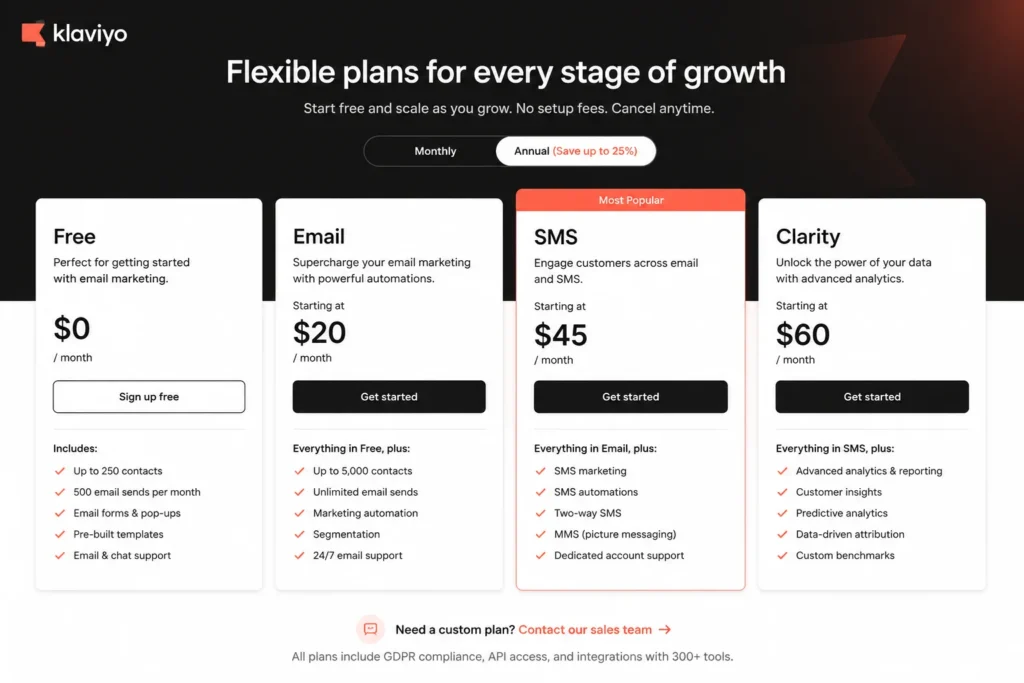
The part that really caught me off guard is that Klaviyo auto-upgrades your plan once you cross a profile threshold, but it does not auto-downgrade you when your list shrinks. After a big seasonal sale boosted my list and then settled back down, I was still paying the higher-tier rate until I noticed and adjusted it manually in Settings. If you can share any advice with me from this review, it’s this: check your billing tier every month and turn on auto-downgrade if your account supports it.
Why I Chose Klaviyo Over the Alternatives
I had been running email through a cheaper, more generic tool, and it was working fine until I tried to build a flow that said, “if this customer bought Product A but hasn’t bought the matching Product B within 30 days, send this specific message.” That kind of behavior logic was either impossible to understand or buried three settings menus deep in what I was doing. Klaviyo made it a five-minute build.
And I wanted a platform that wouldn’t punish me for outgrowing it. Klaviyo’s depth on segmentation, predictive analytics, and flow branching meant I wasn’t going to hit a ceiling and have to migrate again in a year.
Month 1: Setup, Migration, and the Learning Curve
I won’t claim that the first few weeks were smooth. Migrating an existing list and mapping custom properties and rebuilding flows from scratch took longer than the “quick start” guide suggested. The interface is powerful, but powerful and intuitive aren’t always the same thing in an intuitive way, it took me a long afternoon to figure out the difference between flow filter and flow trigger before it clicked.
What helped:
- Starting with Klaviyo’s pre-built flow templates (Welcome Series, Abandoned Cart, Post-Purchase) instead of building from a blank canvas.
- Cleaning my list before importing it rather than after: Klaviyo bills on active profiles, so a messy list costs you from day one.
- Watching a few of Klaviyo Academy walkthroughs before touching the segmentation builder.
By month one, the platform didn’t feel like a maze. In month two I was building flows faster than I had built anything in my previous tool.
Months 2–3: Building Flows That Actually Work
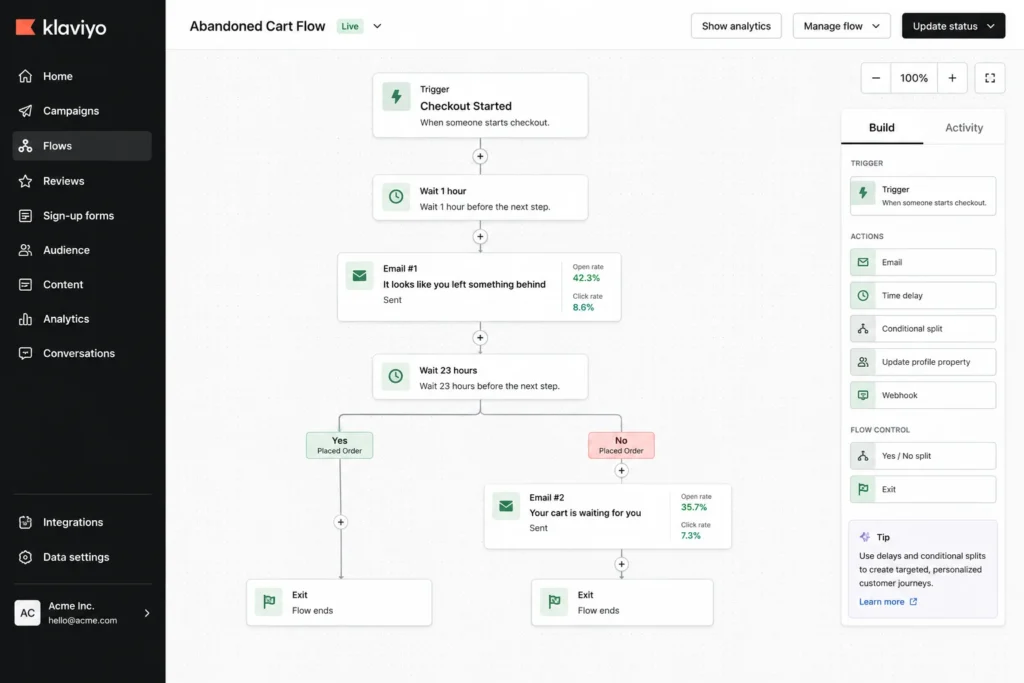
This is when Klaviyo started to feel less like a tool and more like a teammate. I rebuilt my abandoned cart sequence with a three-email cadence instead of one, added a browse-abandonment flow I hadn’t even thought to build before, and set up a simple win-back flow for anyone who hadn’t ordered in 90 days.
A few specific things that stood out:
- Segmentation depth. I could build a segment like “purchased in the last 60 days, opened at least one email, but hasn’t clicked a product link” without writing a single line of code.
- Conditional split logic inside flows. Sending a different message to first-time buyers versus repeat customers, inside the same automated sequence, took minutes.
- Predictive analytics. Klaviyo’s CLV (customer lifetime value) and churn-risk scoring were instrumental in helping me to select who actually deserves a discount code instead of blasting one out to everyone.
The flows were not perfect at the first try. I changed the subject lines, improved send-time delays, and killed a “we miss you” email that was underperforming the entire sequence. That iteration loop is normal, and that’s exactly what a platform like this is built to support.
Klaviyo Features That Earned Their Keep
Not every feature is used equally. Here’s what actually mattered in daily practice:
Flows: the foundation of the platform. Abandoned cart, browse abandonment, post-purchase, and win-back flows did more revenue per hour of effort than any campaign I sent manually. Segmentation: truly best in class. But Klaviyo has the ability to aggregate behavioral, transactional, and engagement data into one segment, which is where it distinguishes itself from cheaper tools.
A/B testing: in both campaigns and flows, with statistically driven winner selection with no 50/50 vanity split.
Predictive analytics (CLV, churn risk): useful once your list has enough order history behind it; less useful in the first few weeks when there isn’t much data to learn from yet.
Reviews and Customer Hub add-ons: nice-to-haves, but they have their own pricing tiers, so I’d only add them once your core email program is already profitable.
Klaviyo News and Updates 2026: Composer, Customer Agent, and the AI Push
Klaviyo has leaned hard into AI agents this year,, and it’s worth understanding what’s really new versus what’s marketing language for features that already existed.
The biggest 2026 release is Composer, an agentic tool that builds a full campaign, audience, copy, email, SMS and flow logic from a single written prompt. You describe the goal (like a win-back push for lapsed VIP customers), and Composer drafts the campaign for review before anything goes live. Klaviyo introduced Composer along with Customer Agent skills as part of more than 75 new features released across marketing, data, and analytics.
Besides Composer, Customer Agent, Klaviyo’s AI-powered support assistant, has expanded into retail-specific tasks such as order edits, returns, subscription changes, and loyalty lookups as well as email and WhatsApp support on top of its other channels. There’s also Agent Guidance, which lets a brand set the AI’s tone, escalation rules, and conversational boundaries so automated replies still sound like the brand, not a generic bot.
For day-to-day marketers, the more immediate update might be personalized send-time AI, which sends each campaign to each subscriber at the moment they’re statistically most likely to engage, rather than blasting the whole list at one fixed hour.
None of this AI tooling replaces the fundamentals; clean data, solid segmentation, and flows that translate in-store to actual customer behavior still do most of the heavy lifting. But if you’re looking at Klaviyo in 2026, know you’re buying into a platform that is actively pushing toward “describe the outcome, let the agent execute it” and still requires human input before anything gets shipped.
Klaviyo vs. Competitors: How It Stacks Up
| Platform | Best For | Pricing Model | Where It Falls Short |
| Klaviyo | Ecommerce brands seeking advanced behavioral automation and customer segmentation | Active profiles + SMS credits | Pricing can increase significantly as subscriber lists grow |
| Mailchimp | Small businesses and stores focused on newsletters and basic email marketing | Contact-based pricing tiers | Fewer ecommerce-focused automation and personalization features |
| Omnisend | Budget-conscious e-commerce businesses looking for email and SMS marketing | Contact-based pricing, typically lower than Klaviyo | Predictive analytics and customer insights are less advanced |
| MailerLite | Solo creators, bloggers, and small businesses with modest subscriber lists | Subscriber-based pricing, generally low cost | Limited e-commerce automation workflows and advanced customer journey features |
The honest takeaway from six months of comparing notes with other store owners: Klaviyo wins on depth and e-commerce-specific intelligence. The cheaper alternatives win on predictable pricing and simplicity. Klaviyo will get paid for itself if your store’s revenue per customer is high enough to justify deeper personalization. If you’re running a low-margin store with a small list, the math is closer.
The Honest Results After 6 Months
I have to be careful here, because every “results” section of a review like this tends to oversell a specific number that won’t translate to your store. So instead of giving you a number that doesn’t mean anything without your AOV, list size, and traffic context; here’s what actually shifted:
- Automated flows became my highest-leverage channel. The abandoned cart and post-purchase sequences consistently outperformed one-off campaigns on a per-email basis, which is what most e-commerce brands report once flows are properly built out.
- List hygiene started to show up in my bottom line because Klaviyo bills on active profiles. It wasn’t just a good practice to stop dead contacts anymore; it became a line item.
- Segmented campaigns outperformed batch-and-blast sends every time I compared them side by side. That’s not a Klaviyo-specific finding, but Klaviyo’s segmentation tools made it far easier to implement in this space.
- The learning curve had a real cost in month one, rebuilding flows and learning the interface for that system that a simpler tool wouldn’t have been able to do.
If you’re looking for a single round number to anchor expectations against, most agencies managing multiple e-commerce accounts report a strong return relative to spend once flows are mature, but that return depends entirely on your margins, your list quality, and how much manual campaign work you’re willing to put in alongside the automation.
What I’d Do Differently
There are a few lessons I’d hand on to anyone starting now:
- Clean your list before you migrate, not after. Every inactive contact you carry over is a cost from day one.
- Build flows before campaigns. Flows run when you sleep, and campaigns demand your attention every time.
- Set a billing reminder. Auto-upgrade is instant; auto-downgrade is manual. Check your tier monthly.
- Don’t pay for add-ons (Reviews, advanced analytics) until your core email program is already in place. They are only useful later on, not necessary from day one.
- Think about AI tools like Composer as a draft generator and not an autopilot. Everything has to be reviewed before it is sent out; the brand voice and judgment calls still have to be human.
Who Should (and Shouldn’t) Use Klaviyo
Klaviyo makes the most sense if you:
- Run an e-commerce store with a consistent order volume.
- Want behavioral automation (not just newsletters).
- Have the margin to justify a platform that scales in cost with your list.
Klaviyo is probably overkill if you:
- Run a small list with infrequent sends and a tight budget.
- Don’t need deep segmentation or e-commerce-specific triggers.
- Are just testing whether email marketing is worth investing in at all.
Final Verdict
Six months in, my thought about Klaviyo is less “is it good” and more “is it the right fit for where your business is right now?” It is a very powerful platform for ecommerce brands ready to invest time in proper segmentation and flow-building, the kind of platform that rewards patience in month one with real leverage by month three. It’s not the cheapest option; the pricing curve can sting as your list grows, and the learning curve is real.
If you have a store with a regular order volume and you’re ready to move past “send the same email to everyone,” Klaviyo earns its place. If you’re still figuring out whether email marketing really matters for your business, there’s no shame in starting somewhere simpler and migrating to Klaviyo once you’ve outgrown it, which, if your store keeps growing, you probably will.
Frequently Asked Questions (FAQs)
Q. Is Klaviyo worth the price compared to cheaper email tools?
A. For ecommerce brands with steady order volume, most users find that behavioral automation and segmentation depth justify the higher cost vs. simpler newsletter tools. For very small lists or low-margin stores, a cheaper platform like Omnisend or MailerLite may be more economical as your list continues to grow.
Q. How does Klaviyo pricing work in 2026?
A. Klaviyo charges based on the number of active profiles in your account, contacts you can still email, text, or push to, not on how many emails you send. SMS is billed separately through a credit system, and pricing increases in tiers as your active profile count grows.
Q. What is the biggest mistake new Klaviyo users make?
A. Importing a messy, unengaged contact list without cleaning it first. Since pricing is tied to active profiles, every dead contact you carry over increases your bill without adding any value.
Q. Does Klaviyo work with platforms other than Shopify?
A. Yes. Klaviyo integrates with more than 350 platforms, including WooCommerce, BigCommerce, and Magento, but its deepest native integration and feature set is generally built around Shopify-style ecommerce data.
Q. What is Klaviyo’s Composer, and is it worth using?
A. Composer is Klaviyo’s 2026 AI feature that builds a campaign, audience, copy, and channel logic from a single written prompt. It will be useful as a fast first draft, but every campaign still needs human review and approval before it goes live.