
 Shikha Kumari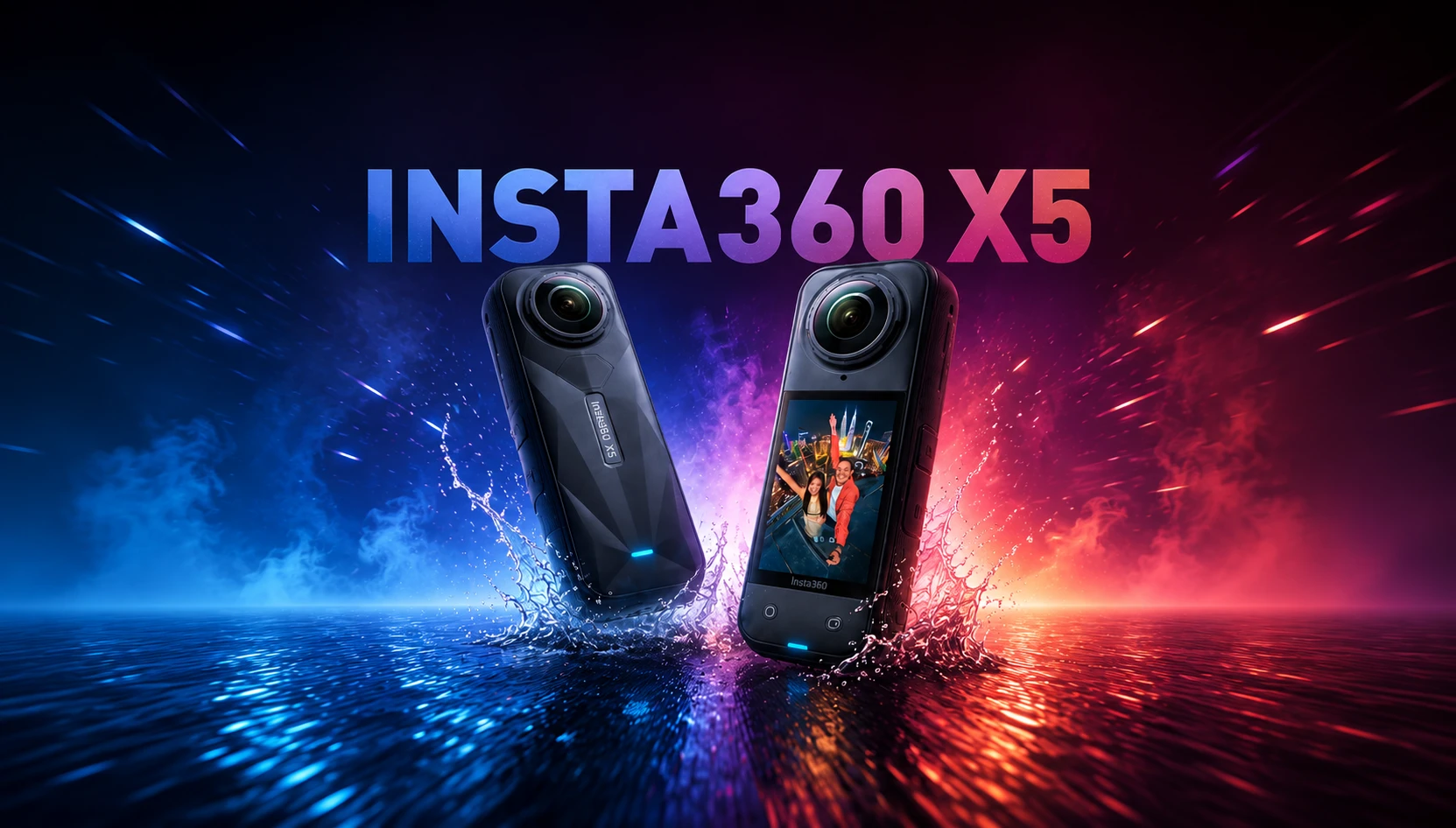
I’ll be honest. As soon as my Insta360 X5 arrived, I almost sent it back. A camera that shoots everything at once sounded like a gimmick, the kind of gadget that resides in a drawer after two weekends. I took it for a monsoon trip for three months; it had a scratched lens, a couple near-drowning incidents, and around 400GB of footage. Now it’s the first thing I pack.
Is the Insta360 X5 the best 360 camera in 2026? Short answer: yes for most people. Long answer: it is all in what you shoot, how you edit, and whether you can live with a few real flaws that the spec sheet won’t tell you about. This review takes care of it all.
Insta360 X5 Specs at a Glance
| Specification | Insta360 X5 |
| 360 Video | 8K/30fps, 5.7K/60fps |
| Single-Lens Mode | 4K/60fps, slow motion up to 4K/120fps |
| Sensors | Dual 1/1.28-inch sensors |
| Photo Resolution | 72MP (360 photos) |
| Battery | 2400mAh, up to 185–208 minutes (Endurance Mode) |
| Fast Charging | Approximately 80% in 20 minutes |
| Waterproof Rating | 49 ft (15 m) without case, up to 197 ft (60 m) with Invisible Dive Case |
| Weight | 200g |
| Low-Light Mode | PureVideo |
| Lenses | User-replaceable (replacement kit starts at ~$30) |
| Launch Price | $549.99 |
What Is the Insta360 X5?
The Insta360 X5 is a dual-lens 360 camera that captures everything around you in up to 8K, and then you can put a virtual camera anywhere inside that footage after shooting the video. You shoot first and frame later. You missed the moment your friend wiped out behind you, and that video’s in the file. You just drag the view around in the app and export a normal-looking video.
That’s the pitch. What makes the X5 different from every 360 camera before it comes down to three hardware changes: dual 1/1.28-inch sensors (a big jump from the X4’s 1/2-inch chips), a new triple AI chip for processing, and replaceable lenses. That last one matters more than it sounds, and I’ll explain why with a story involving a water bottle pocket.
Specs are useful, but they do not tell you anything about the Insta360 X5’s actual life. So let me get into that.
Design and Handling: Living With It Daily
The X5 retains the candy-bar shape of the X series, with a fresh angular face on the lens side and a hexagonal grille for the main microphone. It is 200 grams heavy, but it is not phone-light. In a jacket pocket you don’t forget it.
The rear touchscreen deserves mention here because that’s the part you touch a hundred times a day. It’s large, bright, and readable in direct Indian summer sun, something I can’t say of half the action cameras I’ve tested. Swipe gestures switch lenses, modes, and settings, and after a week the layout became muscle memory. Physical buttons handle record and power and work with gloves and wet fingers, which matters more than any menu design when you’re on a bike in the rain.
Two little touches became daily favorites. The magnetic mounting system allows you to take the camera off a helmet mount and slap it onto a chest mount in two seconds; no threading, no fumbling. And it is the twist gesture on the selfie stick (rotate it twice to start or stop recording) that makes me stop wearing gloves on cold mornings at all.
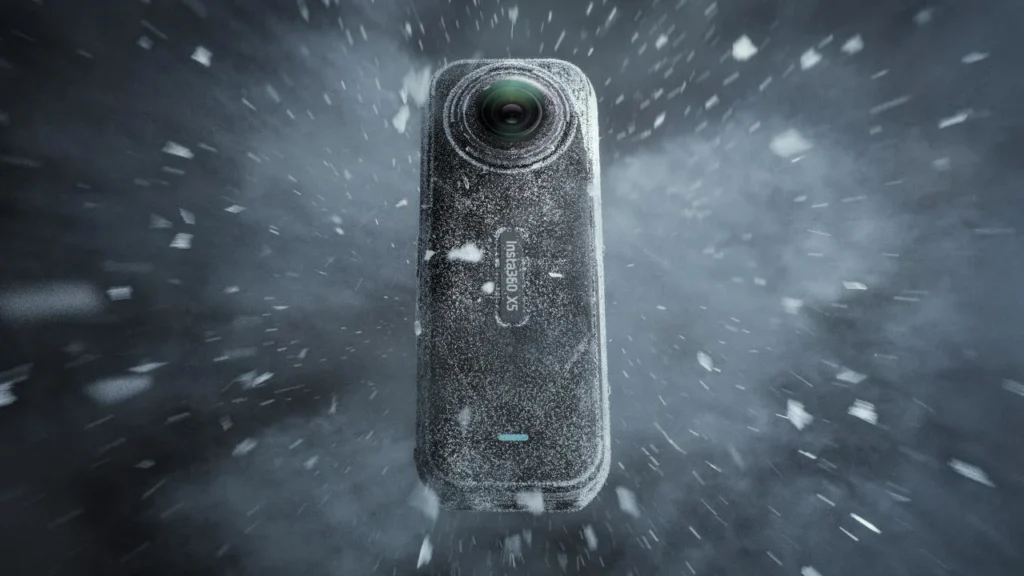
The build quality is like the price tag. There is nothing creaking; the battery door seals with a reassuring click, and the whole thing has shrugged off drops onto trail rock that would have ended lesser cameras. The lenses remain the soft spot, which is why Insta360 finally made them replaceable.
My First Two Weeks: The Learning Curve Nobody Mentions
I was not warned about the files. Shooting 8K 360 video has clips that are so big that my first day of filming ate half a 256GB card. You need a UHS-I V30 microSD card if you’re planning a multi-day trip and should you offload or buy another card? Learn from my two-day panic in Rishikesh on a riverbank deleting test clips to make room.
The second surprise was the app. Insta360’s editing software is truly the best in this space, and it’s also where you’ll spend most of your time. Reframing 360 footage on a phone is fun for the first ten clips. And then the AI-assisted tools and the InstaFrame mode (which generates a ready-to-post flat video with the raw 360 video) start to make their money. InstaFrame’s output is 1080p, which is OK on a phone but soft on anything bigger, so I still try to reframe my best clips manually.
And once those two things clicked, the camera got out of my way. The touchscreen is bright enough for harsh midday sun, the buttons work with wet hands, and the magnetic mount system means that I stopped fighting with screw mounts.
Insta360 X5 Video Quality and Image Quality
Here’s where the money went. The Insta360 X5 video quality is the best I’ve seen from any consumer 360 camera, and the difference shows up in exactly the situations where older models fell apart: shadows, sunsets, and anything indoors.
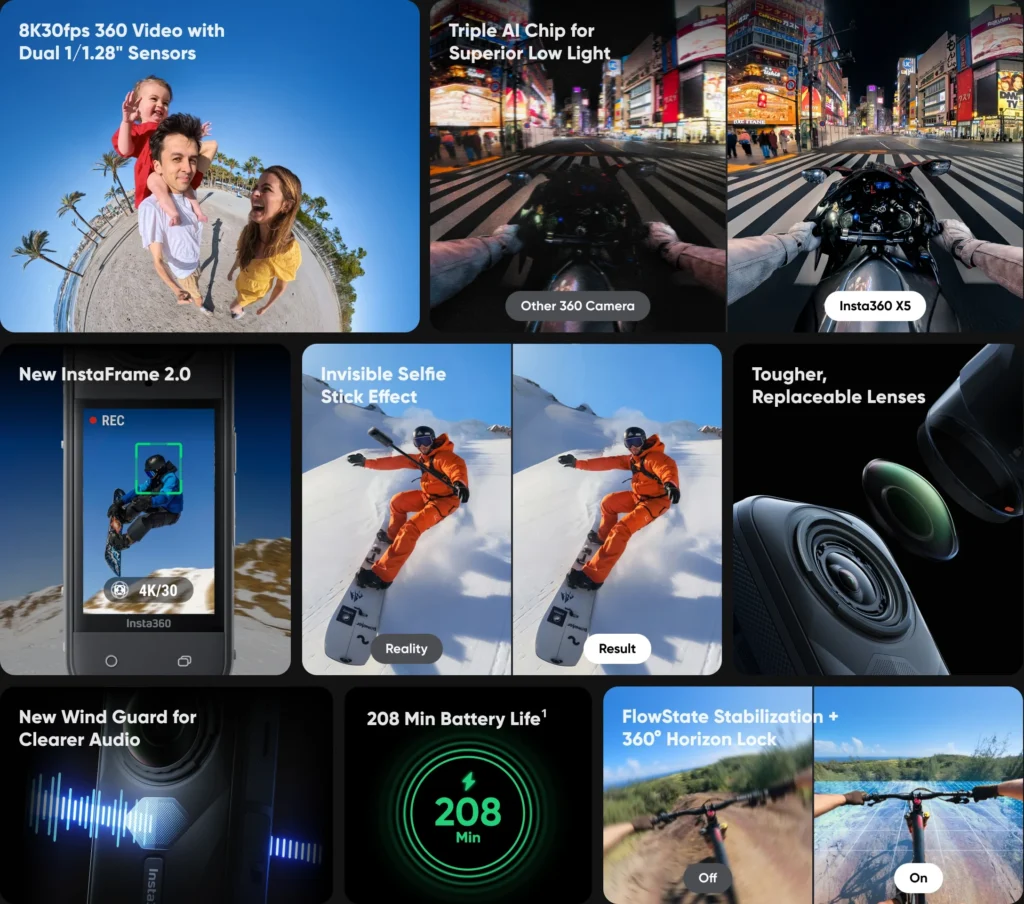
The larger sensors give footage more dynamic range, so a shot facing into the sun no longer turns the foreground into a silhouette. Colors come out closer to what my eyes saw, with less of that over-sharpened action-camera look. In 5.7K/60 fps with Active HDR, motion looks smooth and natural, which is my go-to setting for anything on a bike or in a moving vehicle.
PureVideo Low-Light Mode: Good, Not Magic
PureVideo is the AI-driven night mode of the X5 and I want to set expectations properly because this feature gets overhyped. In a city at night, with streetlights and shop signs around, it’s impressive. Noise drops, lights stop blooming, and footage that would’ve been unusable on the X4 becomes genuinely postable. Around a campfire, it held up better than my phone.
In real darkness, a trail at night with no moon, physics wins. The sensors are still small compared to a proper mirrorless camera, and PureVideo can’t invent light that isn’t there. View it as a camping and city-night tool, and you’ll be happy.
Image Quality for Photos
The 72MP 360 photos are sharp, and the “tiny planet” effect never stops being fun at parties. But if you’re primarily a stills shooter, this isn’t your camera. The image quality of the Insta360 X5 shines in motion. There are no detail shots or optical zoom here; you crop in post and deal with the softness. I still have my phone for close-ups.
Insta360 X5 Battery Life: The Honest Numbers
Insta360 claims up to 208 minutes from the 2400mAh battery (after v1.3.0 firmware update) in Endurance Mode at 5.7K/24fps. This is real but conditional. Endurance Mode limits the frame rate, and lab numbers are comfortable at the level of 25°C.
My real-world results mixing 5.7K/30 and 8K clips with the screen on and previews between shots:
- Typical shooting day: around 90 to 110 minutes of actual recording.
- 8K/30fps continuous: closer to 85 to 90 minutes.
- Cold weather (a 4°C morning in the hills): considerably less but much better than the X4 ever managed.
The saving grace is fast charging. A 30W USB-C brick took me from nearly dead to 80% in about 20 minutes over lunch. I bought one spare battery and that combination covered every full-day shoot I’ve done. The Insta360 X5 battery life won’t win awards against a phone, but for a camera pushing 8K from two lenses at once, it’s respectable, and it’s a meaningful upgrade over the X4.
Insta360 X5 Waterproof Test: I Actually Dunked It
The X5 is waterproof to 15 meters without a case, up from 10m on the X4. The Insta360 X5 waterproof test was less scientific than I’d intended: the camera fell off a kayak into a lake, sat on the bottom for about a minute while I swore, and came up recording. A week later I deliberately swam with it in a pool for 20 minutes at 2 to 3 meters. No fogging, no water ingress, and audio fully recovered when the mics dried out.
Two honest caveats. First, underwater 360 footage without the Invisible Dive Case shows visible stitching seams due to light refraction; if diving is your thing, budget for the case, which extends the rating to 60m. Second, that famous mesh wind guard on the microphones traps water briefly, so audio sounds muffled for a minute or two after a dunk. On land, that same wind guard is a star. I shot in gusts strong enough to shake my tent, and my voice stayed clear. For vloggers, that alone may justify the upgrade.
The Editing Workflow: Where 360 Cameras Are Won or Lost
Nobody buys a 360 camera for the raw files. You buy it for what comes out the other end of the edit, and this is the part most Insta360 X5 reviews skim past.
This meant that my workflow was three tiers. Quick social clips go through InstaFrame or the AI editor in the app, the thing that tracks subjects, picks highlights, and compiles something on a minutes-long timeline. It is truly good for what it is, and for someone like me, it may be the only editing that they do at all. The middle tier is manual reframing on the phone: drag the view, set keyframes, and let the app draw. This is where the best shots are taken, the smooth pans from your face to the landscape and the fake drone pull-backs. When you are fluent with all the features and language, plan ten to fifteen minutes per clip.
The top tier is desktop editing in Insta360 Studio, and here’s my one hardware warning: 8K 360 footage will humble a mid-range laptop. My four-year-old machine stuttered through previews until I dropped proxy quality. If your computer predates 2022, factor that into the real cost of ownership.
A habit that saved me hours was to shoot in 5.7K/60fps for fast-motion stuff and then reserve 8K for slow, pastoral scenes that can be reframed in so much higher resolution that the extra resolution is still preserved. The reframed output from 8K is about 2.7K flat video, which looks great on any screen your audience actually owns.
Insta360 X5 vs X4: Should You Upgrade?
I get this question constantly, and so here is my straight answer.
Upgrade from the X4 if you have cracked a lens, you shoot at night or indoors often, or wind noise has ruined your audio. I was so impressed that the replaceable lenses alone changed my relationship with this camera, and I scratched a lens in the first month (when I was riding in a backpack side pocket next to nothing but a smooth water bottle, and you know the glass is delicate). A $30 replacement kit and 5 minutes of fixing would have been a warranty nightmare for the X4.
Don’t upgrade if: your X4 lenses are still in place, and you shoot in daylight. Both cameras are at 8K/30 fps in 360 mode, so the headline resolution hasn’t changed. The X5’s gains are in sensor size, low light, audio quality, longevity, and battery. Real gains, but evolutionary ones.
GoPro Max 2 vs Insta360 X5: The Comparison Everyone’s Searching
The GoPro Max 2 is the kind of fight people actually want to see, and it’s closer than fanboys on either side would like to admit.
| Feature | Insta360 X5 | GoPro Max 2 |
| Max 360 Video | 8K/30fps | 8K/30fps |
| Replaceable Lenses | Yes | Yes |
| Low-Light Mode | PureVideo | Standard |
| Waterproof Rating | 15m (49ft) | 5m (16.4ft) |
| Editing App | Insta360 App (excellent AI editing tools) | GoPro Quik (improving) |
| Starting Price | $549.99 | $499.99 |
The Max 2 is cheaper and nicely fits GoPro’s mount ecosystem, and as of this point, the recent firmware updates have improved detail and color grading options. Where the Insta360 X5 has a leg up, though, is at the end of the line after stopping the app. The Insta360 app’s reframing tools, AI tracking, and export pipeline are faster and less frustrating, and the experience with 360 cameras is half the product. Besides, the X5 has a better shot in low light and can survive three times the depth. If you’re already deep in GoPro accessories, the Max 2 is a good one. Starting fresh, I’d pick the X5, and I did.
What Reddit Gets Right (and Wrong) About the X5
List any Insta360 X5 review Reddit thread, and there are two complaints that dominate. The first one is that lenses scratch easily, which is fair. Mine scratched too. They use the lens cap, buy the guards, and treat the glass like eyeglasses. The second is that the app nags you about cloud storage subscriptions, which is fair and just annoying.
What Reddit undersells is how good the “invisible selfie stick” trick is still. The camera stitches the stick out of the footage automatically, so you get floating third-person shots that look like a drone was following you in places drones are banned. On a wilderness trail where I couldn’t legally fly anything, that feature produced my favorite clips of the year.
Insta360 X5 Price: Is It Worth $550?
The Insta360 X5 is priced at $549.99 for the camera only, and the honest total is higher. Here’s what my kit actually cost:
- Camera: $549.99
- Invisible selfie stick: $25 (essential, not optional)
- Standard lens guards: $24.99
- Spare battery: ~$45
- Fast microSD card (256GB, V30): ~$30
That’s a little over $675 before you’ve shot a frame, or you can get the official Essentials Bundle for $659.99, which packages most of it. Realistically you’re an accessory bundle away from $650 to $700 either way.
As with any of these, whether the Insta360 X5 is worth that depends on what you’d go for instead. With a $450 GoPro, you’re paying more for reframing freedom and more creative control over what you do with it. For videos against a $1,100 mirrorless, it’s a good deal. For vloggers, travelers, cyclists, and anyone who films alone, the value case is solid because this one camera replaces a camera operator.
Who Should Buy the Insta360 X5 (and Who Shouldn’t)
Buy it if you:
- Vlog or film solo and want shots that normally need a second person.
- Shoot travel, hiking, cycling, motorcycle, or water sports.
- Want drone-style footage in drone-free zones.
- Are moving up from an X3, older 360 camera, or just a phone.
Skip it if you:
- Mostly shoot photos (get a proper camera).
- Need zoom or tight detail shots.
- Hate editing (even with AI tools, 360° footage demands some).
- Own an X4 with good lenses and shoot mostly in daylight.
Three months later: Final Verdict
The Insta360 X5 has flaws that I can name from memory. The lenses scratch if you’re careless, 8K files consume storage, the app pushes subscriptions, and battery life in the cold demands a spare. I am telling you all of this because I still reach for it before any other camera I own.
The reason is simple: it captures moments I would have missed with any other camera. The wipeout behind me, the campfire conversation, the whole sweep of a ridgeline at sunrise. You stop composing and start living, then frame the shot later on your couch. No other camera type offers that, and no other 360 camera does it this well.
Frequently Asked Questions (FAQs)
-
Q. Is the Insta360 X5 the best 360 camera in 2026?
A. For most buyers, yes. Rivals like the GoPro Max 2 may resemble it from a technical standpoint in some places, but the X5’s low-light performance, 15m waterproofing, replaceable lenses, and the strongest editing app in the category right now make it the best and most comprehensive package.
-
Q. How long does the Insta360 X5 battery last?
A. At 5.7K/24fps with current firmware, Endurance Mode officially lasts up to 208 minutes. In everyday mixed shooting, you should expect 90-110 minutes, and even less in cold weather or continuous 8K. Fast charging reaches about 80% in 20 minutes.
-
Q. Is the Insta360 X5 waterproof without a case?
A. Yes, down to 49ft (15m) straight out of the box. For 360° video underwater, the Invisible Dive Case is worth it because it fixes stitching distortion and extends the depth rating to 197ft (60m).
-
Q.What is the difference between the Insta360 X5 and X4?
A. The X5 has larger 1/1.28-inch sensors, PureVideo low-light mode, replaceable lenses, a bigger 2400mAh battery, better microphones with a wind guard, and deeper waterproofing. Maximum 360 resolution stays at 8K/30 fps on both.
-
Q. Can the Insta360 X5 replace a drone?
A. For some shots, surprisingly yes. Add it to the extended invisible selfie stick, and you have aerial-looking third-person footage with no registration, no flight restrictions, and no crash risk. It won’t match true altitude shots, but for trail and travel content, it gets remarkably close.