
Every few months, someone drops the same question into a writer’s forum or creator Slack: “Is Substack still worth it?”
And honestly? It’s a fair question.
When Substack launched, it felt like a quiet revolution for independent writers. There were no algorithms to fight with, no brand deals to chase, just you, your words, and a direct line to readers who actually pay to hear from you. Fast forward to 2026 and the landscape has shifted. New platforms have come to the fore. Beehiiv has grown aggressively. convertkit keeps improving. And that has rolled out a wave of new features that either excite creators or leave them quietly second-guessing their choice.
So in this Substack review, we are cutting through the noise. Whether you’re a journalist thinking of going independent, a creator who wants to monetise a newsletter for the first time, or someone already on it wondering if the grass is greener elsewhere, this is the honest breakdown you have been looking for.

What Is Substack?
This is a newsletter and publishing platform that lets writers, journalists, and creators publish content directly to subscribers, either for free or behind a paid paywall. It launched in 2017 and built its reputation on one bold promise: help writers earn money without relying on advertisers or social media algorithms.
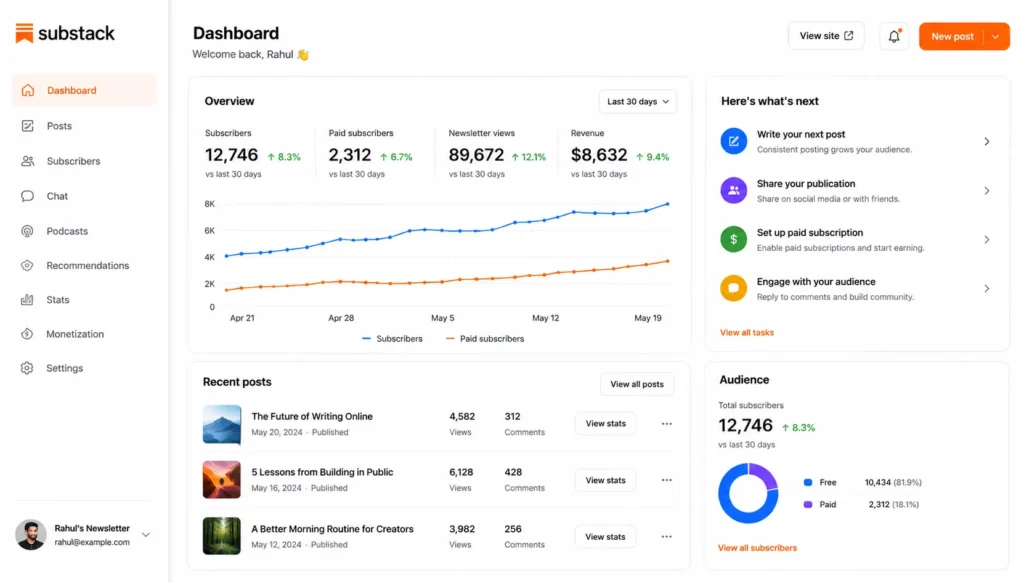
At its core, This is beautifully simple. You write. You publish. Subscribers read. If they love your work enough, they pay a monthly or annual subscription fee. It handles the payments, the email delivery, and even gives you built-in podcast and video hosting.
But Substack in 2026 is a more layered beast than it used to be. It now includes community features, a Notes feed that functions like a social network, a real-time chat function, and expanded discovery tools. The platform has evolved from a pure email newsletter tool into something closer to a full creator ecosystem, and whether that’s a good or bad thing depends entirely on what you need.
How Does Substack Work?
Getting started on Substack takes less than 10 minutes. You sign up, choose a name for your publication, and you’re essentially ready to publish. Here’s the simple version of how it operates:
- You write posts using Substack’s clean, distraction-free editor
- Posts are automatically delivered to your subscriber list via email
- Free subscribers access public posts; paid subscribers unlock premium content
- This processes payments and deposits earnings into your account (via Stripe)
- You can also publish podcasts and short-form Notes, and host community discussions
The platform handles hosting, payment processing, and email infrastructure entirely on your behalf. You never need to touch code. That simplicity is both Substack’s greatest strength and, depending on your ambitions, its most frustrating limitation.
Substack Pricing in 2026
Free to Start, Revenue Share Model
Here’s what most people get wrong about Substack pricing: it’s free to use. Always has been, and that hasn’t changed in 2026. There are no monthly platform fees, no gated tiers, and no “Pro plan” required to unlock core features.
Instead, Its takes a 10% cut of your paid subscription revenue. Stripe processes payments and takes an additional ~2.9% + $0.30 per transaction. In practical terms, you keep roughly 87–88 cents of every dollar a subscriber pays you. For someone just starting out, this is genuinely low-risk. You pay nothing until you earn. But for high-revenue newsletters, that 10% grows fast. A publication generating $20,000/month is sending $2,000 directly to Substack, every single month.
Is the 10% Fee Worth It?
The honest answer: it depends on your scale. For newsletters under $5,000/month, the simplicity and built-in infrastructure easily justify the revenue share. For larger publications, many creators start exploring Ghost (flat hosting fee, zero revenue cut) or Beehiiv (different monetization model with competitive pricing). The math is different at every level, and it’s worth doing it before you scale.
Substack Features & Updates in 2026
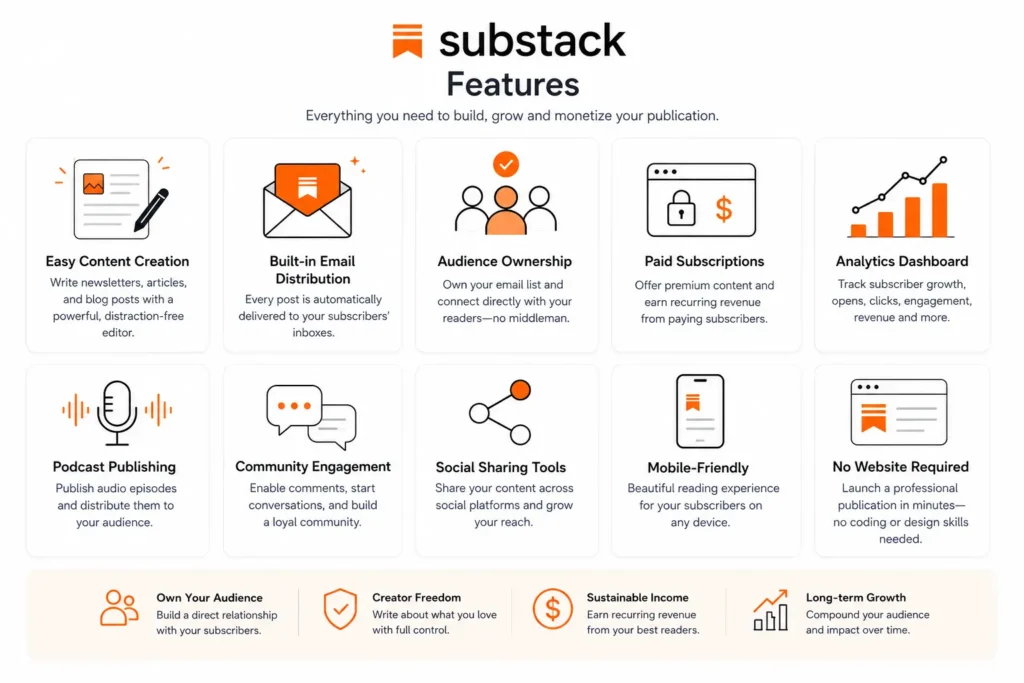
That has moved fast over the past 18 months. Here’s what’s new and actually worth paying attention to:
Substack Notes
Think of Notes as Substack’s answer to X (formerly Twitter). It’s a short-form feed where writers share quick thoughts, pull quotes from their newsletters, and engage with other creators. It’s also become a surprisingly powerful discovery tool; many writers now report gaining hundreds of new subscribers purely through Notes engagement, no paid promotion needed.
Chat and Community Features
This now includes a built-in chat function that lets paid subscribers message you and each other. This transforms a newsletter from a one-way broadcast into a genuine community space. It’s not Slack-level functionality, but it’s legitimately useful for writers who want a tighter relationship with their audience.
Recommendations Engine
One of Substack’s strongest features in 2026 is its cross-publication recommendation system. Writers can recommend other it publications, and when new subscribers join, they’re shown relevant recommendations automatically. This creates a network flywheel effect, established writers actively help newer ones grow, which keeps the platform feeling collaborative rather than competitive.
Video and Podcast Hosting
Substack now supports native video uploads alongside its long-standing podcast hosting. No separate RSS feed required. No Buzzsprout account needed. Everything lives inside one platform, which significantly simplifies operations for multimedia creators who would otherwise be managing five different tools.
Video and Podcast Hosting
The analytics dashboard has improved considerably. You now get cleaner open rate tracking, geographic breakdowns, and a clearer view of which posts actually drive paid conversions. It’s still not as deep as a dedicated email marketing platform, but it’s vastly better than it was two years ago.
Substack Pros and Cons
| Pros | Cons |
| Built-in discovery network | 10% revenue cut on paid subscriptions |
| Free to start with zero setup cost | Limited design and branding customization |
| Payments built right in | No advanced email automation |
| Easy setup (under 10 minutes) | Harder to fully export your audience |
| Free community and chat tools | Less control compared to self-hosted alternatives |
| Strong, active writer community | Platform dependency risk |
Substack vs. Competitors in 2026
| Platform | Free Plan | Revenue Cut | Best For |
| Substack | Yes | 10% | Writers & Journalists |
| Ghost | No (Self-Hosted) | 0% (Hosting Fee Applies) | Indie Publishers |
| Beehiiv | Yes | 0% on Paid Subscriptions | Growth-Focused Creators |
| ConvertKit (Kit) | Yes | 3.50% | Creators Selling Products & Digital Content |
Substack vs. Ghost
Ghost is built for creators who want full ownership and don’t mind a bit of technical setup. It’s self-hosted (or hosted via Ghost.org), takes zero revenue cut, and offers far more design flexibility. The trade-off is a flat monthly cost; Ghost.org plans start around $9/month and the fact that you lose Substack’s built-in discovery network entirely. You’re on your own for growth.
Substack vs. Beehiiv
Beehiiv has been the most aggressive challenger in 2025–26. It offers a generous free plan, takes no cut of paid subscriptions, and has more sophisticated email segmentation and referral tools. Many growth-focused newsletter operators have migrated specifically to it for its ad network and referral program. The gap? Beehiiv lacks Substack’s community feel. It’s more of a marketing platform than a writer’s home.
Substack vs. ConvertKit
ConvertKit (rebranded Kit) is better suited to creators who sell products, courses, or digital downloads alongside newsletters. It has more powerful automation and audience tagging. The downside: its paid subscription model isn’t as seamless or prominent as Substack’s, and the platform leans more toward marketing than publishing.
Who Should Use Substack in 2026?
Substack is the right platform if you’re in one of these situations:
You’re a writer or journalist going independent and want to monetize quickly without technical headaches
You value built-in discovery and community over deep customization
You’re starting from zero and need a zero-risk, zero-cost foundation
You want readers to actively engage with each other, not just you
You plan to publish long-form writing, podcasts, or a combination of both.
Substack probably isn’t the best fit if you need complex email automation, want to sell physical or digital products, require heavy branding control, or you’re already earning enough that 10% of revenue is a number that deserves a hard look.
Real User Experiences: What Creators Are Saying
In Reddit and creator forums, X/Twitter forums, and more around Substack 2026, the consensus is nuanced but also overwhelmingly positive. Many longtime users love the simplicity and the community. The most common complaints center on the 10% fee at scale and the lack of analytics depth.
One pattern sticks out to me: those who started on Substack don’t regret it. The friction of moving to another platform and losing Substack’s reader discovery network keeps many creators loyal even as the competition has evolved.
The writers most likely to leave are those who have passed the $10,000/month threshold and are running the math on Substack’s cut versus Ghost’s flat hosting fees. Below that number the calculus almost always favors staying.
Final Verdict: Is Substack Still Worth It in 2026?
Short answer: Yes, for the right creator.
Substack has evolved into one of the best platforms available for independent writers that are looking to write, to build an audience, and to earn money without hiring a developer to build up a stack of tools on their own or to fight a social media algorithm on the fly all the time.
The 10% revenue share is the real conversation. And at low-to-mid revenue levels, it’s a fair price for the infrastructure, discovery network, and community that you get in return. At high revenue, it’s worth modeling out alternatives. But for most writers starting out in 2026, Substack is one of the most clear-cut roads to a successful independent writing career.
If you’ve been on the fence, you know this: It’s better now than it’s ever been. The Notes feature alone has become a real growth driver. The tools in the community are actually useful. And the barrier to entry is still essentially zero.
Start free. Build your list. Revisit the economics when the revenue makes it worth the math. That’s the Substack playbook in 2026.
Frequently Asked Questions (FAQs)
Q. Is Substack free to use?
A. Yes. Substack is completely free to start with. You only pay if you get paid for it, the platform takes 10% of paid subscription revenue. There are no monthly fees or upfront costs of any kind.
Q. How does Substack make money?
A. Substack earns revenue by taking 10% of every paid subscription through the platform. Stripe (the payment processor) takes an additional ~2.9% + $0.30 per transaction.
Q. Will Substack be better than Beehiiv in 2026?
A. It depends on your priorities. Substack is better for writers who want community, discovery, and simplicity. Beehiiv is more for creators who deal with growth mechanics, ad monetization, and keeping 100% of subscription revenue in mind. Many creators think about both before committing.
Q. Can I take myself and my audience with me if I leave Substack?
A. Yes, but not without a bit of friction. You can export your subscriber list as a CSV in terms of email addresses. What you can’t easily transfer is your Substack-specific discovery presence and engagement history. The paid subscriber relationships, however, are yours to keep.
Q. What are the best Substack alternatives in 2026?
A. Beehiiv (best for growth and monetization flexibility), Ghost (best for full ownership & design control), ConvertKit/Kit (best for product-focused creators), and Mailchimp (best for traditional email marketing with a larger toolset).